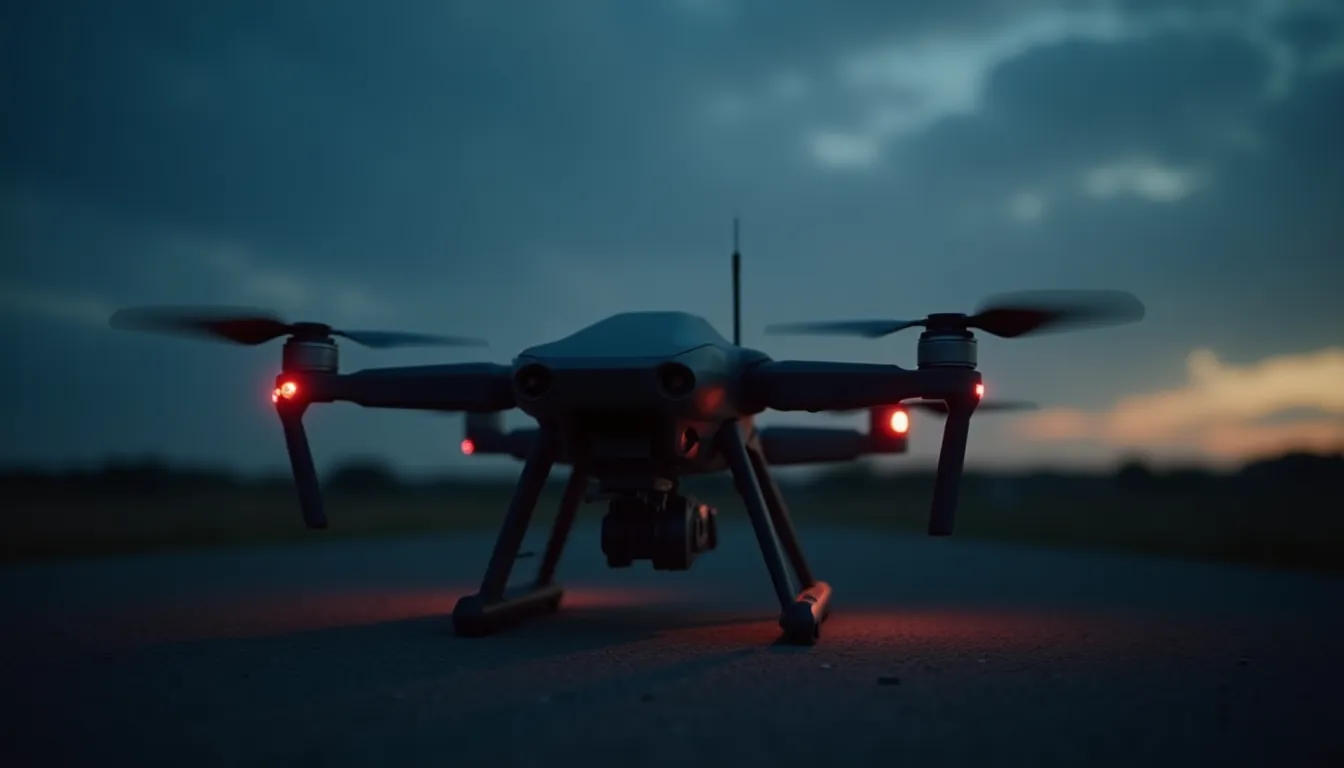
Zone 5 debuted its Eclipse interceptor drone at AUSA 2026, a lower-cost, reusable platform offering modular payloads to compete in the crowded counter-drone market. The company, now owned by Norwegian defense firm Kongsberg, targets production of hundreds of units monthly and views the platform as part of layered air defense alongside its existing weapons portfolio.
Key Takeaways
- Zone 5's Eclipse interceptor, shown at AUSA 2026, features vertical takeoff capability, 200+ knot speeds, modular high-power microwave or kinetic payloads, and 30+ mile range to compete against drone threats
- Norwegian defense firm Kongsberg's acquisition of Zone 5 provides access to international vendors and supply chain resources beyond the US market
- Zone 5 aims for hundreds of Eclipse units monthly production and positions the platform as part of layered air defense alongside its Paladin and White Spike systems
- Congressional budget uncertainty threatens FAMM program funding that Zone 5 is banking on, with CEO warning shortfalls would trigger broader defense sector ripple effects
- Company focuses on Group 1-4 drone defeat across low-cost cruise missiles and interceptors, with goals to produce thousands of missiles annually
Defense startup Zone 5 is joining the rush for counter-drone technology with a new interceptor called the Eclipse, which the company says can combat high-speed, unmanned threats while carving out space in an increasingly crowded market. Zone 5 CEO Thomas Akers told Breaking Defense that his firm has "found a spot" for the platform despite an influx of competing startups targeting similar low-cost drone threats that have dominated recent conflicts.
The Eclipse, shown publicly for the first time at the Association of the United States Army conference in Washington, represents Zone 5's effort to differentiate itself through a modular design philosophy. The platform measures 39 inches long and 32 inches wide, making it portable yet capable of carrying multiple payload options. According to company specifications, the Eclipse can take off and land vertically, achieve speeds of over 200 knots (230 miles per hour), and reach beyond 30 miles.
Dual-Payload Strategy
The platform can sport a high-powered microwave that can disable a drone's electronics, or carry a kinetic payload to knock one out of the sky. This dual-approach design reflects Akers' belief that the market is "coalescing" around smaller interceptors that are themselves challenged by more capable drones, creating demand for a larger platform that bridges that capability gap.
Akers stated that he expects Eclipse to be in development for roughly another six months before entering production, and is initially aimed at the American market. The company declined to disclose expected pricing, citing the complexity introduced by variable payload configurations that significantly influence final costs.
Production Scale and Market Positioning
The company is aiming to build hundreds of copies a month, signaling confidence in near-term demand despite an already crowded vendor landscape. Akers explained that the Eclipse helps round out Zone 5's offerings for layered defenses, from a drone-mounted firearm featured on the firm's Paladin system to its White Spike anti-air missile. This portfolio approach suggests the company is positioning Eclipse as part of a comprehensive air defense suite rather than a standalone solution.
Zone 5's ability to scale production and coordinate multiple air defense platforms has been strengthened by recent corporate developments. Zone 5's burgeoning portfolio, which includes a cruise missile dubbed Rusty Dagger exported to Ukraine and on order for the Pentagon, likely helped attract the attention of the Norwegian defense firm Kongsberg, which completed an acquisition of Zone 5 earlier this year.
Kongsberg Integration and Global Expansion
The Kongsberg acquisition "bring[s] kind of an immediate step change" regarding Zone 5's access to international resources, according to Akers. While Zone 5 still operates separately from Kongsberg in the United States, "globally, we present one unified front under the Kongsberg brand".
The company's new Norwegian ownership also "gives us access to a larger portfolio of vendors" that can help expand supply chains beyond the US, a strategic advantage in an environment where supply chain resilience increasingly influences procurement decisions. This broader vendor network could accelerate Eclipse's time-to-production and improve cost competitiveness as the company scales manufacturing.
Technology Focus and Strategic Goals
Looking ahead, Akers said that the firm is going to remain focused on producing low-cost cruise missiles and technologies that can defeat Group 1-4 drones. This focus reflects lessons from recent conflicts where smaller, lower-cost unmanned systems have become primary tactical threats. A key goal is producing thousands of missiles annually, he said, along with leveraging Kongsberg resources to iterate on Zone 5's products to increase lethality and survivability.
The company has already secured several significant opportunities that validate its market positioning. Alongside recent agreements like a Navy program for maritime strike and a Pentagon-wide effort for containerized munitions, Zone 5 is well positioned for additional opportunities in the defense procurement pipeline.
Funding Risks and Industry Outlook
One significant opportunity for Zone 5 lies with the Air Force's Family of Affordable Mass Missiles (FAMM) program. In the coming years the service plans to acquire tens of thousands of FAMM missiles using multi-year deals, drawing from a pool of vendors including Zone 5, Anduril and CoAspire. However, this opportunity faces near-term uncertainty related to Congressional budget dynamics.
After using dollars from the One Big Beautiful Bill to kickstart procurement in fiscal 2026, the Air Force once again banked on reconciliation to deliver funds for buying FAMM in FY27 — a prospect dimmed by doubts over another reconciliation bill. Akers acknowledged this political risk, stating that "If multi-year doesn't happen the way that it's scheduled to, that sends a clear signal to industry," adding that a shortfall of appropriations means "you're going to have, definitely, a recoil, and it's going to be felt beyond just FAMM". This comment underscores how Congressional funding decisions ripple through the entire defense industrial base, affecting not just FAMM vendors but companies across the sector.
Zone 5's Eclipse entry into the counter-drone market reflects a broader shift in defense procurement where modular, low-cost platforms designed for rapid iteration are increasingly favored over single-vendor solutions. The company's Kongsberg backing, existing portfolio of weapons systems, and focus on Group 1-4 drone threats position it to capture market share in what remains a fluid and competitive landscape.
Sources
- Breaking Defense: Zone 5 'found a spot' in drone interceptor market with new Eclipse: CEO
- Breaking Defense: Germany changes course on plans to buy MQ-28 drone wingman: Boeing official
- Breaking Defense: Open system architecture will be 'hyper important' in downselect of Army's XM30: Senior official
- Breaking Defense: As critical mineral deadline looms, Army expects to feel 'some impact'
- SpaceNews: How NASA is thinking about a moon base
- MachineHours Encyclopedia: PropTech and AI — Drones, Virtual Staging, and Automated Property Marketing
Frequently Asked Questions
What is Zone 5's Eclipse interceptor?
Eclipse is a new drone interceptor system from Zone 5, which the company's CEO says has found a distinct position in an increasingly crowded counter-drone market, according to Breaking Defense.
Why did Germany change course on the MQ-28 drone wingman?
A Boeing official told Breaking Defense that Germany has shifted its plans for acquiring the MQ-28, though specific reasons for the reversal were not detailed in the report.
What does open system architecture mean for the Army's XM30 program?
A senior Army official said open system architecture will be critical when the service narrows down competitors for its XM30 combat vehicle, favoring modular designs over systems tied to a single contractor.
How are critical minerals affecting Army procurement?
Breaking Defense reported the Army expects to feel some impact as a critical minerals deadline approaches, highlighting materials sourcing as a growing procurement risk.
What is NASA's current approach to a moon base?
SpaceNews reported on how NASA is currently thinking through the planning and design considerations for a future lunar base, though the article did not specify a construction timeline.
Get MachineHours in your inbox
AI compute and the machine economy in your inbox.