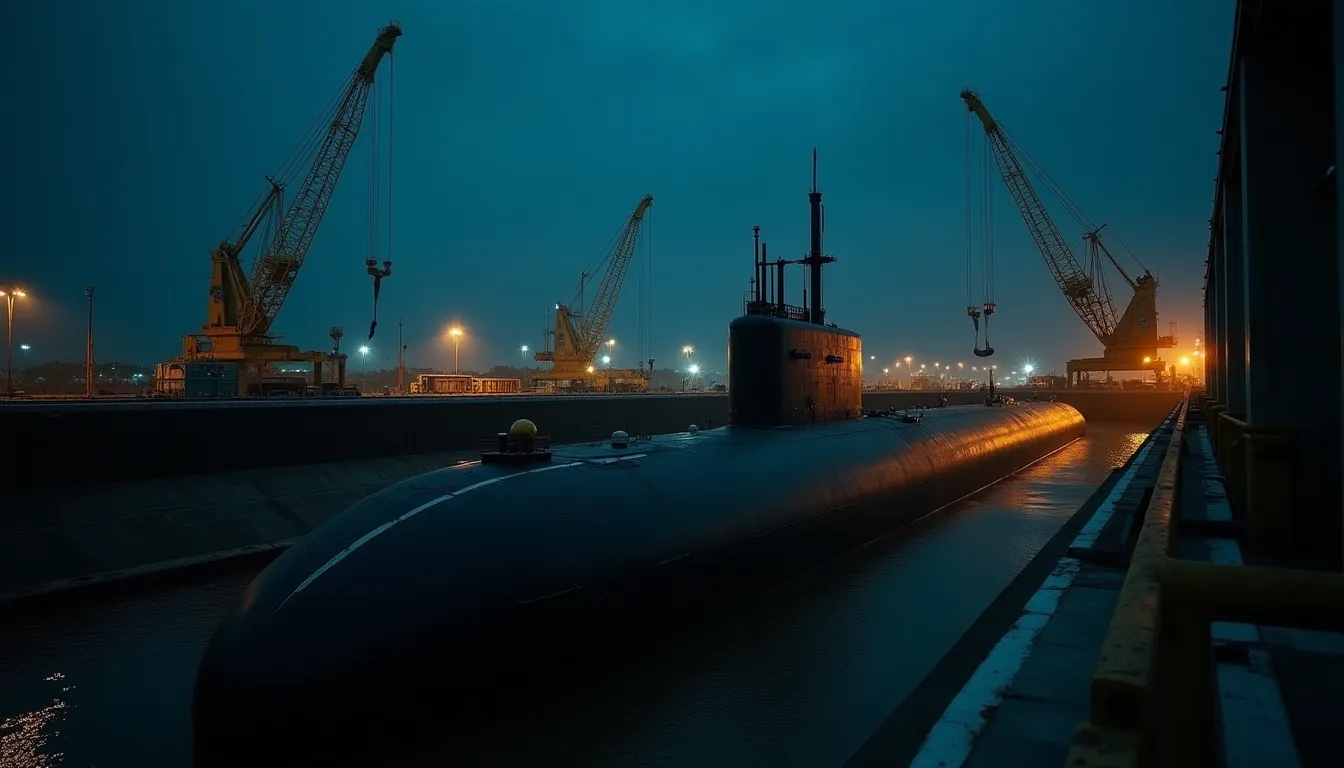
A Government Accountability Office report documents $3.4 billion in costs from submarine maintenance delays and idle time over the past decade, with projections of additional $3.1 billion in costs through 2030 as 15 attack submarines enter inactive status due to shipyard bottlenecks.
Key Takeaways
- Submarine maintenance delays and idle time have cost the U.S. Navy $3.4 billion over the past decade, with an additional $3.1 billion projected through 2030 without mitigation
- Shipyard capacity constraints force submarines into extended inactive status; the USS Pasadena example shows a single submarine costing $300 million over a nearly four-year decommissioning delay
- Virginia-class submarine production is limited to one per year—half the Navy's two-per-year goal—due to supplier delays and labor market constraints
- The GAO found that the Navy has not fully evaluated alternative decommissioning options or developed an inactivation plan to reduce idle time costs
- The submarine industrial base faces a structural mismatch between fleet maintenance requirements and certified shipyard throughput that has persisted since 2015
Maintenance delays and inactive idle time for Navy attack submarines have cost the U.S. military $3.4 billion over the past decade, according to a Government Accountability Office report published in August 2026. The finding represents a stark indictment of the submarine industrial base's capacity to sustain the Navy's undersea fleet at operationally necessary rates, signaling both a readiness crisis and a fundamental contracting failure in how the U.S. maintains its most survivable nuclear deterrent platform.
The GAO report, a public version of a classified edition issued in July 2026, projects that the cost problem will accelerate rather than resolve. Without mitigation measures, 15 attack submarines will enter inactive idle time from fiscal year 2026 through fiscal year 2030, during which the Navy could incur more than 14,000 days of inactive idle time and an additional $3.1 billion in costs to operate and support these inactive submarines. This forward projection suggests that the $3.4 billion historical figure is not a one-time anomaly but rather a structural problem that will persist and potentially worsen across the near-term defense budget cycle.
The USS Pasadena Case Study
The GAO report illustrates the human and financial cost of shipyard constraints through a specific example: the USS Pasadena, which entered inactive status on January 1, 2025 for decommissioning but is not expected to be decommissioned before November 15, 2028 due to shipyard constraints. During this nearly four-year interim period, the submarine remains unable to be operational since its dive certification is expired, but continues to be fully crewed with sailors.
The extended delay is costing the U.S. Navy over $300 million in operating and support costs over the USS Pasadena's nearly four-year inactive idle period, according to GAO analysis. Navy officials indicated that the service is attempting to mitigate the situation by using the Pasadena as a training platform, yet this repurposing does not resolve the underlying inefficiency: the submarine is burning through operational budget for support costs while not contributing to active fleet capabilities.
Systemic Industrial Base Constraints
The submarine maintenance bottleneck stems from a tightly constrained supply of certified shipyards and supplier capacity. The GAO report indicates that readiness data showed that the Navy has been suffering a significant rise in idle times for submarines since 2015—both for would-be active submarines and those destined for decommissioning. This decade-long trend points not to temporary disruptions but to a systematic mismatch between fleet maintenance requirements and industrial base throughput.
The production of new Virginia-class attack submarines amplifies this constraint. The Navy is producing one Virginia-class submarine per year, which is half the service's two-a-year goal. According to GAO analysis, late material deliveries from suppliers and limited availability of experienced workers due to competition in the labor market drive these production shortfalls. The same supplier and labor constraints that throttle new construction also slow maintenance and overhaul schedules for existing boats, creating a feedback loop where fleet readiness deteriorates even as budget dollars accumulate in idle-time costs.
Policy and Procurement Implications
The GAO report asserts that the U.S. Navy has not fully evaluated alternative options to more efficiently decommission attack submarines and develop and implement an inactivation plan that could allow them to reduce inactive idle time for crews and save billions. This critique suggests that the Navy's contracting and planning approach to submarine disposition lacks the analytical rigor required to manage the cost impact of an undersea fleet aging faster than maintenance capacity can sustain it.
The $3.4 billion figure represents not merely a readiness shortfall but a procurement architecture failure. When a military department cannot move submarines through maintenance or decommissioning pipelines at operationally necessary rates, taxpayer dollars flow to static costs—crew salaries for idle platforms, facility maintenance, support contracts for submarines that contribute nothing to deterrence or fleet readiness. From a budgetary standpoint, this is lost opportunity cost: money spent on idle time is money not available for new maintenance starts, modernization, or other defense priorities.
Context Within Defense Budget Competition
The submarine maintenance crisis arrives amid broader competition for defense appropriations across all service domains. The undersea fleet is the centerpiece of U.S. strategic nuclear deterrence and increasingly critical to conventional operations in contested maritime environments. Yet the industrial base supporting submarine operations has long been flagged by defense analysts and congressional oversight committees as under-resourced relative to strategic requirements. A formal GAO report quantifying the cost of shipyard bottlenecks in nine-figure terms provides congressional proponents of increased shipyard investment with a data-driven rationale for dedicating defense dollars to capacity expansion rather than dispersing funds across competing modernization priorities.
The timing of the GAO report—published as Congress prepares to negotiate the FY27 defense budget—creates an opportunity for the Navy to frame submarine industrial base investment not as new spending but as cost avoidance. If Congress appropriates funds to expand certified shipyard capacity and accelerate maintenance throughput, those investments could prevent the additional $3.1 billion in idle-time costs projected through 2030. The question for budget negotiators is whether the upfront capital cost of shipyard expansion is lower than the ongoing operational costs of maintaining an idle fleet.
Outlook and Challenges
Resolution of the submarine maintenance crisis requires action at multiple levels. Expanding shipyard capacity demands capital investment and multi-year contracting commitments that extend beyond annual appropriations cycles. Addressing supplier constraints and workforce shortages in submarine construction requires coordination between defense contractors, trade labor organizations, and naval industrial base planning offices. Neither problem can be solved through operational efficiency alone; both demand structural changes to how the U.S. contracts for and sustains submarine maintenance.
The 15 attack submarines projected to enter inactive status between FY26 and FY30 represent a significant portion of the attack submarine fleet at any given time. If these boats spend years in inactive status while waiting for shipyard capacity, the Navy's ability to sustain a credible force posture in contested waters may be impaired. Conversely, if Congress responds to the GAO findings by appropriating funds to address shipyard bottlenecks, those investments will ripple through supplier networks and labor markets, potentially accelerating both submarine maintenance and new production across the industrial base.
Sources
- Breaking Defense: Submarine maintenance delays, 'idle time' cost $3.4 billion, GAO says
- Breaking Defense: How the Army benefits from diverse interceptors, plus a window into modernization
- Breaking Defense: The president doesn't need a one-trick Army
- Breaking Defense: Air Force seeks more portable C2, comms approach after studying Epic Fury
- Breaking Defense: The fight over the FY27 defense budget is on. Here's 13 key issues for Congress to resolve.
- MachineHours Encyclopedia: PropTech and AI — Drones, Virtual Staging, and Automated Property Marketing
Frequently Asked Questions
How did submarine maintenance delays cost $3.4 billion?
According to a GAO report cited by Breaking Defense, the $3.4 billion reflects the combined cost of delayed scheduled maintenance periods and idle time submarines spend waiting for shipyard capacity - a bottleneck in the US industrial base.
Why does the Army want a diverse range of missile interceptors?
Breaking Defense analysis argues interceptor diversity hedges against saturation attacks and complicates adversary planning. Relying on a single system creates a single point of failure that adversaries can target or overwhelm.
What is the Epic Fury exercise and what did it reveal?
Epic Fury is an Air Force exercise whose lessons revealed gaps in current command-and-control and communications infrastructure. The Air Force is now seeking a more portable C2 approach to support distributed, expeditionary operations.
What are the key issues in the FY27 US defence budget fight?
Breaking Defense identified 13 issues Congress must resolve, covering shipbuilding capacity, missile defence funding, space system investment, and next-generation platform development timelines.
Can the submarine maintenance backlog be fixed quickly with more funding?
The article notes that submarine maintenance depends on a small number of certified shipyards, meaning bottlenecks cannot be resolved quickly even if additional funding is appropriated - a structural industrial base constraint.
Get MachineHours in your inbox
AI compute and the machine economy in your inbox.