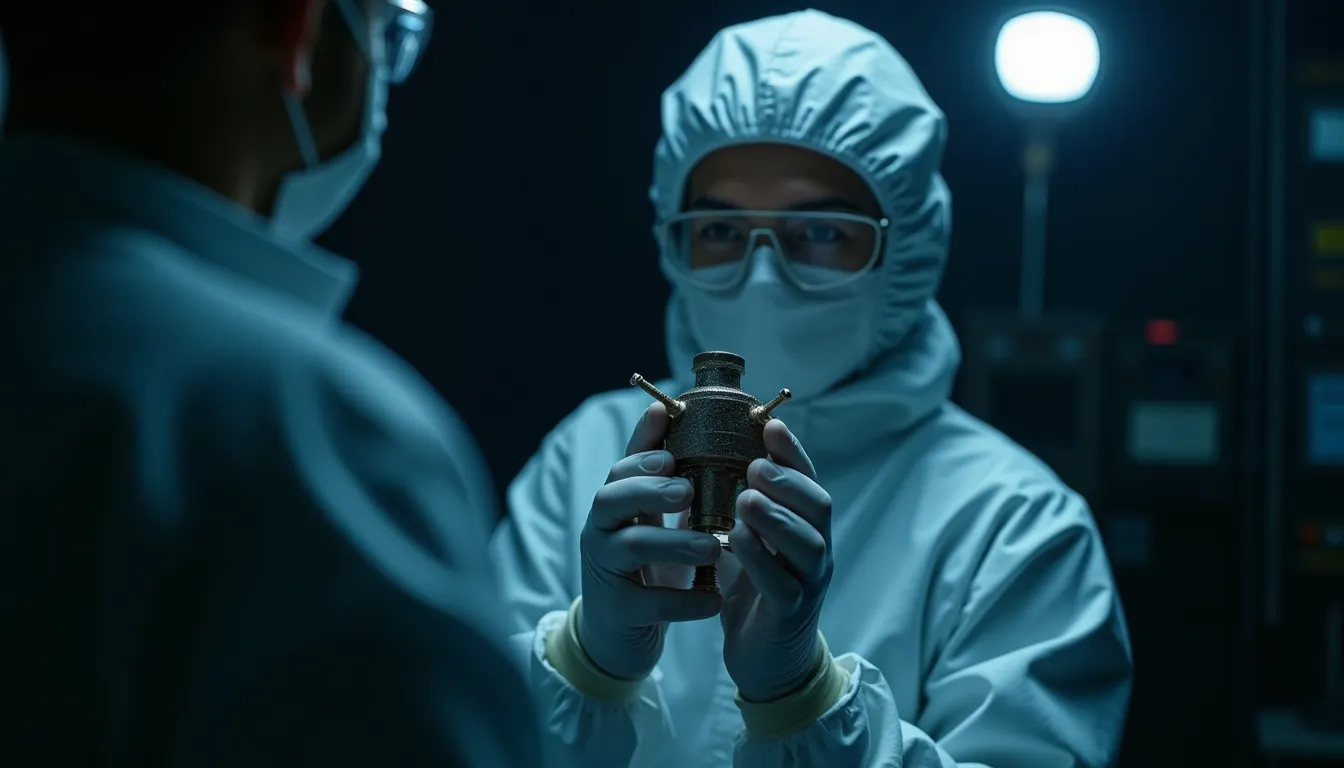
Moog completed a new ISO Class 8 clean room in Niagara Falls to expand satellite thruster production, alongside major defence contract and safety news this week.
Key Takeaways
- Moog completed an ISO Class 8 clean room at its Niagara Falls facility to expand satellite thruster production, per SpaceNews.
- SpaceNews published a separate true-or-false interview with Pacôme Révillon testing common assumptions about space industry trends.
- OCCAR awarded a $4.2 billion DDX destroyer contract to a Fincantieri and Leonardo joint venture, per Breaking Defense.
- The U.S. Air Force says its China-focused think tank will continue, though its director called it effectively defunct.
- A Hawk trainer crash prompted the UK to ground its entire Hawk aircraft fleet pending investigation.
Moog says the clean room expansion supports a growing portfolio of both defense and commercial spaceflight programs, with executives specifically citing missile defense, space-based interceptor, and Golden Dome programs as key drivers., according to SpaceNews. The upgrade lands the same week SpaceNews published a separate industry check-in on satellite manufacturing trends and Breaking Defense reported a $4.2 billion European destroyer contract, underscoring how propulsion supply chains and defence procurement are both scaling at once.
What Happened
Moog's new clean room in Niagara Falls, New York, is built to ISO Class 8 standards, a controlled-environment classification commonly required for spacecraft propulsion component assembly.
In a separate piece, SpaceNews ran a true-or-false interview with Pacôme Révillon examining widely repeated assumptions about the space industry, from launch cost trajectories to satellite manufacturing bottlenecks. The format is designed to test conventional wisdom against current market data, and it lands at a moment when component suppliers like Moog are visibly repositioning for higher-volume production.
On the defence side, Breaking Defense reported that OCCAR, the European joint armaments cooperation organization, awarded a $4.2 billion contract for the DDX destroyer program to a joint venture between Fincantieri and Leonardo. Separately, Breaking Defense also reported that the U.S. Air Force says its China-focused think tank will continue operating, even as the center's own director described it internally as effectively defunct. A third Breaking Defense report detailed a Hawk trainer aircraft crash that prompted the United Kingdom to ground its entire Hawk fleet pending investigation.
Why It Matters
Moog's clean room expansion is a supply-side signal. Satellite thruster capacity has become a real constraint as constellation operators place larger orders, and a components manufacturer investing in dedicated production infrastructure suggests order books are firm enough to justify fixed capital spending rather than one-off contracts. Read alongside Révillon's trend-testing interview, the picture is one of a sector trying to separate durable growth from hype. For investors tracking where defence and space capital is actually flowing, that kind of ground-level manufacturing signal often says more than headline valuations, a point worth weighing against broader defence and space sector equity analysis covering propulsion and destroyer-program suppliers alike. The $4.2 billion DDX award and the UK's Hawk grounding are reminders that hardware programs, whether naval or aviation, remain exposed to cost overruns and safety stand-downs even as space-side manufacturing scales more smoothly.
Background
MachineHours' broader look at automated inspection and manufacturing tooling notes that precision quality control, whether drone-based property inspection or clean-room component assembly, increasingly depends on standardized sensor and robotics protocols to cut cost and human error. Satellite thruster production shares that logic: clean-room certification exists specifically to keep contamination-sensitive propulsion components within tight manufacturing tolerances before they reach orbit.
What to Watch
Watch whether other propulsion suppliers announce similar capacity expansions in coming months, which would confirm Moog's move reflects a sector-wide production ramp rather than a single-company bet. The OCCAR destroyer award will draw scrutiny over delivery timelines given Europe's recent history of shipbuilding delays. The UK's Hawk fleet grounding will also need a resolution timeline, since trainer aircraft availability affects pilot pipelines feeding both defence and eventually space-adjacent aerospace programs.
Sources
- SpaceNews: Moog Completes ISO Class 8 Clean Room at Niagara Falls Facility to Expand Thruster Production
- SpaceNews: True or false on space industry trends with Pacôme Révillon
- Breaking Defense: OCCAR awards $4.2B DDX destroyer contract to Fincantieri, Leonardo joint venture
- Breaking Defense: The Air Force says its China think-tank will continue. Its director says it's basically dead.
- Breaking Defense: Hawk trainer crash prompts UK to ground fleet
- MachineHours Encyclopedia: PropTech and AI — Drones, Virtual Staging, and Automated Property Marketing
Frequently Asked Questions
What did Moog announce about its Niagara Falls facility?
Moog completed a new ISO Class 8 clean room at its Niagara Falls facility, expanding its capacity to build satellite thrusters used for orbit-raising, station-keeping, and deorbiting, according to SpaceNews.
Why does clean room certification matter for satellite thrusters?
ISO Class 8 clean rooms limit contamination during assembly, which is required for propulsion components that must meet tight manufacturing tolerances before launch.
What is the DDX destroyer contract reported by Breaking Defense?
OCCAR, Europe's joint armaments organization, awarded a $4.2 billion contract for the DDX destroyer program to a Fincantieri and Leonardo joint venture.
What happened with the UK's Hawk trainer aircraft?
A Hawk trainer crash led the UK to ground its entire Hawk fleet while the incident is investigated, according to Breaking Defense.
What did SpaceNews' interview with Pacôme Révillon cover?
The interview used a true-or-false format to examine common assumptions about space industry trends, including manufacturing and market dynamics.