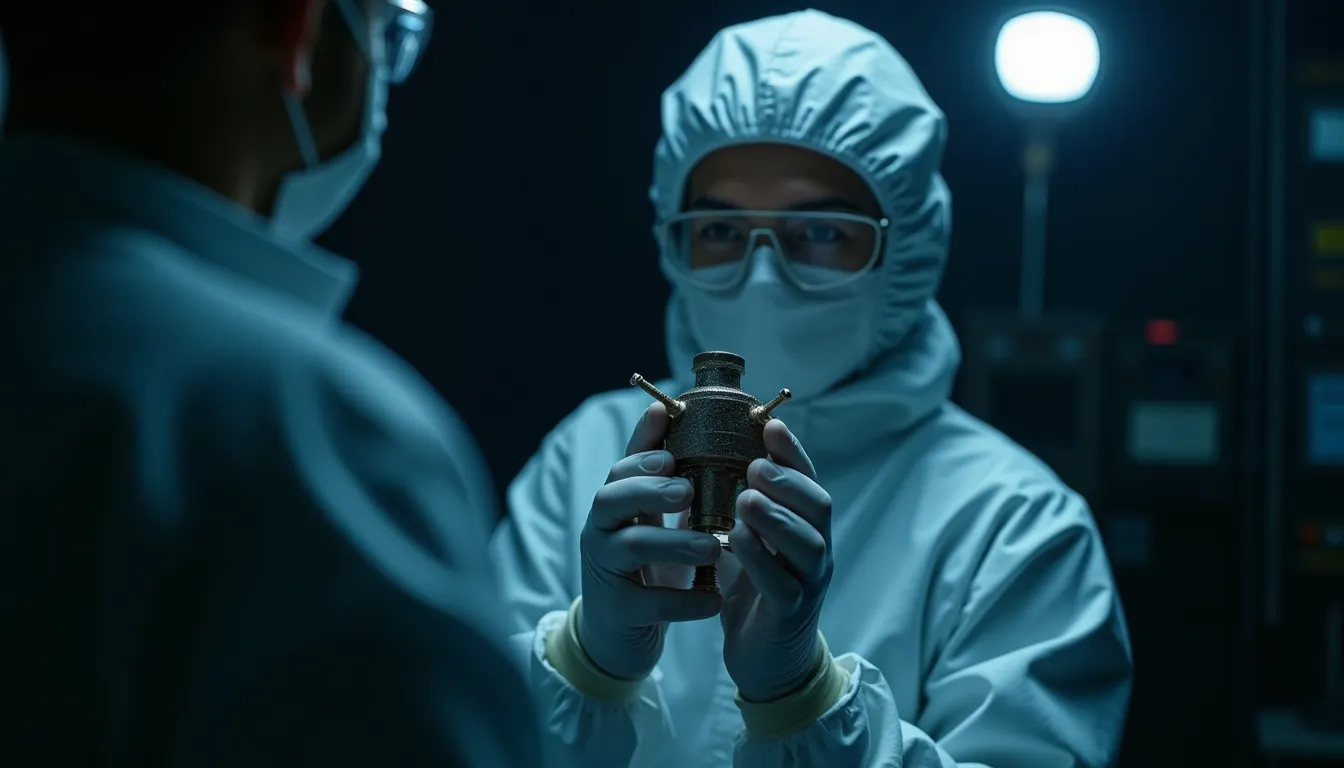
Moog has completed a new ISO Class 8 certified clean room at its Niagara Falls facility to expand thruster assembly and testing capacity. The 80% expansion supports growing satellite and defense propulsion demand, marking a significant supply-chain investment signal as constellation operators place larger orders.
Key Takeaways
- Moog completed a new ISO Class 8 clean room at its Niagara Falls facility, increasing dedicated thruster production capacity by more than 80% and enabling continuous multi-shift operations for defense and commercial programs.
- The facility integrates with four existing high-altitude hot-fire test chambers on site, maintaining Moog's vertically integrated propulsion expertise and allowing rapid iteration on thruster validation.
- Capacity constraints in satellite thruster supply have become a genuine bottleneck as constellation operators place larger orders, making Moog's fixed capital investment a signal of firm order visibility and sustained demand.
- The expansion explicitly supports missile defense, space-based interceptor, and Golden Dome defense programs alongside commercial spaceflight, diversifying customer risk across government and civil-commercial segments.
- Moog has hired dozens of new operations and engineering roles to support growth, indicating the company is preparing for sustained production scaling rather than temporary demand fluctuations.
Moog Completes Niagara Falls Clean Room Expansion
Moog Inc. (NYSE: MOG.A and MOG.B) announced the completion and commissioning of a new ISO Class 8 certified clean room at its Niagara Falls facility. The advanced manufacturing environment is now fully operational and designed to accelerate assembly, integration, and testing of thrusters supporting both defense and commercial spaceflight programs. Completed on schedule, the expansion increases dedicated clean room capacity by more than 80% and is specifically engineered for continuous, multi-shift operations for thrusters and propulsion systems.
The new environment supports the full production flow, from precision subassembly and integration through hot-fire testing. This capability enables Moog to shorten lead times and respond more rapidly to evolving mission requirements. According to Mark Covelli, senior vice president of Moog Space Division, "As national security priorities evolve, we are rapidly transforming our manufacturing footprint to enable faster, higher-volume delivery of critical defense capabilities. Our investments in capacity, workforce, and advanced production technologies ensure we can support the accelerated timelines demanded by missile defense, space-based interceptor, and Golden Dome programs."
Mike Popadick, general manager of Propulsion Systems, emphasized the facility's operational focus: "Our Niagara Falls clean room is a foundational enhancement for our propulsion business. With this expanded, purpose-built space, we are equipped to ramp up production while maintaining the precise quality and reliability our customers expect, whether for satellites, lunar landers, or defense applications."
Clean Room Standards and Manufacturing Significance
ISO Class 8 clean room certification is a controlled-environment classification commonly required for spacecraft propulsion component assembly. These environments maintain strict specifications for airborne particle counts, humidity, and contamination control—critical factors when manufacturing thrusters that must operate reliably in the vacuum of space. Contamination-sensitive propulsion components require these manufacturing tolerances before they reach orbit, making clean room certification not optional but fundamental to product quality.
The new clean room integrates seamlessly with the broader Niagara Falls site, which is home to four in-house high-altitude hot-fire test chambers and extensive engineering capabilities, reinforcing Moog's vertically integrated propulsion expertise. This consolidation of design, manufacturing, and testing on a single site reduces complexity in the production workflow and allows engineers to iterate rapidly when validating performance.
Since breaking ground on this expansion, Moog has also added dozens of new operations and engineering roles to support continued growth while upholding best-in-class quality and safety standards. Workforce additions alongside capital deployment indicate that the company is preparing for sustained production scaling rather than temporary demand spikes.
Supply-Chain Signal and Market Implications
Moog's clean room expansion is a meaningful supply-side signal. Satellite thruster capacity has become a genuine constraint as constellation operators place larger orders for replacement units and new deployments. A components manufacturer investing in dedicated production infrastructure—rather than relying on one-off contract manufacturing or short-term capacity leasing—suggests that order books are firm enough to justify fixed capital spending. This type of ground-level manufacturing investment often reveals more about market conviction than headline valuations or equity analysis alone.
The timing and scale of the investment reflect accelerating demand across multiple customer segments. The expansion explicitly supports missile defense, space-based interceptor, and Golden Dome programs as key drivers, alongside ongoing commercial spaceflight activity. This diversification across defense and civil-commercial missions suggests that Moog's order visibility spans both stable government budgets and growing commercial constellation activity.
Vertical Integration and Manufacturing Precision
Moog's Niagara Falls facility exemplifies a broader manufacturing approach: keeping critical capabilities—design, subassembly, integration, and hot-fire testing—under one roof reduces supply-chain fragmentation and allows tighter quality control. For propulsion systems where reliability directly affects mission success, this vertical integration model is increasingly attractive despite higher internal overhead. The 80% capacity increase, achieved within a single facility rather than distributed across multiple contractors, preserves this integration advantage while scaling output.
Precision quality control in modern propulsion manufacturing increasingly depends on standardized sensor and robotics protocols to minimize cost and human error. Clean-room certification forms the environmental baseline; within that controlled space, components can be assembled to the tight tolerances demanded by space-qualified thrusters. The investment in clean-room infrastructure is therefore complementary to automation and sensor-driven quality assurance systems that manufacturers across aerospace are deploying to maintain consistency as production volumes rise.
Historical Context and Long-Term Position
Moog's propulsion systems have powered missions throughout the solar system, and this latest clean room completion further solidifies Moog's 75-year legacy of innovation, precision engineering, and commitment to enabling exploration and defense. The company's track record in propulsion extends across decades of space missions, lunar systems, and defense applications—a foundation that current capacity investments build upon.
The completion of the Niagara Falls expansion also reflects evolution in how defense and space contractors approach capacity planning. Historically, fixed manufacturing investments were often deferred until government contracts were formally signed, creating delays when demand suddenly accelerated. Moog's decision to complete this facility on schedule, without waiting for every contract amendment to be finalized, suggests confidence that the underlying demand drivers—national security priorities around missile defense and space-based capabilities, combined with commercial constellation growth—will sustain utilization across multiple years.
What Comes Next
The significance of this expansion will become clearer as other propulsion suppliers announce similar capacity moves in coming months. If Moog's investment reflects a sector-wide production ramp driven by sustained demand, competitors will likely follow with comparable facility upgrades. Conversely, if Moog's move proves to be an outlier, it may indicate company-specific contract wins rather than industry-broad acceleration.
For investors and defense analysts tracking where capital is actually flowing—beyond press releases and budget projections—ground-level manufacturing signals like dedicated clean room completion often provide earlier and more reliable indicators than headline contract awards alone. Moog's Niagara Falls expansion is one such signal: a tangible, capital-intensive commitment to higher-volume thruster production that reflects both near-term demand visibility and longer-term strategic positioning in a sector where propulsion capacity continues to constrain growth.
Sources
- SpaceNews: Moog Completes ISO Class 8 Clean Room at Niagara Falls Facility to Expand Thruster Production
- SpaceNews: True or false on space industry trends with Pacôme Révillon
- Breaking Defense: OCCAR awards $4.2B DDX destroyer contract to Fincantieri, Leonardo joint venture
- Breaking Defense: The Air Force says its China think-tank will continue. Its director says it's basically dead.
- Breaking Defense: Hawk trainer crash prompts UK to ground fleet
- MachineHours Encyclopedia: PropTech and AI — Drones, Virtual Staging, and Automated Property Marketing
Frequently Asked Questions
What did Moog announce about its Niagara Falls facility?
Moog completed a new ISO Class 8 clean room at its Niagara Falls facility, expanding its capacity to build satellite thrusters used for orbit-raising, station-keeping, and deorbiting, according to SpaceNews.
Why does clean room certification matter for satellite thrusters?
ISO Class 8 clean rooms limit contamination during assembly, which is required for propulsion components that must meet tight manufacturing tolerances before launch.
What is the DDX destroyer contract reported by Breaking Defense?
OCCAR, Europe's joint armaments organization, awarded a $4.2 billion contract for the DDX destroyer program to a Fincantieri and Leonardo joint venture.
What happened with the UK's Hawk trainer aircraft?
A Hawk trainer crash led the UK to ground its entire Hawk fleet while the incident is investigated, according to Breaking Defense.
What did SpaceNews' interview with Pacôme Révillon cover?
The interview used a true-or-false format to examine common assumptions about space industry trends, including manufacturing and market dynamics.
Get MachineHours in your inbox
AI compute and the machine economy in your inbox.