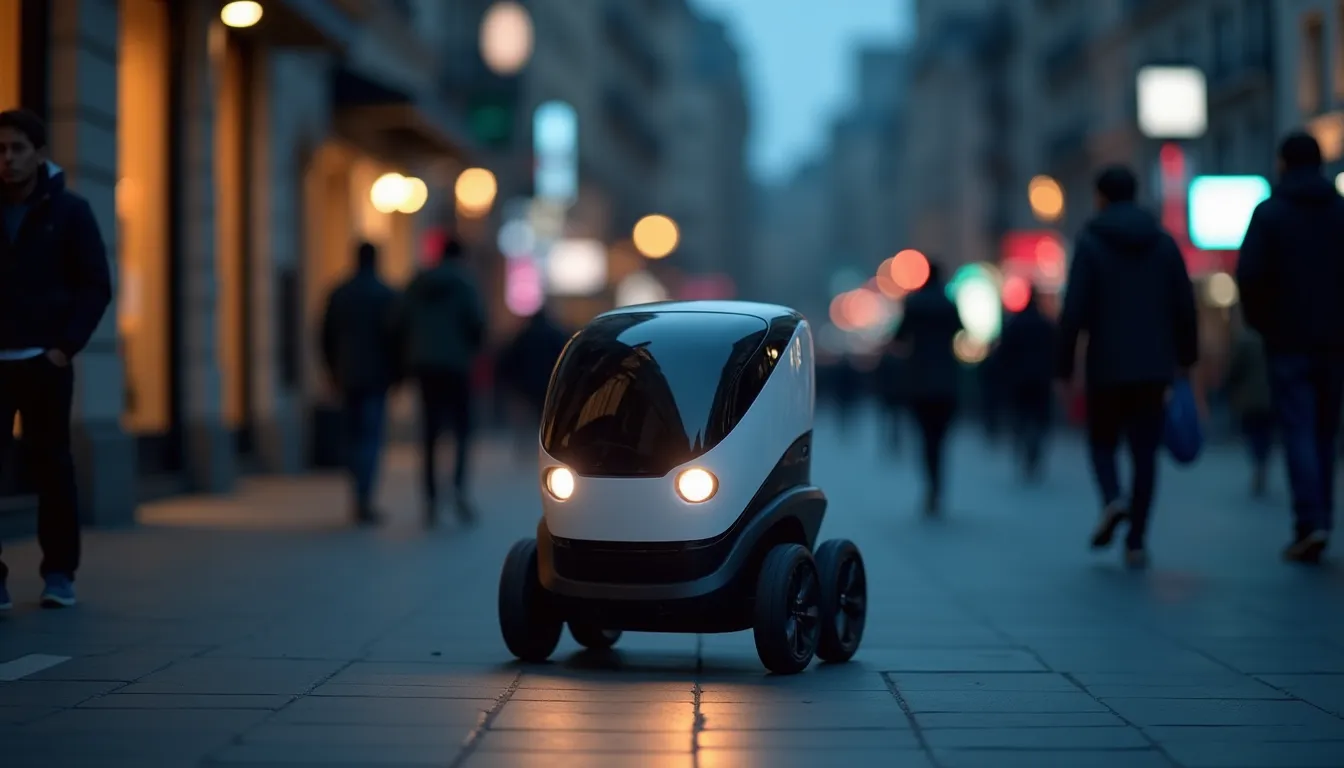
Carolyn Marvin was arrested in Philadelphia and charged with disorderly conduct after repeatedly blocking an Uber delivery robot to protest job losses. The incident highlights a broader legal challenge facing cities nationwide as they draft rules to regulate autonomous vehicles that current enforcement frameworks—designed for human drivers—struggle to address.
Key Takeaways
- A Philadelphia woman was arrested and charged with disorderly conduct for repeatedly blocking an Uber delivery robot to protest job losses from automation
- Current criminal and traffic law frameworks were designed around human drivers and do not adapt easily to autonomous vehicles with no occupant to cite or penalize
- Multiple cities are drafting new ordinances to physically immobilize or restrict robotaxis, reflecting frustration with federal regulatory gridlock and inadequate local enforcement tools
- Political consensus on tightening autonomous vehicle regulation is bipartisan, with both blue and red states moving to limit fleet sizes, restrict hours, and require emergency response protocols
- The patchwork of local regulations is likely to persist long-term, as cities retain core authority over street operations even if Congress eventually passes federal safety standards
A Philadelphia woman was arrested this week for physically blocking a delivery robot from completing its route. Carolyn Marvin was charged with disorderly conduct after repeatedly standing in front of an Uber delivery robot and refusing to move when police asked her to step aside. The incident, captured on video and now garnering significant media attention, represents a new type of legal dispute emerging as autonomous systems become fixtures on urban streets.
The Arrest and Marvin's Motivation
According to police records and video evidence, Marvin told Philadelphia's ABC13 that she was protesting delivery robots taking jobs from human workers. "I know they're taking the jobs of human delivery workers and so, I have been protesting them whenever I saw them by standing in front of them and preventing them from going forward," Marvin said in the broadcast interview. When police responded to the scene and asked her to move, she refused, at which point officers placed her in handcuffs and arrested her.
This was not Marvin's first confrontation with delivery robots. The delivery robots have become a common sight on the streets of downtown Philadelphia and have sparked backlash, with one robot kicked over in Center City earlier this year. The pattern suggests growing tension between the public and autonomous delivery systems in the city.
The Broader Regulatory Challenge
Marvin's arrest arrives at a critical moment in autonomous vehicle policy. Cities and states across the political spectrum are frustrated by federal gridlock and are taking matters into their own hands to rein in autonomous vehicles. The legal tools available to municipalities, however, were built for a different era. While federal regulators scramble to establish safety standards, legislation to establish rules for autonomous vehicles remains stalled in Congress and has been for years.
Multiple cities are now considering laws that would let officials physically boot or immobilize robotaxis that break parking rules, block traffic, or stop illegally, much as cities already do with human-driven vehicles. Municipal officials say current enforcement tools, originally built around ticketing a human driver, do not translate cleanly to vehicles with no one behind the wheel to cite or tow in the usual sense. The Philadelphia arrest demonstrates the inverse problem: applying human-centered criminal law to obstruction of machines rather than vehicles or people.
A Patchwork of Local Solutions
The absence of federal rules has left local lawmakers to create their own playbooks to ensure autonomous vehicles follow at least some rules of the road. Specific proposals are already emerging across the country. Minneapolis is considering an ordinance to require human monitors inside autonomous vehicles, which would effectively ban driverless operations. The San Diego City Council passed a resolution seeking to block Waymo from the airport and give local agencies direct control over AVs in emergencies. Austin firefighters have expressed concern over the Tesla Cybercab's lack of steering wheel or pedals, arguing this could lead to issues if first responders need to move a stalled vehicle, and they want to require AV developers to establish dedicated, rapid-response towing protocols and direct human operator communications for emergency situations.
Political consensus is also emerging in unexpected places. It used to be the case that Republicans were seen as more welcoming of autonomous vehicles, while Democrats were seen as more skeptical, but now even some red states are considering tightening the leash, including Kentucky, Oklahoma, South Dakota, and Iowa. Even in tech-friendly California, state lawmakers are mulling ways to bring robotaxis to heel, with several bills introduced to give cities direct authority to limit AV fleet sizes, restrict operating hours, or enact local permit bans within municipal limits.
Land-Use and Zoning Tactics
Some municipalities are flexing their land-use and zoning powers to crack down on robot cars, with Culver City exploring emergency moratoriums on building permits for AV fleet facilities, while Santa Monica used local noise and traffic ordinances to restrict 24-hour charging hubs. These approaches reflect NIMBY-style resistance extending into the autonomous vehicle realm.
The Industry Response and Global Expansion
As the local debate over autonomous vehicles intensifies, AV developers are increasingly looking overseas as a potential hedge against obstacles cropping up in the US, with Waymo planning to expand its service in London, Tokyo, and Munich, while Uber is teeing up vehicles for Manchester, Madrid, and Dubai. However, the US still presents the industry's best chances of turning a profit, especially as costs for developers continue to grow.
Rather than fighting strict local regulations head-on, companies like Waymo, Zoox, and Aurora are prioritizing states with explicit legislative preemption that prevents individual cities from banning the technology. Industry trade groups like the Autonomous Vehicle Industry Association are aggressively pushing for more preemption powers in an attempt to create more unified standards. Yet even these lobbying efforts face headwinds: even airport authorities are getting in on the action, proposing their own slate of rules for robotaxis.
Structural Implications
The Marvin arrest and the parallel regulatory push expose a structural mismatch between existing legal frameworks and emerging autonomous systems. Traditional traffic and criminal law assumes a human operator who can receive a ticket, face civil liability, or be held criminally accountable. Delivery robots and robotaxis have no occupants to penalize. Prosecutors treating obstruction of a robot as seriously as obstruction of a human worker signals a willingness to extend criminal law into new territory. Conversely, municipal enforcement officials unable to ticket a driverless vehicle through traditional mechanisms are improvising physical immobilization schemes.
Congress may eventually pass high-level safety legislation, but it is highly unlikely that any bill would seek to strip cities of their core police, zoning, and emergency response powers. Cities will be the main arbiters of robotaxi permission for the foreseeable future, ensuring that the patchwork of local regulations will persist and likely expand as autonomous systems proliferate across more urban environments.
Sources
Frequently Asked Questions
What happened with the delivery robot arrest in Philadelphia?
According to The Verge, a woman was arrested after repeatedly blocking a delivery robot from completing its route, marking a notable case of criminal charges tied to interference with an autonomous device.
Why are cities trying to boot robotaxis?
The Verge reported that cities are drafting laws to physically immobilize robotaxis that violate parking or traffic rules, since existing enforcement tools assume a human driver to cite.
Is the Philadelphia robot interference case connected to robotaxi laws?
They are separate incidents but share a common thread: public robots are now common enough that cities and courts must improvise legal responses that existing law did not anticipate.
What did the Munich Quantum Software Company comment have to do with robotics?
It did not directly relate to robotics; Robert Wille's comments concerned quantum computing design automation, included here only as parallel context on infrastructure lagging deployment speed.
Get MachineHours in your inbox
AI compute and the machine economy in your inbox.