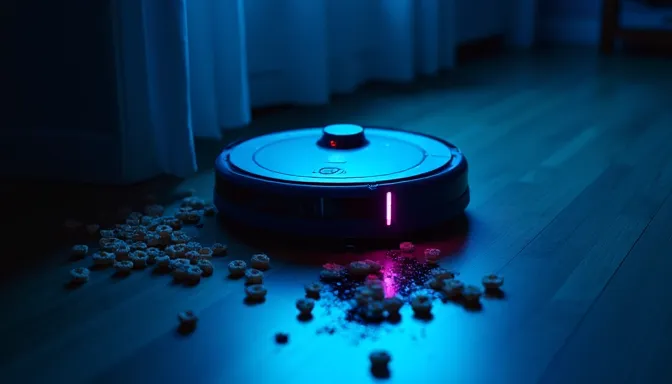
Wired's 2026 robot vacuum guide crowns the Shark PowerDetect UV Reveal ($1,300) top overall, with Roborock's $800 Qrevo 2 Pro as its budget pick.
Key Takeaways
- Wired named the Shark PowerDetect UV Reveal its top robot vacuum of 2026, listed at $1,300 but commonly discounted to $693.
- Roborock's Qrevo 2 Pro took Wired's budget pick at $800 list price, often found around $450 with 20,000 Pa suction.
- Eufy's Omni C28 earned budget runner-up status at $800 list, discounted to $380, though battery dropped to 37% after one run.
- The Matic Robot Vacuum Bundle at $1,495 received the only perfect 10/10 score former WIRED editor Adrienne So has given a robot vacuum.
- All top-tier models in Wired's November 2026 guide carried discounts between 44% and 53% off list price.
Wired has named the Shark PowerDetect UV Reveal its top robot vacuum of 2026, citing the $1,300 model's UV-light stain detection and automated deep-cleaning passes, according to Wired. The publication also crowned Roborock's $800 Qrevo 2 Pro as its budget pick after testing it against cherry juice spills and Cheerios wedged into tight corners, while Eufy's $800 Omni C28 took the runner-up budget slot. Across all three top-tier models, prices have collapsed 44 to 53 percent from their list prices.
What Happened
Wired reviewer Nena Farrell tested the current crop of robot vacuums in a three-story home against a standardized gauntlet of Cheerios, cherry juice, carpet, hard floors, and cat litter. According to Wired, the Shark PowerDetect UV Reveal, retailing at $1,300 but frequently discounted to $693 (a 47 percent reduction), uses NeuroNav AI paired with RGB sensors, lasers, and an UltraRange camera to spot stains a UV light reveals, then sends the robot back to re-clean those exact spots with dedicated scrubbing passes. Farrell's testing showed the vacuum finished a four-room main-floor run in roughly 60 minutes, with an additional 30 minutes dedicated to scrubbing detected stains. The vacuum recovered two of three Cheerios, missing the one placed near a chair leg, while the article's text notes it skipped a third Cheerio near bar stools to avoid bumping them — Wired's own test score and narrative are inconsistent on which Cheerios were retrieved.
Farrell praised the Shark's performance on hard floors - both luxury vinyl plank and tile - where it performed as a mop-and-vacuum combo, and noted the rug felt "just as fluffy and well-vacuumed as if I had cracked out my favorite Dyson stick vacuum." The spill test revealed a limitation: while the vacuum mopped away the first cherry juice spot with no problem, it required a second pass to fully clean the second spill. The robot uses an extendable arm for corner work and features "NeverStuck Technology" that lifts the chassis off obstacles; Farrell confirmed this worked effectively on flat-legged side tables. One constraint emerged in multi-floor mapping - the vacuum can learn only a single map, requiring remapping for different floors, though Farrell noted this takes only a couple of minutes. SharkNinja has declined to disclose the exact suction specification for the model, leaving that performance metric undocumented.
Wired's budget pick, the Roborock Qrevo 2 Pro, normally lists at $800 but is commonly found around $450, a 44 percent reduction. According to Wired, the outlet reported it ships with 20,000 Pa of suction, a FlexiArm mop for corner cleaning, and multi-floor mapping. Farrell found it outperformed the Eufy Omni C28 in cord avoidance, with the Qrevo 2 Pro attempting to eat cords without getting stuck while the Eufy became trapped during testing. Both vacuums scored 2 out of 3 on Farrell's Cheerio test, but the Qrevo 2 Pro deployed its FlexiArm to retrieve the harder fridge Cheerio; it missed the bookshelf Cheerio. The Qrevo 2 Pro also achieved a 1.25 out of 2 on the spill test - one cherry juice spot was nearly cleaned, though the surrounding area remained slightly sticky, while the second spill received only partial cleaning. Farrell noted the vacuum occasionally leaves small debris behind when transitioning between carpet and hard flooring at thresholds, though it handled transitions onto rugs more cleanly. The base station is quieter than the Eufy, particularly noticeable when running separate vacuuming and mopping sessions; Farrell completed a full two-hour separate vacuum-and-mop cycle on her main floor, a time comparable to what most competing vacuums take just for a single combo clean.
The Eufy Omni C28, also $800 and discounted to $380 (53 percent off), carries 15,000 Pa of suction - nearly double the suction of its predecessor - and supports multi-floor mapping for all three floors of Farrell's home. However, Wired found its battery dropped to 37 percent after a single main-floor clean, a constraint that prevents full multi-floor operation on a single charge, though the battery recovers to 57 percent after just 20 minutes at the docking station. The Eufy scored 2 out of 3 on the Cheerio test, missing the fridge-corner Cheerio, the most challenging placement. During the spill test, it completely cleaned the first cherry juice spot but left sticky residue on the second, partially dried spill. The Eufy attempted to tangle with cords near Farrell's bed, requiring manual intervention to free them, underscoring the need for cord management with this model.
The guide also cataloged several honorable mentions, including the Dreame X50 Ultra at $800, with AI-powered dirt detection that former WIRED editor Adrienne So described as 'the most effective dirt- and obstacle-identification system,' particularly useful for homes with pets. The Dyson Spot+Scrub Ai at $800 uses a unique base station design and built-in AI for stain detection, though Wired found Shark's implementation superior despite similar starting retail prices. The Matic Robot Vacuum Bundle at $1,495 received the only perfect 10-out-of-10 score former WIRED editor Adrienne So has given a robot vacuum, attributed to its six RGB infrared cameras for 3D mapping and compact square design for corner access; former WIRED editor Adrienne So noted the low 3,200 Pa suction did not compromise cleaning results, and the vacuum remained quiet enough to run without disturbing children watching television.
Why It Matters
The consistent 44 to 53 percent discounts across every model in Wired's top tier reflect steep markdowns from list price, though Wired's article does not characterize this as a 'price war' or market maturation signal. According to MachineHours' AI Acceleration Index, calculated November 23, 2026, the adoption sub-score sits at 44, higher than the overall index reading of 34 and the venture funding component at 31. That gap suggests AI-equipped consumer hardware, like stain-detecting vacuums, is being adopted faster than the capital markets are rewarding frontier AI research, a pattern worth watching for anyone tracking robotics deployment across both consumer and industrial tiers.
This also reflects a broader commoditization trend across robotics price brackets. The same forces pushing $1,300 vacuums to sub-$700 price points echo what MachineHours has tracked in humanoid robotics pricing, where platforms once reserved for research labs are reaching five-figure and now four-figure price brackets. Hardware differentiation - UV stain detection, FlexiArm mopping, multi-floor mapping, obstacle-lifting via "NeverStuck Technology" - has become the battleground rather than raw suction power, which Shark itself declined to disclose for its flagship model. As adoption metrics outpace venture returns, manufacturers are compressing margins to gain market share in a category where roboticists and engineers have solved core navigation and cleaning challenges, leaving software intelligence and mechanical refinement as the primary competitive vectors. Investors tracking robotics as an asset class should monitor whether these discount levels persist or compress profit margins across SharkNinja, Roborock, and Eufy, particularly as AI-driven feature parity emerges.
What to Watch
Monitor whether SharkNinja, Roborock, and Eufy sustain these discount levels through the 2026 holiday shopping season or whether the cuts prove temporary promotional pricing tied to end-of-year inventory clearance. Also track whether AI-driven stain detection, the feature Wired highlighted as the Shark's standout capability, becomes a standard checkbox across the category the way LiDAR navigation did in prior years, potentially compressing margins further for manufacturers competing on software rather than hardware specs. Watch too whether the low adoption of Shark's single-floor-mapping constraint forces a software update or hardware redesign to match competitors' multi-floor capability, and whether Eufy's battery-life deficit becomes a dealbreaker as consumers test longer cleaning cycles across larger homes. Finally, observe whether emerging models from lesser-known brands attempt to undercut the $380 to $450 budget tier with their own AI-detection features, further fragmenting market share and accelerating the race to feature parity at lower price points.
Background
Wired found the Eufy Omni C28 was left with 37 percent battery remaining after a single main-floor run, a 63 percent drop that limited how much of the home it could clean on one charge. The integration of mopping alongside vacuuming has become standard rather than premium, with corner-reaching tools like Roborock's FlexiArm and Matic's compact geometry addressing a longstanding weakness in autonomous floor cleaning.
Further reading and context
For broader context on how robotics pricing and commercial deployment trends are evolving across categories, see MachineHours' coverage of humanoid robot commercial deployment and the race to scale physical AI.
Key Facts
- Wired's top overall pick, the Shark PowerDetect UV Reveal, lists at $1,300 but is commonly discounted to $693 (47% off); it uses NeuroNav AI with RGB sensors, lasers, and an UltraRange camera to detect and re-clean UV-revealed stains.
- Wired's budget pick, the Roborock Qrevo 2 Pro, lists at $800 and is commonly found around $450 (44% off), with 20,000 Pa of suction and multi-floor mapping via PreciSense LiDar.
- The Eufy Omni C28 budget runner-up lists at $800, discounted to $380 (53% off), with 15,000 Pa of suction but 37% battery remaining after one main-floor clean.
- The Matic Robot Vacuum Bundle at $1,495 received the only perfect 10/10 score Wired has given a robot vacuum, using six RGB infrared cameras and operating at just 3,200 Pa with proprietary waste bags.
Further reading and context
Sources
- Wired: Best Robot Vacuum of 2026: Shark, Eufy, Roborock
- MachineHours: AI Acceleration Index
- MachineHours Learn: The $5,900 Robot — Unitree R1 and the Race to Affordable Humanoids
- Boston Dynamics Atlas Humanoid Robot
- Unimate — The First Industrial Robot Arm
- Humanoid Robot Commercial Deployment — The Race to Scale Physical AI
Frequently Asked Questions
Which robot vacuum did Wired name best overall for 2026?
Wired selected the Shark PowerDetect UV Reveal, listed at $1,300 and often discounted to $693, citing its UV-light stain detection and automatic re-cleaning feature.
What is Wired's top budget robot vacuum pick?
The Roborock Qrevo 2 Pro, listed at $800 but commonly available around $450, earned Wired's budget recommendation, with 20,000 Pa of suction and a FlexiArm mop for corners.
How much suction does the Eufy Omni C28 have compared to Roborock's model?
The Eufy Omni C28 offers 15,000 Pa of suction versus the Roborock Qrevo 2 Pro's 20,000 Pa, according to Wired's testing.
Did any robot vacuum get a perfect score in Wired's testing?
The Matic Robot Vacuum Bundle at $1,495 received the only 10/10 rating former WIRED editor Adrienne So has given a robot vacuum, citing its six RGB infrared cameras and corner-reaching design.
Why are robot vacuum prices dropping so sharply in 2026?
Wired's guide shows discounts of 44% to 53% across top models, though the outlet does not describe those markdowns as a price war.
Get MachineHours in your inbox
AI compute and the machine economy in your inbox.