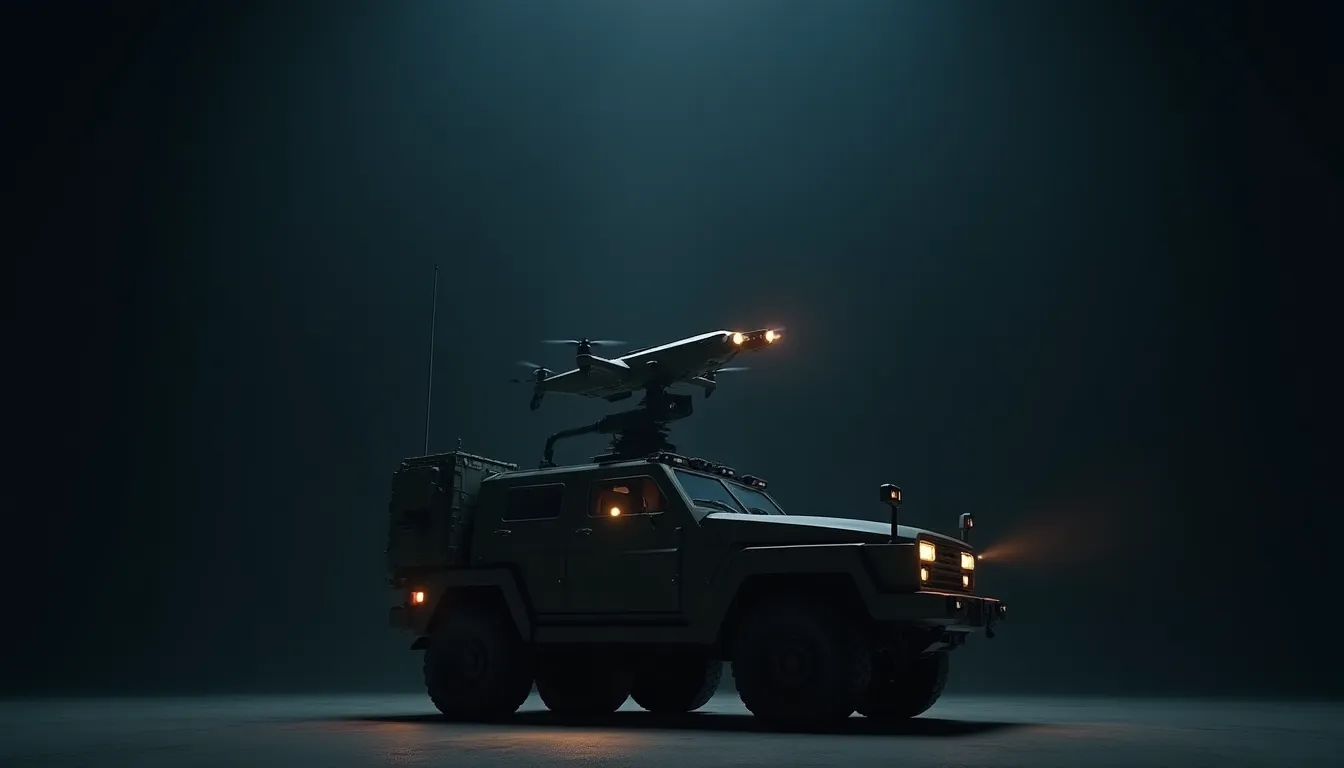
The Pentagon's Joint Task Force for the Southern Border successfully used an Army Multipurpose High Energy Laser system to engage and defeat three hostile drones, marking an operational milestone for directed energy weapons in domestic border security. The non-kinetic technology mounted on AeroVironment systems offers cost-effective advantages over traditional kinetic interceptors in countering ae
Key Takeaways
- US military successfully deployed an Army Multipurpose High Energy Laser (AMP-HEL) system to engage and defeat three hostile drones at the southern border, representing an operational milestone for directed energy weapons in domestic security
- Directed energy systems offer significant cost-per-intercept advantages over traditional kinetic missiles, becoming increasingly important as adversaries deploy drone swarms
- The AMP-HEL system cleared critical credibility thresholds by proving operational effectiveness in real-world conditions rather than controlled testing environments
- The Pentagon is using the southern border as a testing ground for counter-drone capabilities through the Army-led Joint Interagency Taskforce 401 to accelerate technology transition from development to field use
- Global drone market growth from $43.6 billion to $109.8 billion by 2030 is driving military investment in non-kinetic counter-drone solutions that can scale economically
American military forces have achieved an operational success deploying a directed energy laser system at the southern border, according to Breaking Defense reporting, in what represents a significant milestone for counter-drone technology. Task force personnel used an Army Multipurpose High Energy Laser (AMP-HEL) system to "engage and defeat three hostile UAS," which posed a "physical threat" to US military personnel and US Customs and Border Patrol members. The deployment underscores how rapidly counter-drone capabilities have transitioned from testing ranges to active operational use in a domestic security context.
The Operational Deployment
According to the Joint Task Force – Southern Border (JTF-SB), the laser system successfully engaged and defeated three hostile drones, demonstrating the effectiveness of directed energy technology against unmanned aerial threats. The system was part of AeroVironment's non-kinetic counter-drone capabilities, representing the product of the Army's Multipurpose High Energy Laser (AMP-HEL) program.
Major General Curtis Taylor, commander of JTF-SB, stated in a release that "Cartel networks are increasingly employing unmanned aircraft systems to facilitate illicit human-smuggling and actively spy on our personnel and law enforcement partners. By integrating layered countermeasures alongside advanced directed-energy capabilities like this laser system, we have made it clear that we will not tolerate hostile surveillance." The release suggested the drones could have been used for reconnaissance by a drug cartel, though it did not disclose exactly where the drones were engaged or who was suspected of flying them.
The task force carried out the mission under US Northern Command and "in support of" US Customs and Border Protection. This operational coordination marks a significant step in integrating advanced military technologies into the broader border security mission.
Technological Significance
The AMP-HEL system represents a fundamental shift in counter-drone approach. Unlike traditional kinetic interceptor missiles, which are expensive to deploy and operate, directed energy systems offer a cost-per-intercept advantage that becomes increasingly attractive as adversaries deploy drone swarms. The delivery of a counter-UAS system to the Army in December aligned with the timeframe of AeroVironment's delivery of its prototype 20kW-class LOCUST system, indicating the rapid advancement of these technologies toward operational deployment.
The significance of this deployment lies not merely in technical achievement but in its confirmation that directed energy weapons have cleared a critical operational credibility threshold. Directed energy systems have spent years in laboratory evaluation and controlled testing. Seeing one confirmed as operationally effective against real drone threats—not in a controlled range environment but under actual border security conditions—signals institutional confidence that the technology is mature enough for frontline use. Each successful engagement demonstrates that the system can track, discriminate, and neutralize aerial threats in contested, real-world conditions.
The non-kinetic nature of the AMP-HEL system carries additional operational advantages. Traditional air defense systems designed for manned aircraft or ballistic missiles operate on fundamentally different time scales and engagement profiles than drones. Directed energy systems can engage targets at the speed of light, eliminating the tracking and flight time delays inherent in kinetic systems. This speed advantage becomes decisive against swarm tactics, where multiple drones approach in coordinated patterns. A single directed energy platform can address multiple threats in sequence without the resupply requirements of missile-based systems.
Strategic Context in Border Security
The Pentagon has turned the southern border into a "sandbox" of sorts to test new counter-drone capabilities in collaboration with the Army-led Joint Interagency Taskforce 401. Through this initiative, JIATF 401 has invited industry partners to the border to show off their tech aimed at taking down adversary drones in a cost-effective way that also minimizes the threat of collateral damage to the nearby civilian population. This structured testing environment has accelerated the transition of promising technologies from development to field use.
The emerging drone threat at the southern border reflects broader technological trends. Unmanned aerial systems have become increasingly accessible, capable, and difficult to detect. Cartel networks, as noted by Major General Taylor, have recognized their utility for surveillance and illicit operations. Unlike traditional border security threats, which typically involve stationary infrastructure or vehicles, drone incursions present dynamic, distributed targets that require rapid-response, scalable countermeasures. A fixed radar or tower-mounted system cannot address threats approaching from multiple vectors simultaneously. A mobile, directed energy platform mounted on an autonomous or semi-autonomous vehicle platform solves this problem by enabling counter-drone defense to move with operational requirements.
Broader Procurement and Technology Trajectory
The AMP-HEL system represents a key component in a broader military reckoning with drone technology. The global drone market is projected to grow from $43.6 billion to $109.8 billion by 2030, with defence applications driving a substantial share of that expansion. The same AI navigation and sensor fusion capabilities that make commercial drones more capable also make adversarial drones harder to detect and intercept. This dynamic creates a self-reinforcing procurement cycle: as adversary drones become more capable, defenders must invest in more sophisticated countermeasures, which in turn accelerates the development and fielding of advanced systems.
Directed energy weapons offer a response to this escalation that is economically sustainable. Each kinetic intercept—whether by missile or kinetic projectile—consumes an expensive, single-use asset. Directed energy systems, by contrast, consume energy at a marginal cost that becomes negligible at scale. In scenarios where adversaries deploy dozens or hundreds of drones, the cost arithmetic strongly favors directed energy solutions. The successful engagement of three hostile drones at the southern border may be modest in absolute terms, but it validates a cost structure that can scale to the threat level.
Operational Lessons and Future Trajectory
The operational deployment at the southern border also reflects lessons from international conflict dynamics. Drone proliferation and increasing sophistication have emerged as defining characteristics of modern warfare, particularly visible in the Russia-Ukraine conflict. The scalability challenge—how to defend against multiple simultaneous drone threats without bankrupting the defense budget—has become a central preoccupation for military planners globally.
The JTF-SB deployment suggests that US military leadership views directed energy systems as mature enough to be trusted with real-world missions in a domestic security context. This confidence carries implications for future procurement decisions. If the AMP-HEL system receives formal designation as a program of record—a step that would institutionalize ongoing funding and development—it would signal a long-term commitment to directed energy technology as a pillar of air defense strategy rather than a provisional or experimental capability.
The integration of the directed energy system into existing border security architecture also indicates that the military has solved key integration challenges: power requirements, thermal management, autonomous or semi-autonomous vehicle platforms capable of reliable operation in austere environments, and coordination protocols with civilian law enforcement partners. These technical and organizational hurdles have historically delayed the deployment of advanced military systems. Their successful resolution at the border suggests that directed energy counter-drone systems are approaching the operational maturity required for broader deployment across the military's air defense enterprise.
Sources
- Breaking Defense: Military uses AV directed energy system to 'defeat' drones at the border
- Breaking Defense: With AI hackers in mind, Air Forces Cyber develops defensive 'campaign plan'
- Breaking Defense: Finland and Sweden team up to boost counter-drone defenses
- Breaking Defense: F-35 lifetime price tag dips beneath $2 trillion even as buying costs rise
- Breaking Defense: The big defense spending priorities awaiting Congress in September
- MachineHours Encyclopedia: Drone Technology — Autonomous Flight and Its Economic Impact
Frequently Asked Questions
What is a directed energy system and how does it defeat drones?
Directed energy systems use focused beams of energy - such as high-power lasers or microwave emitters - to disable or destroy drones. They offer a low cost-per-intercept compared to kinetic missiles, making them effective against high-volume drone threats.
Why is the US Air Force developing a specific plan against AI hackers?
Air Forces Cyber has built a defensive campaign plan because AI enables adversaries to automate vulnerability scanning, accelerate attack cycles, and generate novel intrusion techniques faster than human defenders can respond. The plan acknowledges AI as the specific threat model.
What are Finland and Sweden doing together on counter-drone defence?
The two Nordic NATO members have formalised a bilateral agreement to pool resources and share technical standards for counter-drone detection and interdiction systems, drawing on lessons from drone warfare observed in Ukraine.
Has the F-35's total program cost gone down?
The F-35's projected lifetime cost has dipped below $2 trillion, but this reflects updated sustainment assumptions and fleet size adjustments - not a reduction in per-unit procurement price, which has actually risen.
What defence spending decisions does the US Congress face in September 2026?
According to Breaking Defense, Congress must decide on contested funding lines for autonomous systems, directed energy programmes, and next-generation cyber infrastructure as part of the broader defence appropriations process.
Get MachineHours in your inbox
AI compute and the machine economy in your inbox.