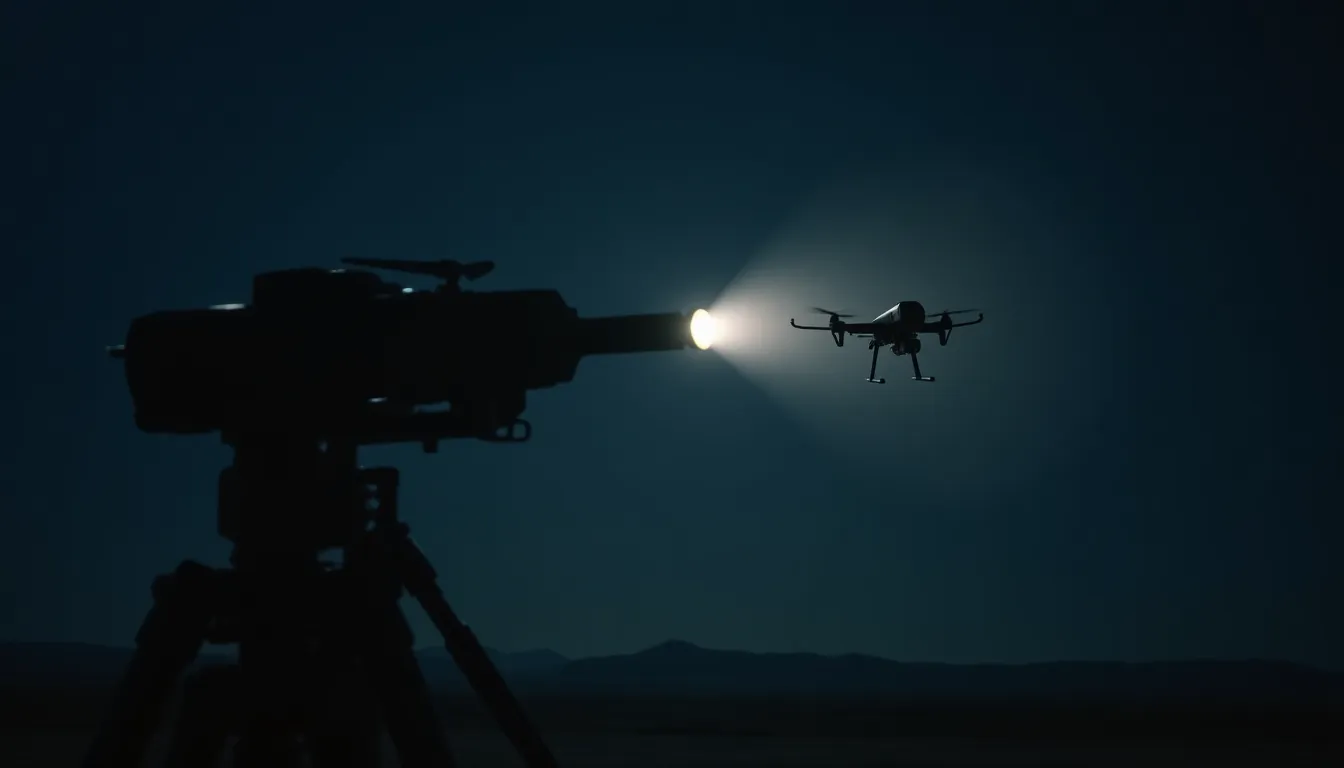
The Pentagon's Joint Task Force–Southern Border used an AeroVironment-supplied Army Multipurpose High Energy Laser system to defeat three hostile drones, marking an operationally significant domestic deployment of directed energy counter-UAS technology in response to increased cartel surveillance threats.
Key Takeaways
- The Pentagon's Joint Task Force–Southern Border successfully used an AeroVironment-supplied Army Multipurpose High Energy Laser (AMP-HEL) system to defeat three hostile drones that posed a threat to US military and border patrol personnel
- Drug cartels are increasingly using unmanned aircraft systems for surveillance and to facilitate human smuggling operations, prompting the military to deploy directed energy counter-drone capabilities at the border
- Directed energy weapons offer significant per-shot cost advantages over conventional missile interceptors and minimize collateral damage risks in border defense scenarios
- The southern border is serving as a testing ground where the Pentagon validates new counter-drone technologies through collaboration between military personnel and industry partners before broader procurement decisions
- This operational success occurs as Congress prepares major defense spending decisions in September, positioning counter-drone and directed energy systems as priority investments backed by demonstrated battlefield effectiveness
The US military has confirmed it successfully used an AeroVironment directed energy system to defeat three hostile drones operating near the southern border, marking one of the most operationally visible deployments of counter-drone directed energy technology on American soil to date.
The Operation
According to a release from the Joint Task Force–Southern Border (JTF-SB), task force personnel used an Army Multipurpose High Energy Laser (AMP-HEL) system to "engage and defeat three hostile UAS," which posed a "physical threat" to US military personnel and US Customs and Border Patrol members. The release did not disclose the exact location where the drones were engaged or the identity of those suspected of flying them, though officials suggested they could have been used for reconnaissance by drug cartels.
AeroVironment confirmed that the task force used one of the company's non-kinetic counter-drone systems, which is the product of the Army's Multipurpose High Energy Laser (AMP-HEL) program. The statement referenced a counter-UAS system delivered to the Army in December, the same timeframe that an AeroVironment press release indicated the company delivered its prototype 20kW-class LOCUST system. The release did not disclose whether the laser system was mounted on a vehicle or provide other specific operational details.
Strategic Significance
This deployment represents a watershed moment in the operational integration of directed energy systems into domestic military defense. The Pentagon has long pursued counter-drone capabilities as a critical gap in air defense, particularly given the proliferation of low-cost unmanned systems that can evade or overwhelm traditional missile-based air defenses. The fact that the system successfully engaged and defeated three drones demonstrates that directed energy is no longer merely a developmental concept but a fielded capability.
The shift from kinetic to directed energy defense has multiple strategic implications. Directed energy weapons—which defeat targets using focused electromagnetic or laser power rather than kinetic projectiles—offer a per-shot cost advantage over conventional interceptor missiles, a factor that becomes critical when defending against drone swarms or repeated incursions at scale. In a border defense context where budget constraints and political sensitivities around civilian proximity are acute, the ability to neutralize threats with electromagnetic beams rather than missiles or conventional munitions substantially reduces both fiscal and collateral damage risks.
The cartel-drone threat that prompted this deployment reflects a broader trend in unconventional security challenges. Drug cartels are increasingly employing unmanned aircraft systems to facilitate illicit human-smuggling and conduct surveillance on US military and border patrol personnel. This operational necessity—the need to defend against non-state actors equipped with commercial or semi-military drones—has pushed the Pentagon to accelerate deployment timelines for technologies that might otherwise have remained in testing phases for years.
Testing Ground for Emerging Technologies
The Pentagon has increasingly treated the southern border as a "sandbox" of sorts to test new counter-drone capabilities in collaboration with the Army-led Joint Interagency Taskforce 401. Through this initiative, JIATF 401 has invited industry partners to the border to demonstrate their technology aimed at taking down adversary drones in a cost-effective way that minimizes the threat of collateral damage to the nearby civilian population. This approach mirrors how militaries have historically used operational theaters to validate emerging technologies before broader procurement decisions.
The AeroVironment system's success at the border positions it as a leading candidate for expanded military adoption. The company's AMP-HEL program represents years of research into high-energy laser systems specifically designed for counter-UAS missions. By demonstrating real-world effectiveness against actual threats—rather than in controlled test environments—the system has crossed a critical threshold in military procurement: it has proven operational viability under conditions that procurement committees and budget officials can point to as evidence of capability.
Market and Threat Context
The global drone market is projected to expand from $43.6 billion to $109.8 billion by 2030, driven by advances in artificial intelligence navigation, sensor integration, and autonomous decision-making. This dramatic expansion in civilian drone capability has a direct security corollary: the same commercial technologies that enable logistics improvements and agricultural innovation are lowering barriers to entry for adversarial drone use.
Organized criminal networks operating at the US southern border are early adopters of this technology. Small drones cost substantially less than helicopter reconnaissance or manned surveillance operations, yet provide real-time reconnaissance capabilities that cartels use for both operational planning and personnel protection. The Pentagon's response—deploying directed energy systems specifically to address this threat—suggests a recognition that counter-drone capability is no longer a future requirement but an immediate operational necessity.
The cost-per-engagement calculus further reinforces the strategic logic of directed energy deployment at the border. Conventional air defense missiles can cost $40,000 to over $100,000 per round. When defending a 1,954-mile border against swarms of inexpensive drones, the arithmetic strongly favors energy-based solutions that can engage multiple targets with substantially lower per-shot costs. This economic reality has accelerated military interest in directed energy across multiple service branches.
Implications for Defense Procurement
The AeroVironment system's successful deployment occurs at a moment when Congress is preparing major defense spending decisions. Congress faces a packed defense agenda in September, including decisions on procurement, readiness funding, and emerging technology investment. The timing places counter-drone and directed energy programs squarely in the legislative spotlight at a moment when operational evidence of their effectiveness is accumulating.
Real-world combat results—three confirmed drone defeats in an operational setting—carry substantially more weight in procurement debates than laboratory demonstrations. As Congress weighs budget priorities in the coming months, this successful border deployment provides a concrete data point supporting expanded counter-drone investments. The fact that the system was developed through the Army's established AMP-HEL program also suggests a structured acquisition pathway, reducing procurement risk and timeline uncertainty that might otherwise constrain funding decisions.
The broader implication is that directed energy technology is transitioning from experimental status to operational deployment. Other defense services and allied militaries monitoring this success are likely to accelerate their own counter-drone technology evaluations, potentially creating a cascade effect in directed energy procurement across NATO and Pacific defense partnerships.
Sources
- Breaking Defense: Military uses AV directed energy system to 'defeat' drones at the border
- Breaking Defense: The big defense spending priorities awaiting Congress in September
- Breaking Defense: Finland and Sweden team up to boost counter-drone defenses
- Breaking Defense: With AI hackers in mind, Air Forces Cyber develops defensive 'campaign plan'
- Breaking Defense: F-35 lifetime price tag dips beneath $2 trillion even as buying costs rise
- MachineHours Encyclopedia: Drone Technology — Autonomous Flight and Its Economic Impact
Frequently Asked Questions
What is a directed energy system and how does it defeat drones?
A directed energy system uses focused electromagnetic or laser power to disable or destroy targets. Against drones, it can fry electronics or physically damage the airframe at a fraction of the per-shot cost of a conventional missile interceptor.
Why are Finland and Sweden teaming up on counter-drone defences?
Both Nordic nations face growing drone threats and are now NATO allies. Collaborating on counter-UAS capabilities allows them to harmonise systems and share costs, fitting a broader NATO pattern of treating drone defence as a collective responsibility.
What does the F-35 lifetime cost dipping below $2 trillion mean?
The reduction reflects revised sustainment estimates and fleet size changes, not lower per-aircraft prices. Per-unit buying costs are actually rising, which complicates procurement planning for international partners who operate the platform.
Why is Air Forces Cyber developing a plan specifically for AI hackers?
AI enables adversaries to automate and accelerate cyberattacks against military networks at a pace that traditional reactive defences cannot match. The campaign plan aims to build a structural defensive posture rather than responding incident by incident.
What defence spending decisions is Congress expected to address in September 2026?
According to Breaking Defense, priorities include counter-drone and directed energy programme funding, F-35 procurement adjustments, readiness budgets, and emerging technology investment, all requiring legislative action before the fiscal year closes.
Get MachineHours in your inbox
AI compute and the machine economy in your inbox.