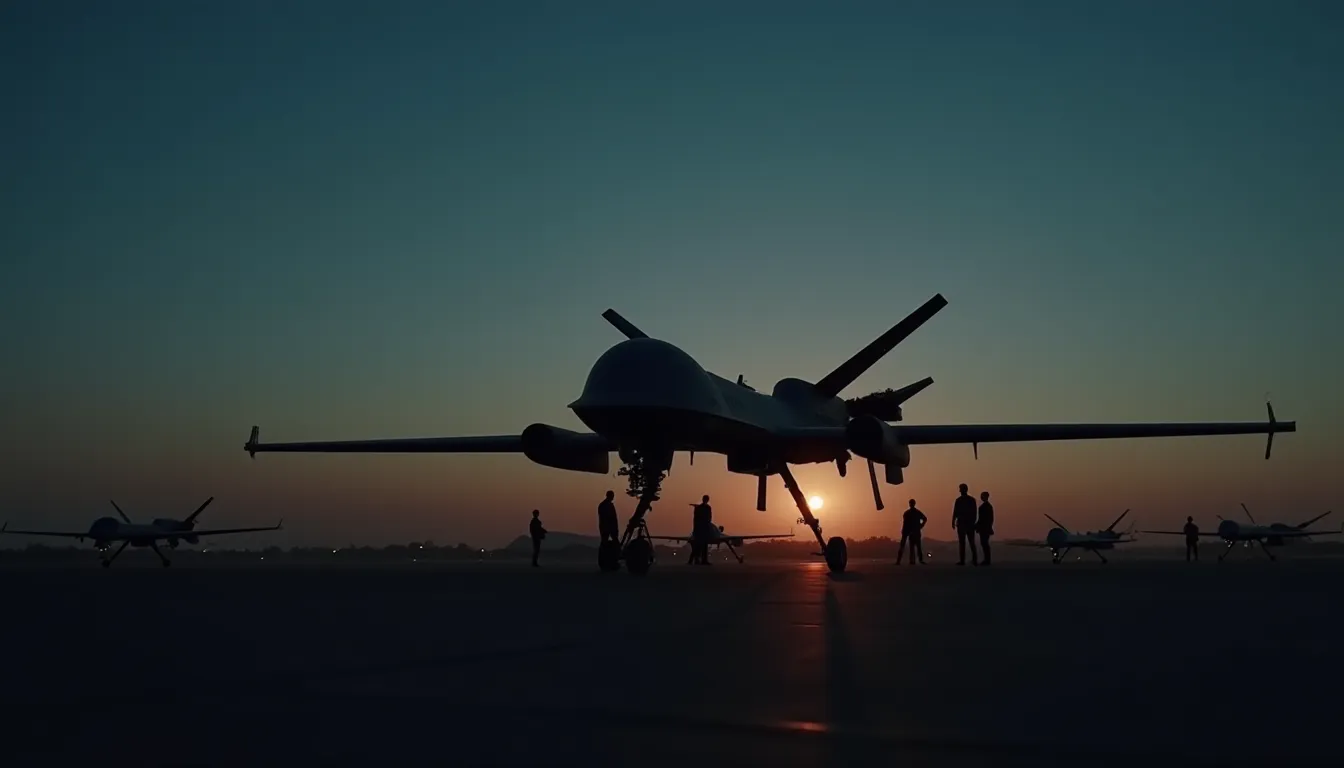
The US Army has achieved sufficient volume of small, one-way attack drones to outfit every squad ahead of its fiscal 2026 deadline, but now faces a critical gap in training qualified operators—particularly for contested electromagnetic spectrum environments where enemies actively jam communications and drone signals.
Key Takeaways
- The US Army has acquired sufficient volume of small attack drones to equip every squad ahead of its fiscal 2026 Drone Dominance deadline, but these systems have not yet reached all units in the field.
- Qualified drone operators trained to squad level remain limited, representing the Army's primary capability gap despite achieving hardware volume targets.
- Contested electromagnetic spectrum operations—where adversaries attempt to jam drone communications—require fundamentally different training than basic device operation, driving the need for interagency coordination with the FAA and allies.
- The Army is conducting real-world spectrum-contested training through exercises like Saber Junction in Germany with Ukrainian and NATO partners, scaling from pilot-level to force-wide proficiency.
- The situation illustrates a persistent defense acquisition challenge: hardware production timelines can be accelerated through competition and streamlined procurement, but doctrine development and operator training require longer timeframes that cannot be compressed proportionally.
The US Army has reached a critical milestone in its Drone Dominance program: sufficient volume of small, one-way attack drones to equip every squad. However, the service now faces a substantial operational challenge—training enough qualified soldiers to operate these systems, particularly in contested electromagnetic spectrum conditions where adversaries actively attempt to jam or disrupt drone and communications equipment.
Col. Gregory Merkl, the Army's Drone Dominance director, acknowledged this gap in an interview about the program's progress. "We do have the volume to do that. A lot of that has been facilitated by [the Pentagon's] Drone Dominance program," Merkl said, noting that "where we still have some work to do, candidly, is getting everybody trained at the appropriate level." He further emphasized that while the capability exists in every platoon, the Army still needs to "get the qualified pilots down to the squad level."
The Volume Achievement and Its Caveats
The Defense Secretary Pete Hegseth launched the Drone Dominance program in 2025 with an explicit mandate: equip every Army squad with small, one-way attack drones by the end of fiscal 2026. The program has accelerated drone production and fielding through what Merkl described as a "gauntlet-style competition" approach, helping the Army achieve the necessary volume ahead of the fiscal 2026 deadline approaching at month's end.
However, Army officials introduced an important clarification to Merkl's initial statements. A service spokesperson explained to Breaking Defense that because such small drones are attritable—consumed or expended in use—the Army will never actually have "enough" of the systems. More significantly, the spokesperson clarified that while the Army has acquired the quantity of drones needed, "these systems have not yet reached every squad across the Army," though they are "moving quickly to achieve that objective with an agile, sustained process for acquisition, fielding, and replacement."
This distinction between acquiring sufficient hardware and actually fielding it to operational units highlights a pattern common in defense acquisition: production timelines often outpace logistics and distribution capabilities. The Army's acknowledgment reflects the practical reality that having drones in inventory is only the first step; getting them into soldiers' hands requires coordinated distribution and integration with existing unit structures.
The Training and Spectrum Challenge
The more urgent challenge, according to Merkl, centers on operator proficiency in contested electromagnetic environments. Merkl stated that the service is "running a whole series of working groups" within Army headquarters and with interagency partners like the Federal Aviation Administration to help soldiers better understand how to "safely use the spectrum."
This interagency coordination reflects the complexity of electromagnetic spectrum management in military operations. Unlike simple device operation training, spectrum-contested operations require soldiers to understand not only how to launch and control drones but also how to detect jamming attempts, adapt to frequency interference, and maintain command-and-control links when adversaries actively attempt disruption. Such training cannot be conducted in garrison or through classroom instruction alone.
To address this gap, the Army is conducting real-world spectrum-contested training at exercises such as Saber Junction in Germany. During the exercise, the 504th Parachute Infantry Regiment, a drone-focused unit, worked with Ukrainian and NATO counterparts to better understand how to operate in a contested spectrum. These multinational exercises provide invaluable operational learning: soldiers gain hands-on experience operating systems against realistic electromagnetic interference while also building interoperability with allied forces who face similar challenges.
Recurring Acquisition-to-Capability Gaps
The Army's situation illustrates a recurring challenge in modern defense acquisition. The Drone Dominance program successfully accelerated hardware procurement—a traditional procurement bottleneck—by cutting through bureaucratic processes. However, acceleration of the manufacturing and acquisition timeline cannot be matched one-to-one by acceleration of doctrine development, training pipeline expansion, and operational proficiency building.
Training qualified operators at squad level requires time investment that cannot be compressed significantly. Each soldier must learn drone operation mechanics, communications protocols, and—critically—how to maintain operational effectiveness when adversaries attempt to disrupt their systems. The NATO and Ukrainian partnerships evident in exercises like Saber Junction suggest the Army recognizes that spectrum-contested drone operations are not yet well-established doctrine, even among allied militaries.
The timeline pressure is real: with the fiscal 2026 deadline imminent, the Army faces pressure to demonstrate that it has met the Pentagon's mandate to equip every squad. Yet Merkl's candid acknowledgment that training remains incomplete suggests that the service is prioritizing honesty about operational gaps over meeting headline timelines. This reflects an important shift in Pentagon leadership communication under Defense Secretary Hegseth's aggressive acquisition approach—the goal is to accelerate effective capability, not merely to accumulate hardware.
Forward Requirements
The training challenge ahead involves scaling beyond current exercise-level proficiency to force-wide competency. The Army's working groups with the FAA and other interagency partners suggest the service is developing systematic approaches to spectrum-safety training. However, moving from pilot exercises to force-wide training will require significant investment in trainer capacity, simulation systems, and dedicated training time.
The contested spectrum challenge is particularly acute because it fundamentally differs from traditional small-unit training. In a GPS-denied, electronically jamming environment, drone operators cannot rely on automated navigation or standard communication protocols. Instead, they must develop adaptive proficiency and understand enemy electronic warfare tactics—a significantly more demanding training requirement than basic device operation. The fact that the Army is already conducting this training in multinational exercises suggests recognition that this capability gap could undermine the Drone Dominance program's broader strategic objective if left unaddressed.
Sources
- Breaking Defense: Army has enough drones for each unit, now it needs to train soldiers to use them
- Breaking Defense: US clears $24B F-35 sale for Saudi Arabia
- Breaking Defense: Army adds $234M in undefinitized contract funding for Black Hawk deal
- Breaking Defense: Northrop eyes munitions supply work, Lockheed eyes funding: CEOs
- Breaking Defense: 'They overreached': Amid industry worry, new Feinberg memo tweaks accounting regime
- MachineHours Encyclopedia: Drone Technology — Autonomous Flight and Its Economic Impact
Frequently Asked Questions
Does the US Army have enough drones for every squad now?
The Army says it has the overall volume of small, one-way attack drones needed to equip every squad, driven by the Pentagon's Drone Dominance program. However, a service spokesperson clarified the systems have not yet reached every squad across the Army, and training enough qualified pilots at the squad level remains a work in progress.
What is the status of the F-35 sale to Saudi Arabia?
The US State Department has cleared a potential sale of up to 48 F-35A jets and 49 F135 engines to Saudi Arabia, valued at up to $24.3 billion. The deal is not final — prices and quantities could change, and it now faces a 30-day congressional review period during which lawmakers could seek to block it.
What is an undefinitized contract action and why did the Army use one for Black Hawk?
An undefinitized contract action (UCA) lets the Pentagon begin production before final pricing and quantities are settled. The Army used a $234 million UCA to fund an initial 16 Black Hawk helicopters from Sikorsky, bringing that contract's value to $356 million, so production could continue without waiting on a fully negotiated deal.
What did the Feinberg memo change for defense contractors?
Deputy Secretary of Defense Stephen Feinberg issued a memo encouraging the Pentagon to accept commercial GAAP accounting standards instead of government Cost Accounting Standards 'to the maximum extent the law permits.' Analysts say it softens an earlier, more aggressive August directive on pricing oversight that had alarmed industry, particularly non-traditional defense firms.
What are Northrop Grumman and Lockheed Martin focused on right now?
Northrop Grumman is seeking to expand its role as a munitions supplier, with active discussions on roughly eight weapons programs, including scaling up PAC-3 solid rocket motor production in negotiations with Lockheed Martin. Lockheed also manufactures the F-35 involved in the proposed Saudi Arabia sale.
Get MachineHours in your inbox
AI compute and the machine economy in your inbox.