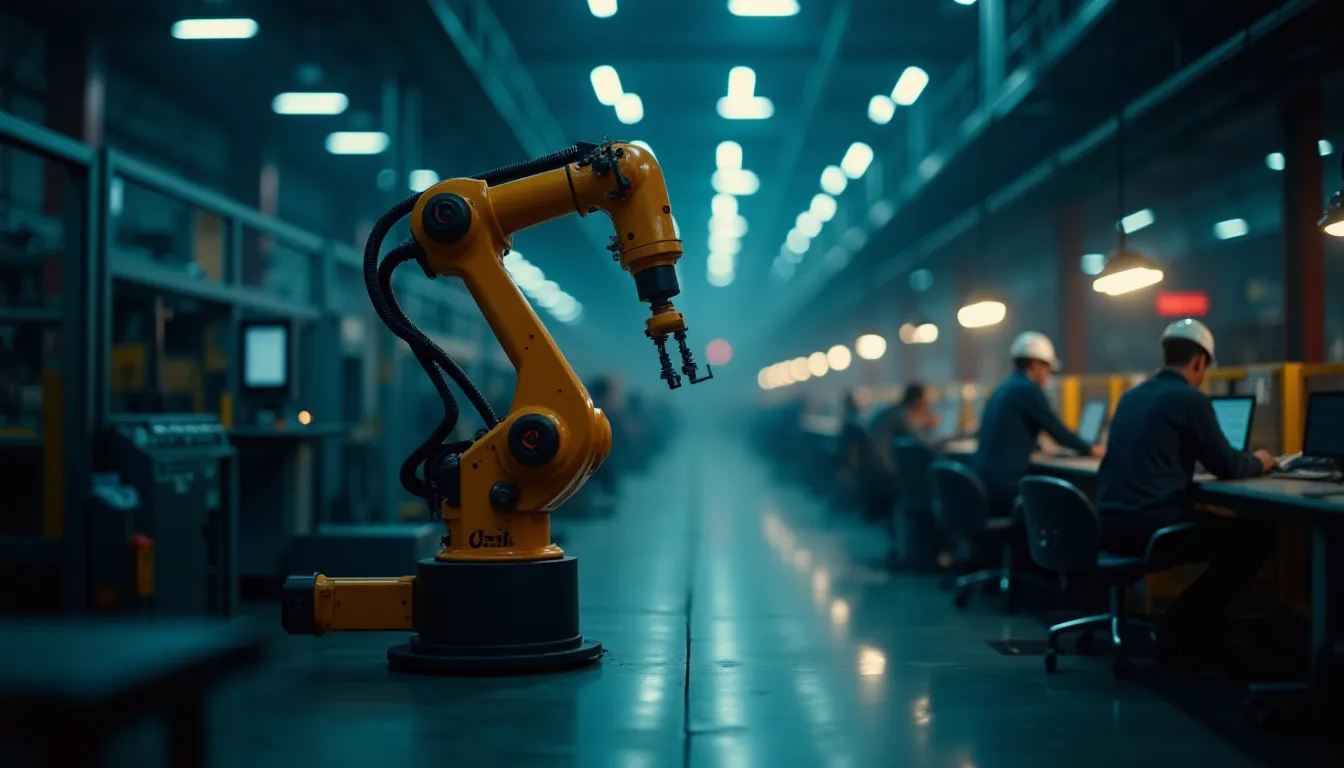
Policymakers and economists are advancing the case for a robot tax to address wealth concentration from automation, with proponents arguing it should fund retraining and income transfers while critics raise concerns about innovation and implementation feasibility.
Key Takeaways
- A robot tax would redirect automation gains to displaced workers through retraining, income transfers, and social safety nets, addressing wealth concentration from AI and robotics
- South Korea reduced automation subsidies in 2017, and the EU has debated similar proposals, though no major economy has implemented a full robot tax at scale
- Defining what qualifies as automation for taxation purposes remains a fundamental challenge, and critics argue reforming broader capital taxation is more effective
- Proponents argue retraining programs alone are insufficient and that structural policies must address how contribution and entitlement are defined in post-labor-growth economies
- Without policy intervention, continued automation risks concentrating economic power in tech companies while increasing unemployment and wage inequality across displaced sectors
Rest of World published a detailed case on September 18 for implementing a robot tax—or automation impact levy—as a structural policy response to wealth concentration from AI and robotics deployment. The proposal frames the tax not as a penalty on innovation but as a mechanism for redirecting economic gains from automation back to workers displaced by it. This policy debate reflects a fundamental shift in how institutions are processing automation's consequences: the conversation has moved from whether displacement will occur to who bears the cost when it does.
The argument for a robot tax rests on what economists describe as a core market failure. When a firm automates, it privatizes savings from reduced wage bills while socializing the costs of unemployment and community decline. A tax on displacement would aim to slow automation to a socially manageable rate and generate revenue to fund transition policies. Experimental evidence supports the mechanistic function of such a tax, showing that it can reduce the probability of worker substitution.
The policy addresses a critical limitation of existing displacement responses. Retraining programs are described as necessary but insufficient responses to systemic displacement, as they place the full burden of adaptation on individuals and often fail to match the velocity of technological change. Proponents argue that structural policies transforming economic relationships—such as safety nets, reduced working hours, or universal basic income—must complement retraining efforts. The revenue from a robot tax could fund these broader social programmes without diverting resources from healthcare and education.
The concept of such a levy has historical precedent, though not in its modern form. Medieval economies featured retraining systems through guild structures, churches, and monasteries, which served as training centers when innovations like the windmill and watermill created demand for skilled workers. However, the argument continues, these innovations did not automatically translate into improved living standards for the majority. The implication is that automation will not distribute its benefits equitably without deliberate policy intervention.
The debate over a robot tax reflects a renegotiation of the social contract in automated economies: if productivity increasingly derives from capital rather than labor, continued reliance on labor-based taxation becomes normatively unstable. This raises fundamental questions about how contribution and entitlement should be defined in a post-labor growth model where machines perform functions historically performed by workers.
Design Challenges and Practical Obstacles
Despite the intellectual case for a robot tax, significant design and philosophical critiques challenge its viability. Defining the taxable unit as "the robot" or "the AI algorithm" is fraught, as automation is often a process of software integration rather than discrete hardware purchase. Tax scholars have argued that a new, targeted robot tax is less effective than reforming broader capital taxation systems, suggesting that its political appeal may stem from behavioral biases more than sound fiscal policy.
An additional governance challenge is the absence of standardized metrics to quantify automation-induced displacement. An effective policy would require firm-level reporting of labor substitution, productivity gains, and capital deepening attributable to automation. Without such accounting frameworks, taxation risks being blunt or easily arbitrated, undermining both efficiency and legitimacy. Critics also contend that taxing automation discourages investment and may harm business growth and new invention.
Real-World Policy Attempts
South Korea offers the closest thing to a real-world test case, though it did not call its approach a robot tax at the time. In 2017, the Moon Jae-in administration quietly scaled back the tax credit companies received for investing in automation equipment: the deduction for large firms fell from 3 percent to 1 percent, for mid-sized firms from 5 percent to 3 percent, while small businesses kept their 7 percent benefit intact. This approach was less a penalty than a withdrawal of a subsidy, which sidestepped the thorny issue of defining the "robot" as a taxable unit.
In Europe, the pathway has been different. The European Parliament's 2017 robot tax proposal was roundly rejected, with many lawmakers feeling that taxing machines would hurt business growth and stop new inventions. No major economy has yet implemented such a measure at scale, leaving the debate largely theoretical but gaining urgency as displacement rates accelerate. However, policymakers have continued to circulate such proposals in both South Korea and the European Union as automation accelerates.
The Broader Policy Imperative
The fear of techno-feudalism—a concentration of economic power in the hands of a few tech giants—is framed as legitimate rather than paranoia. Without appropriate policy interventions, the continued adoption of AI, robots, and automation technologies could lead to higher unemployment and wage inequality. Proponents of the robot tax argue that intervention is necessary to reduce inequality, even though such policies carry electoral risks and face industry opposition.
The case for a robot tax ultimately rests on the premise that AI has the potential to increase current disparities and inequalities and exacerbate environmental issues if not addressed critically. Integrating AI-driven innovation with social ideals emphasizing shared wealth, a just society, and ecological balance is described as a difficult but necessary task. The robot tax debate represents one policy pathway toward achieving this balance, though significant obstacles remain regarding implementation, definition, and political viability.
Sources
- Rest of World: The case for a robot tax to redistribute wealth
- Financial Times: How should investors position for the robot apocalypse?
- Wired: Meet Dyson's New Robot Vacuum Line: The Dyson Nurovi Line (2026)
- Wired: iRobot Promo Code: 15% Off
- Breaking Defense: Rocket engines, helmet displays and ground robots: Last looks from AFA Day 3
- MachineHours Encyclopedia: AI and Wealth Generation — How Artificial Intelligence is Reshaping Who Gets Rich
Frequently Asked Questions
What is a robot tax and how would it work?
A robot tax would levy companies that replace human workers with automated systems. Revenue would fund retraining programmes or direct income transfers to displaced workers. No major economy has implemented one at scale yet.
How are investors positioning for automation-driven job displacement?
According to the Financial Times, investors are evaluating positions in robotics hardware, AI software platforms, logistics automation, and retraining or education technology firms that may benefit from displaced-worker programmes.
Why is the robot tax debate gaining urgency now?
The debate reflects a shift from asking whether automation displacement will happen to assuming it is already underway and asking who bears the cost. Policy and investment communities are now treating it as a structural, not temporary, economic shift.
What is Dyson's Nurovi line?
The Dyson Nurovi is a new robot vacuum product line unveiled in September 2026, covered by Wired, representing Dyson's latest push in the household automation market.
Which countries are closest to introducing a robot tax?
Rest of World's analysis points to South Korea and the European Union as the jurisdictions where robot tax proposals have been most formally debated, though neither has enacted legislation as of September 2026.
Get MachineHours in your inbox
AI compute and the machine economy in your inbox.