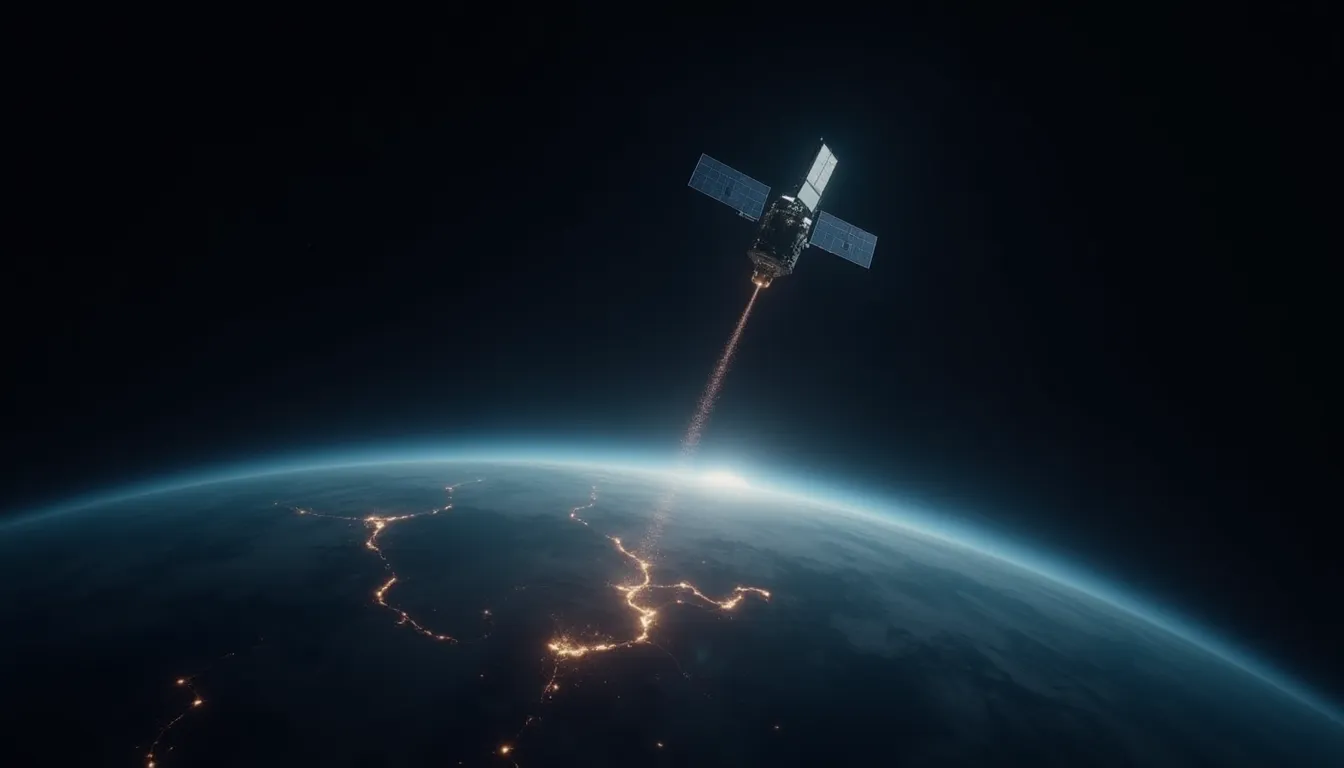
The Space Force has formally disclosed its Resilient Radar System-Ground (RRS-G) program and named Northrop Grumman as prime contractor, with plans to launch the space-based ground moving target indicator constellation by 2028. The announcement signals the military's shift toward orbital surveillance infrastructure for persistent tracking of mobile ground threats in contested environments.
Key Takeaways
- Space Force officially disclosed the Resilient Radar System-Ground (RRS-G) program and named Northrop Grumman as prime contractor, planning initial launches in 2028 to establish persistent space-based ground surveillance capability.
- The RRS-G constellation aims to accelerate target detection and engagement timelines in contested environments by shifting ground moving target indicator capability from vulnerable airborne platforms to orbit.
- The Space Force established the 77th Surveillance Squadron as its first dedicated space-based sensing and tracking unit to operationalize GMTI missions from the RRS-G constellation before system deployment.
- RRS-G is backed by $1.02 billion in fiscal 2027 baseline procurement funding plus $1.1 billion in combined baseline and reconciliation R&D funding, reflecting program priority in military space acquisitions.
- The program is being developed in partnership with the National Reconnaissance Office and operates in parallel with a separate AMTI (airborne moving target indicator) constellation, both targeting 2028 operational readiness.
The Space Force has formally disclosed the name and industrial prime contractor for its space-based ground surveillance program. According to Breaking Defense, Space Force Lt. Gen. Gregory Gagnon revealed at the Air & Space Forces Association conference that the program is called the Resilient Radar System-Ground, or RRS-G, and will be built by Northrop Grumman, with initial launches planned for 2028. The disclosure marks a concrete step toward deploying space-based radar infrastructure capable of detecting, tracking, and imaging ground and maritime targets from orbit—a capability long sought by the Pentagon but never before operationalized at scale.
\n\nThe RRS-G Program and Northrop's Role
\n\nGagnon, commander of the Space Force's Combat Forces Command, stated that the RRS-G constellation will launch "in the next two years," placing initial operational capability in 2028. A Space Force spokesperson confirmed to Breaking Defense that the program "focuses on achieving target detection, custody, and sensor-to-shooter timelines necessary for dynamic targeting and long-range strike within highly contested and non-permissive environments."
\n\nNorthrop Grumman issued a brief statement affirming its commitment to the mission. The company stated: "We have a deep, operational understanding of the threats our warfighters face and are focused on delivering capability at the speed and scale required to stay ahead of them." The company's selection as prime contractor reflects its extensive heritage in advanced radar systems and satellite design, positioning Northrop to lead the technical development and integration challenges inherent in a space-based GMTI constellation.
\n\nBudget and Institutional Alignment
\n\nThe Space Force's fiscal 2027 baseline budget request includes $1.02 billion for GMTI procurement, with an additional request of roughly $1.1 billion in combined baseline and reconciliation funding under a separate research and development effort. This substantial commitment underscores the program's priority within the service's acquisition strategy.
\n\nTo operationalize the GMTI mission, the Space Force last month established its first "space-based sensing and tracking unit," the 77th Surveillance Squadron, specifically to manage ground moving target indicator operations from the RRS-G constellation. This organizational move signals institutional readiness to transition from development and testing into operational employment. The establishment of a dedicated operational unit before the system reaches orbit is unusual and reflects confidence in the program's timeline and design maturity.
\n\nThe Space Force has partnered with the National Reconnaissance Office (NRO) for the GMTI mission, a collaboration that ensures intelligence community equities are integrated into system design and operational planning. Gen. Stephen Whiting, commander of US Space Command, stated that he met with NRO officials to coordinate on moving target indicator operations in both air and ground domains, and indicated that concepts of operations are being developed "in partnership with the other combatant commands and elements of the intelligence community that have equities there."
\n\nShift from Airborne to Space-Based Surveillance
\n\nThe move to space-based GMTI represents a fundamental transition in how the U.S. military approaches persistent ground target tracking. Currently, ground targets are primarily tracked by sensors aboard manned and unmanned aircraft. This airborne approach has several inherent constraints: aircraft are expensive to operate, vulnerable in contested airspace where adversaries possess air defense systems, and limited in persistence due to fuel and crew endurance. A space-based radar constellation would overcome these limitations by providing constant surveillance coverage that is not dependent on aircraft availability, pilot safety, or airspace access.
\n\nThe technical demand of space-based GMTI is substantial. Ground moving target indicator radar must detect small, moving objects against a complex background of stationary terrain, vegetation, buildings, and sea clutter. Historical systems performing this task, such as the Air Force's E-8 Joint STARS aircraft (retired in 2019), required large radar apertures and sophisticated signal processing. Adapting this capability to satellite platforms demands significant innovation in miniaturization, power efficiency, and onboard data processing. The RRS-G program aims to address these challenges through advanced radar design and potentially onboard artificial intelligence to filter and prioritize target detections before downlinking data to ground control stations.
\n\nOperational Implications and Kill Chain Closure
\n\nThe strategic significance of space-based GMTI lies in its potential to accelerate the targeting cycle in contested environments. In modern military doctrine, the sequence of detecting a target, determining its location and intent, and deciding whether to engage—known as the find-fix-finish kill chain—must occur at increasing speed to outpace adversary movement and countermeasures. The Space Force GMTI program explicitly targets "sensor-to-shooter timelines necessary for dynamic targeting and long-range strike within highly contested and non-permissive environments."
\n\nPersistent space-based radar would enable continuous monitoring of known or suspected target areas without gaps caused by aircraft transition times or weather delays. When a moving target is detected—such as a mobile air defense system, armored vehicle column, or maritime target—the system could relay coordinates and tracking data in near-real time to strike platforms, whether manned fighters, unmanned aircraft, or ground-based and sea-based missiles. This acceleration of the kill chain is particularly valuable in scenarios where adversaries possess the capability to relocate quickly or defend against traditional air operations.
\n\nParallel Programs and Broader Strategy
\n\nThe RRS-G program is one component of a broader Space Force effort to establish multiple layers of space-based surveillance. The Space Force is working in parallel to develop satellites for airborne target tracking, known as AMTI, with the first AMTI satellite launching this month and an initial constellation planned by 2028. A multibillion-dollar award was made to SpaceX in May for the AMTI mission. This dual-constellation approach—tracking both ground and airborne moving targets from space—represents a comprehensive transformation of U.S. military surveillance architecture.
\n\nThe Space Force's fiscal 2027 budget request for the AMTI mission includes over $7 billion in reconciliation funds, indicating that airborne moving target indicator is receiving substantial investment parallel to the ground-focused RRS-G program. Both efforts aim for 2028 operational capability, a compressed timeline that reflects urgency within military leadership to close persistent surveillance gaps in contested environments.
\n\nIndustry Momentum and Acquisition Path
\n\nThe public disclosure of the RRS-G program name and Northrop Grumman's role as prime contractor accelerates program momentum and clarifies the acquisition path for industry partners and allied nations. Naming the program and contractor signals that the Space Force has moved beyond conceptual planning into committed acquisition and production. This transparency also allows supporting contractors—those supplying components for the radar, spacecraft bus, launch systems, and ground infrastructure—to align their development efforts with the program's established timeline.
\n\nNorthrop Grumman's selection reflects its technical depth in advanced radar systems, space platforms, and integration of complex sensor-to-shooter architectures. The company's experience with programs such as the advanced airborne sensors and large satellite systems positions it to address the novel challenges of translating proven ground-based and airborne GMTI principles to an orbital constellation operating in the harsh radiation and thermal environment of space.
\nSpace Force GMTI Satellite Program Gets Official Name, Northrop Grumman PrimeSources
- Breaking Defense: Space Force's GMTI program gets a name, with Northrop as prime: General
- Breaking Defense: Chairman Caine talks cislunar ops, plus a window into next-gen airlift
- SpaceNews: Catalyst Campus selects Focus Area Cohort Teams for Cohort 26.A
- Breaking Defense: Nammo CEO warns European rupture with US risks 10-year capability gap
- Breaking Defense: Closing the Navy's find, fix, and finish kill chain with remote mine hunting
- MachineHours Encyclopedia: Von Neumann Architecture — The Blueprint of Every Computer
Frequently Asked Questions
What is the Space Force GMTI program?
It is a Space Force program to deploy ground moving target indicator capability from orbit, allowing persistent tracking of mobile ground threats. Northrop Grumman has been confirmed as the prime contractor.
Why does cislunar space matter militarily?
The cislunar region between Earth and the Moon has no established rules of engagement or traffic management. As more nations operate there, it is attracting serious US military planning attention as a future operational domain.
What gap did the Nammo CEO warn about?
Nammo CEO Morten Brandtzaeg warned that a decisive rupture in US-European defence cooperation could produce a 10-year capability gap for European forces, particularly in propulsion and air defence supply chains.
What is the BMC3I TAP Lab cohort programme?
It is an accelerator run by Catalyst Campus for Technology and Innovation that selects early-stage dual-use technology companies focused on battle management, command, control, communications, and intelligence, feeding them into defence acquisition channels.
Get MachineHours in your inbox
AI compute and the machine economy in your inbox.