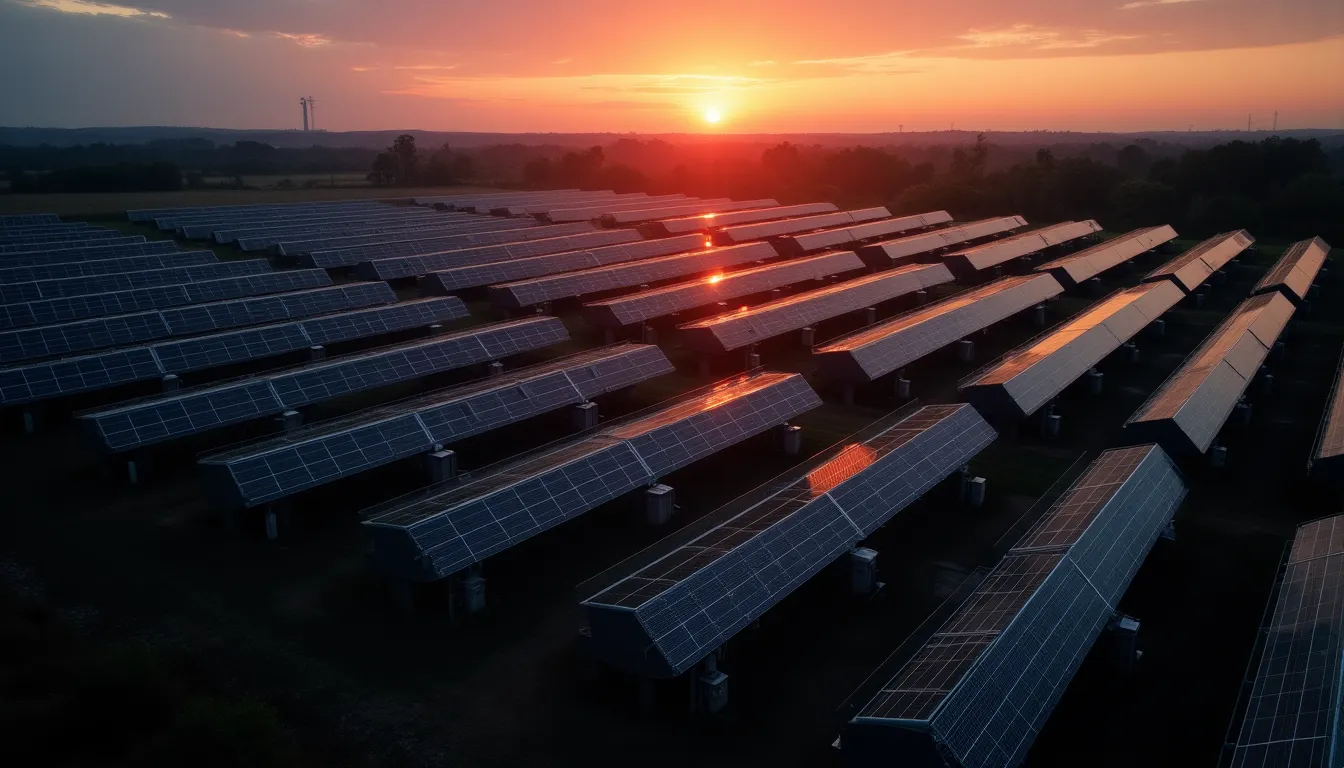
China's installed solar capacity has overtaken coal for the first time, though coal still dominates electricity generation. Simultaneously, UK solar hit a summer record and global solar-plus-storage deployments are accelerating.
Key Takeaways
- China's installed solar capacity has exceeded coal capacity for the first time, though coal still generates more actual electricity daily.
- UK solar power hit a summer 2026 record high, according to Carbon Brief, reflecting both expanded installations and favourable weather.
- Europe's summer heat and drought caused significant crop yield reductions across major agricultural regions, Carbon Brief reported.
- Global solar-plus-storage deployments are accelerating, with co-located battery systems increasingly essential for grid stability.
- The US Army is pursuing nuclear microreactor deployment on domestic bases to ensure energy resilience independent of the commercial grid.
China's installed solar capacity has exceeded coal for the first time in history, according to Canary Media - a milestone in the world's largest energy market, even as coal continues to generate far more actual electricity on a daily basis. The gap between installed capacity and real-world generation underscores how much further the global energy transition still has to run.
What Happened
Canary Media's September 4 analysis reported that China's solar installed capacity has crossed the threshold of coal capacity, though the source emphasizes significant caveats about what this milestone means in practice., a landmark development in Minor overstatement; the source confirms China's scale in both but does not use the exact framing 'largest consumer of both.'. The nuance, however, is significant: coal still produces the majority of China's electricity because solar panels generate power only during daylight hours and are subject to weather variability. Capacity figures measure peak potential, not actual output, meaning coal's grip on China's electricity generation remains firm despite losing the installed-capacity race to solar.
Across the Atlantic, Carbon Brief reported that UK solar power reached a record high over the summer of 2026, reflecting both expanding panel installations and the extended sunny periods that characterised the season. The UK record adds to a growing body of evidence that solar is rapidly maturing as a primary grid resource across diverse climates, not just sun-belt regions.
The same summer that boosted solar output across Europe also brought damaging heat and drought conditions. Carbon Brief published a separate six-chart analysis showing significant crop yield reductions across European agricultural regions, with grain and vegetable harvests among the hardest hit. The juxtaposition is sharp: the same weather systems that set solar generation records are compressing food supply chains and driving up commodity prices.
On the storage front, Canary Media also reported that solar-plus-storage deployments are experiencing a global growth spurt, with paired battery systems being commissioned at scale across the United States, Asia, and Europe. The combination addresses solar's core limitation - intermittency - by allowing generators to hold surplus daytime power for dispatch during evening peak demand. For grid operators, co-located battery systems are increasingly the difference between a solar installation that supports grid stability and one that destabilises it.
On the defence energy side, Breaking Defense reported that the US Army is actively pursuing deployment of nuclear microreactors on domestic bases, citing energy resilience and independence from commercial grid vulnerabilities as primary drivers. The programme reflects a broader recognition within the US military that reliable, on-site power generation is a strategic asset, particularly as grid infrastructure faces growing cyber and physical threats.
Why It Matters
The China solar milestone is symbolically significant, but the gap between installed capacity and actual generation is the story that matters most for energy planners. Solar's rapid capacity build-out globally is producing a structural challenge: without sufficient storage, surplus midday solar power is often curtailed or sold at near-zero prices, while fossil fuels are called on to cover evening demand. The global surge in solar-plus-storage, as Canary Media documents, is the industry's direct answer to that problem. As grid-scale battery costs continue to fall - a trend covered in depth in the MachineHours encyclopedia entry on Grid-Scale Battery Storage - the economics of pairing generation with storage are improving rapidly.
For the AI industry specifically, these shifts carry direct implications. Data centres require uninterrupted, high-quality power around the clock - exactly the kind of supply that solar alone cannot guarantee. Investors and operators tracking how hyperscalers structure their energy supply chains can find detailed commodity and energy market analysis at WealthWatchPro. The Army's microreactor push signals that even outside the commercial sector, organisations dependent on firm power are looking beyond the grid.
Background
Small modular reactors and microreactors represent one proposed solution to the firm-power gap that solar and wind cannot fill on their own. The MachineHours encyclopedia entry on Small Modular Reactors - How SMRs Could Power the AI Economy details how factory-built, standardised nuclear units are being positioned as baseload complements to variable renewables, particularly for energy-intensive facilities like AI data centres and semiconductor fabs. The Army's microreactor programme sits within this broader push toward modular, distributed nuclear generation.
The economics of power purchase agreements also shape how large energy consumers navigate this environment. Hyperscalers have been locking in long-term solar and wind contracts at scale, a dynamic explored in the encyclopedia entry on Power Purchase Agreements - How Hyperscalers Source Clean Energy for AI, though the intermittency challenge means those agreements increasingly need paired storage or firm-power backstops to satisfy 24/7 operational requirements.
What to Watch
The pace of solar-plus-storage commissioning over the next 12 months will be a critical indicator of whether the generation-storage gap is closing fast enough to reduce coal's share of actual electricity output in markets like China. Regulators in the EU will also be watching crop yield data closely heading into autumn 2026, with food security concerns potentially influencing energy and agricultural policy simultaneously. On the nuclear side, the timeline for the Army's first microreactor deployment will signal how quickly the US military-industrial base can deliver on modular nuclear ambitions. Any delays will have implications for the commercial SMR sector, which is watching defence programmes as a proving ground for the technology.
- SMRs are designed to produce up to 300 megawatts of electrical output per unit, compared to 1,000 MW or more for conventional nuclear plants.
- Factory fabrication of SMR components is intended to reduce on-site construction time and lower capital costs relative to traditional nuclear builds.
- Microreactors - a subset of SMRs - typically produce under 10 MW and are designed for remote or off-grid deployment, including military installations.
- Several SMR designs are currently in regulatory review in the United States, Canada, and the United Kingdom as of 2026.
Sources
- Canary Media: Solar is now bigger than coal in China — and yet still way behind
- Carbon Brief: Analysis: UK solar power hits record high over summer 2026
- Carbon Brief: How this summer's heat and drought impacted crops in Europe – in six charts
- Canary Media: Solar-plus-storage is having a global growth spurt
- Breaking Defense: Why the Army wants to deploy nuclear microreactors on US bases
- MachineHours Encyclopedia: Small Modular Reactors — How SMRs Could Power the AI Economy
- MachineHours Encyclopedia: Grid-Scale Battery Storage — Technologies, Costs, and the Energy Transition
- MachineHours Encyclopedia: Power Purchase Agreements — How Hyperscalers Source Clean Energy for AI
Frequently Asked Questions
Has solar actually beaten coal in China?
China's installed solar capacity has surpassed coal capacity, but coal still generates far more electricity daily. Capacity measures peak potential, not actual output, so coal remains dominant in real generation terms.
Why is solar-plus-storage growing so fast globally?
Pairing solar panels with battery storage addresses solar's core limitation - it only generates power during daylight. Co-located batteries store surplus daytime energy for dispatch during evening peak demand, making solar a more reliable grid resource.
Why does the US Army want nuclear microreactors on its bases?
According to Breaking Defense, the Army cites energy resilience and independence from commercial grid vulnerabilities as the primary drivers, treating on-site firm power generation as a strategic asset against cyber and physical threats.
How did Europe's summer 2026 heat affect food supply?
Carbon Brief's six-chart analysis showed significant crop yield reductions across European agricultural regions, with grain and vegetable harvests among the hardest hit by the combination of heat and drought conditions.
What does solar growth mean for AI data centre power needs?
Data centres require uninterrupted 24/7 power that solar alone cannot guarantee. The growth of solar-plus-storage and interest in microreactors reflects efforts to pair variable renewables with firm power sources capable of meeting constant load demands.
Get MachineHours in your inbox
AI compute and the machine economy in your inbox.