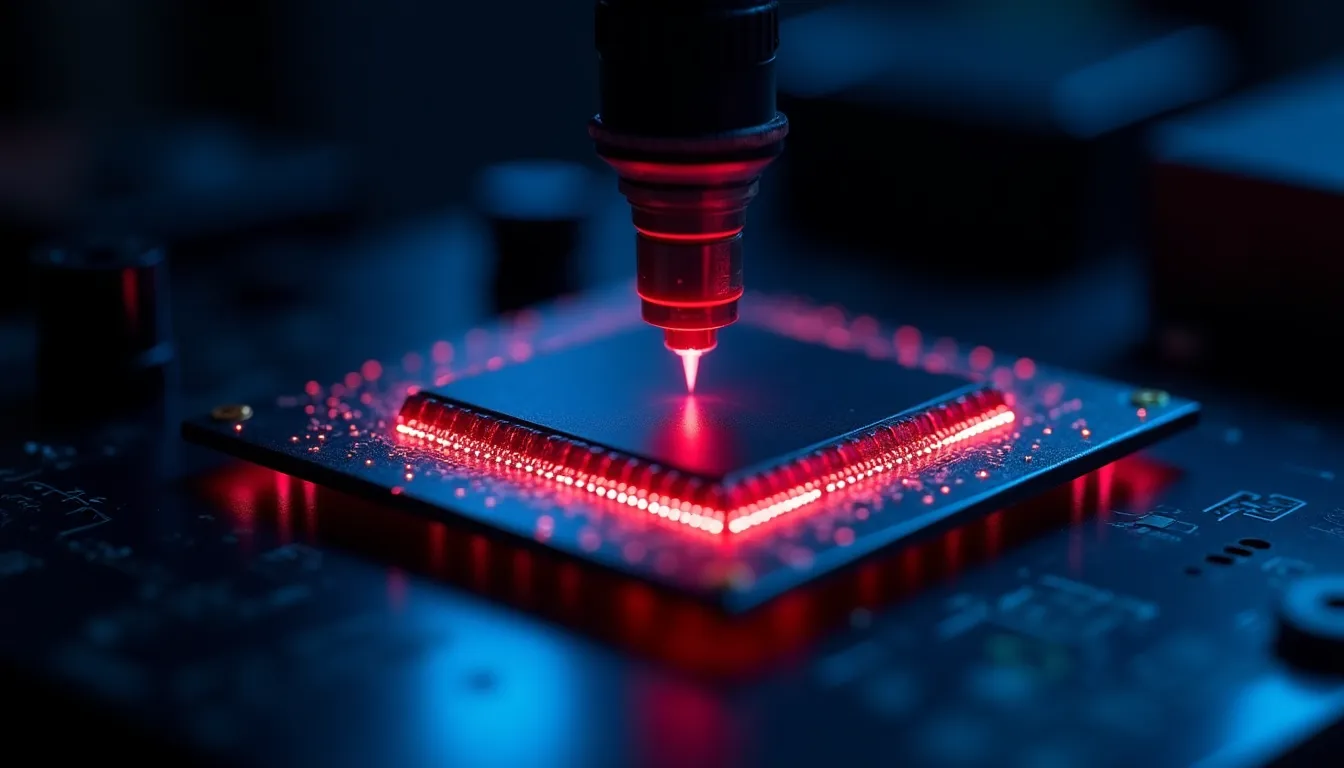
Quandela, the French photonic quantum computing company, has designated South Korea as its primary Asian manufacturing and hardware research hub for photonic quantum processing units, establishing semiconductor-level fabrication capabilities and forming an industrial consortium with major South Korean tech firms.
Key Takeaways
- Quandela established South Korea as its primary Asian hub for photonic quantum processor manufacturing and R&D, involving Samsung Electronics, SK hynix, and LG Innotek in an industrial consortium for mass production scaling
- KAIST and KRIBB research institutions are integrating Korean-fabricated electronic control modules into Quandela systems, establishing a cross-border supply chain for fault-tolerant quantum computing
- Seoul Metropolitan Government committed ₩80 billion in support, with Quandela Korea expanding from 3 to 10 systems engineers by 2027, signaling permanent infrastructure rather than pilot operations
- Quandela achieved millisecond-scale GPU-to-QPU communication latency with NVIDIA collaboration, enabling practical hybrid quantum-classical workflows essential for near-term enterprise applications
- Photonic QPUs operate at room temperature compared to superconducting circuits, and South Korea's semiconductor expertise addresses the manufacturing bottleneck limiting photonic quantum computing's commercial deployment
Quandela has unveiled a strategic framework establishing South Korea as its primary Asian hub for quantum processor manufacturing, system integration, and collaborative research and development. Announced in Seoul on September 29, 2026, the initiative positions the French photonic quantum computing manufacturer to localize hardware production outside Europe, marking a significant geographic expansion for one of the few companies scaling photonic qubits commercially.
Manufacturing Strategy and Industrial Consortium
The South Korea hub targets semiconductor-level fabrication of integrated photonic quantum processing unit (QPU) modules, component co-development, and hybrid high-performance computing software integration. The manufacturing strategy seeks to form an industrial consortium involving South Korean semiconductor foundries—such as Samsung Electronics and SK hynix—and optoelectronic system integrators including LG Innotek to scale mass production of photonic control chips and optical component packaging.
This consortium approach reflects a deliberate effort to leverage South Korea's existing semiconductor and optoelectronics capabilities rather than building manufacturing infrastructure from scratch. By integrating with established players in chip fabrication and optical systems, Quandela can accelerate the path from prototype to production-scale photonic QPU units, a critical challenge for photonic quantum computing which requires precision integration of optical components at scales beyond traditional research laboratory settings.
Intellectual Property Framework and Partner Roles
Under the proposed intellectual property framework, pre-existing IP remains with individual partners, while co-developed manufacturing protocols and integrated optical modules will be shared based on institutional contributions. This structure creates incentives for long-term collaboration while protecting each party's proprietary technology—a practical necessity in a complex supply chain involving competing semiconductor manufacturers.
Several South Korean research institutions are already engaged in the initiative. KAIST's Son Young-ik Research Group is focused on optical component and electronic control co-design, with the technical scope involving integrating Korean-developed electronic control modules directly into Quandela QPU chassis in Paris. This cross-border supply chain arrangement means South Korean engineers will be fabricating critical components that ship to France for final system assembly, establishing sustained employment and technical infrastructure development in South Korea.
KRIBB, South Korea's Bio-Research Institute, is contributing to photonic QPU molecular simulation, focusing on proof-of-concept quantum molecular modeling for drug discovery and algorithmic validation. This partnership establishes an application-specific use case for Quandela's systems before they reach commercial maturity—testing photonic QPUs on realistic chemistry problems rather than abstract benchmarks.
Geographic Expansion and Regional Capacity Building
The Seoul Metropolitan Government has aligned ₩80 billion (approximately $60–65 million) in support toward establishing a regional QPU cluster and supply chain hub, with expansion of the local Quandela Korea subsidiary from 3 to 10 systems engineers by 2027. This commitment of government capital and the planned three-fold expansion of local engineering staff signals serious intent from both Quandela and Seoul authorities to establish permanent, scalable infrastructure rather than a temporary pilot program.
The move represents a strategic pivot from Quandela's North American operations, which operate through Quandela Federal, a defense subsidiary. By establishing a distinct civilian manufacturing hub in South Korea, Quandela separates commercial quantum computing development from defense-focused work, allowing the company to pursue enterprise customers in Asia without navigating overlapping regulatory frameworks.
Hybrid Computing Integration with NVIDIA
Collaborating with NVIDIA, Quandela reduced GPU-to-QPU communication latency to the millisecond regime, enabling high-speed hybrid error mitigation and job execution across HPC supercomputing clusters such as the 12-qubit Lucy processor deployed at France's TGCC facility. This technical achievement is significant because near-term quantum computing utility depends heavily on hybrid classical-quantum workflows where classical GPUs handle error correction and data preprocessing while QPUs execute quantum-specific subroutines.
Reducing latency from tens of seconds to milliseconds makes hybrid quantum-classical algorithms practical for time-sensitive enterprise applications. The technical integration also strengthens Quandela's positioning relative to other quantum hardware approaches, as photonic systems can in principle operate at room temperature, avoiding the extreme cooling requirements of superconducting circuits and reducing operational costs once manufacturing scales.
Photonic QPU Technology and Competitive Positioning
Photonic quantum computing, the approach Quandela pursues, is one of four major hardware paths alongside superconducting circuits, trapped ions, and topological qubits. Photonic systems use light particles as qubits and can in principle operate at room temperature, avoiding the extreme cooling superconducting circuits require, though they face their own challenges in achieving reliable qubit interactions at scale.
The South Korea facility addresses one of these core challenges: reliable manufacturing of integrated photonic components at volumes large enough to produce commercial systems. Photonic QPUs require precision optical alignment and component integration that demands semiconductor-grade fabrication processes. By anchoring production capacity in South Korea—a nation with world-leading expertise in both semiconductor and optical component manufacturing—Quandela positions itself to overcome the engineering bottleneck that has historically limited photonic quantum computing's commercial deployment.
Industry Implications
Quandela's decision to establish Asia-based manufacturing capacity reflects a broader industry trend toward geographic diversification of quantum hardware production. As quantum computing transitions from pure research toward commercial deployment, companies are moving beyond centralized fabrication in Europe or North America to localize production where they can access specialized supply chains, government support, and regional customer bases simultaneously. The South Korea initiative demonstrates that photonic quantum computing is advancing toward commercially viable manufacturing rather than remaining confined to academic laboratories.
Sources
- Quantum Computing Report: Quandela Establishes South Korea as Asian Hub for Photonic QPU Manufacturing and Hardware R&D
- Quantum Computing Report: Pasqal Restructures French Government Collaboration and Secures EIC Recognition Following Nasdaq Debut
- The Quantum Insider: Infleqtion and Riverlane Partner on Quantum Error Correction
- The Quantum Insider: Royal Bank of Canada Expands Quantum Strategy With New Director and University Partnerships
- Quantum Computing Report: KIST Delegation at Quantum World Congress 2026 Advances Korean Quantum Startup Ecosystem and U.S. Market Entry
- MachineHours Encyclopedia: Quantum Hardware — Superconducting, Trapped Ion, Photonic and Topological Approaches Compared
Frequently Asked Questions
Why did Quandela choose South Korea for its manufacturing hub?
Quantum Computing Report did not detail the specific reasons, but the move coincides with a KIST delegation actively promoting Korea's quantum startup ecosystem, suggesting coordinated national interest in attracting hardware manufacturing.
What changed for Pasqal after its Nasdaq debut?
According to Quantum Computing Report, Pasqal restructured its collaboration with the French government and secured recognition from the European Innovation Council following the listing.
What does the Infleqtion-Riverlane partnership focus on?
The Quantum Insider reported the partnership targets quantum error correction, a key technical requirement for building fault-tolerant quantum computers.
Why is Royal Bank of Canada investing in quantum computing?
RBC expanded its quantum strategy with a new director and university partnerships, reflecting financial sector interest in quantum applications for portfolio optimization and risk modeling, per The Quantum Insider.
How does photonic quantum computing differ from other approaches?
Photonic systems use light particles as qubits and can operate without the extreme cooling superconducting circuits need, though they face distinct scaling challenges, as outlined in MachineHours' quantum hardware background entry.
Get MachineHours in your inbox
AI compute and the machine economy in your inbox.