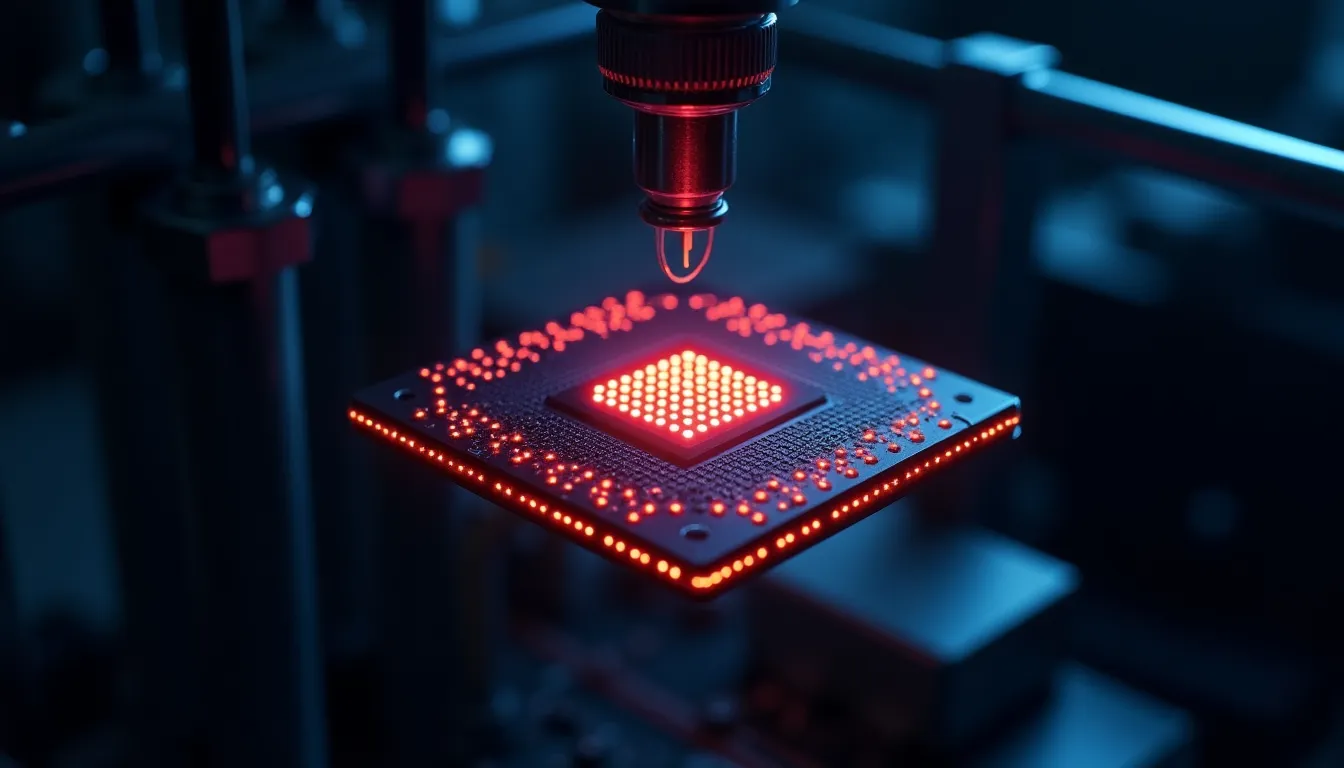
PsiQuantum has finalised a $100 million award from the US Department of Commerce to advance its photonic quantum computing research and development programme. The award reflects growing federal recognition that photonic approaches to quantum hardware merit direct government backing alongside competing superconducting and trapped-ion architectures, and signals accelerating investment in quantum inf
Key Takeaways
- PsiQuantum finalised a $100 million award from the US Department of Commerce to advance its photonic quantum computing research programme, reflecting federal strategic backing for room-temperature quantum approaches compatible with existing semiconductor fabrication.
- The federal award is driven by national security concerns over quantum computing's eventual threat to RSA and elliptic-curve cryptography standards, which protect government, military, and commercial communications.
- Photonic quantum systems operate at room temperature and leverage existing semiconductor foundry infrastructure, offering potential cost and scalability advantages over superconducting systems requiring cooling near absolute zero.
- The US government's diversified portfolio approach—funding multiple competing quantum hardware architectures—reduces risk that any single technological pathway will fail to achieve fault-tolerant quantum computing at scale.
- Post-quantum cryptography migration deadlines established by NIST in 2024 create urgency around quantum hardware development and accelerate investment timelines across the sector.
PsiQuantum has finalised a $100 million award with the US Department of Commerce, marking a significant federal commitment to photonic quantum computing research. The award was announced on September 8, 2026, and positions the company to advance its research and development programme with direct government backing. The announcement underscores Washington's strategic view that photonic approaches deserve funding alongside superconducting and trapped-ion rival architectures in the race toward scalable quantum computing.
PsiQuantum's Photonic Approach and Strategic Positioning
PsiQuantum pursues a photonic qubit architecture and has long argued that fault-tolerant quantum computing at scale requires manufacturing techniques compatible with existing semiconductor chip foundries. Unlike superconducting qubits, which must operate near absolute zero (typically below 15 millikelvin), photonic quantum systems can operate at room temperature. This operational advantage aligns naturally with established semiconductor fabrication infrastructure, potentially offering a pathway to cost-effective manufacturing at scale.
The company's technical strategy centers on leveraging existing foundry capabilities rather than developing entirely novel manufacturing processes. This approach contrasts with other quantum hardware platforms that have required custom, specialized production environments. By positioning photonic systems as compatible with conventional chip manufacturing, PsiQuantum has made a compelling case for federal support based on manufacturability and infrastructure leverage.
Federal Investment and Cryptographic Security
The Commerce Department award is particularly significant from a national security standpoint. Governments acquiring or funding quantum hardware are motivated in part by the threat that sufficiently capable quantum computers will eventually break widely used public-key cryptographic standards, including RSA and elliptic-curve cryptography. The US Department of Commerce award reflects a recognition that the timeline to cryptographically relevant quantum computing, while still uncertain, is no longer purely theoretical.
This federal backing indicates that US policy makers view the development of quantum hardware as a strategic imperative tied directly to cybersecurity resilience. As quantum computing capabilities advance, the existing encryption standards that protect government, military, and commercial communications become vulnerable. By funding multiple competing hardware approaches—including PsiQuantum's photonic pathway—the Commerce Department is hedging its bets on which architecture will first achieve fault-tolerant quantum computing at scale. The diversified portfolio approach reduces the risk that an exclusive bet on a single technological pathway will fail to deliver results.
Quantum Hardware Landscape and Competing Approaches
Quantum hardware today spans four main technical approaches: superconducting circuits, trapped ions, photonic systems, and topological qubits. Each involves distinct trade-offs in qubit coherence time, gate speed, operating temperature, and scalability. Trapped-ion systems offer high gate fidelity but slower operation speeds compared to superconducting qubits. Photonic approaches, as pursued by PsiQuantum, operate at room temperature and are compatible with existing semiconductor fabrication, but face challenges in deterministic photon-photon interactions—a critical technical hurdle that the $100 million award will help address.
Superconducting qubits, pursued by companies including IBM and Google, require cooling to near absolute zero but enable faster gate operations. The diversity of these approaches reflects genuine uncertainty in the quantum computing field about which pathway will prove most practical for achieving error-corrected, fault-tolerant quantum computing. No single architecture has yet demonstrated clear superiority across all relevant metrics. Federal funding distributed across multiple approaches acknowledges this uncertainty and supports a broader ecosystem rather than backing a single technological horse.
Manufacturing Scale and Foundry Partnerships
The integration of quantum hardware development with semiconductor foundry capabilities represents a critical shift in how quantum devices are being manufactured. The classical semiconductor industry achieved its current scale and cost-efficiency through contract manufacturing models pioneered by foundries like TSMC. As quantum hardware moves from laboratory demonstrations toward production systems, the same logic is beginning to apply. Established foundries possess expertise in yield optimization, process control, and volume manufacturing that can dramatically accelerate the transition from prototype to commercially viable quantum systems.
PsiQuantum's strategy of designing systems compatible with existing foundry processes offers a direct pathway to leverage this industrial infrastructure. Rather than requiring quantum hardware companies to build and maintain custom fabrication plants, photonic approaches can ride the coattails of the semiconductor industry's existing manufacturing ecosystem. This economics-of-scale argument has clearly resonated with federal decision-makers evaluating which quantum approaches merit large-scale investment.
Policy Context and Post-Quantum Cryptography Standards
The Commerce Department award operates within a specific policy framework. Post-quantum cryptography standards finalised by NIST in 2024 provide the policy backdrop for much of this activity: governments and enterprises are now under pressure to migrate cryptographic infrastructure before quantum capabilities reach the threshold that makes current encryption vulnerable. This cryptographic migration timeline creates urgency around quantum hardware development. If quantum computers capable of breaking RSA encryption emerge before organisations complete their transition to post-quantum cryptographic systems, the security implications would be severe.
The federal investment in PsiQuantum therefore serves dual purposes: advancing quantum computing capability itself while simultaneously creating competitive pressure that accelerates timelines across the entire quantum hardware sector. By funding PsiQuantum's photonic approach, the US government signals that it expects progress on multiple hardware fronts and that no single company or approach should be left unchallenged.
Implications for the Quantum Computing Timeline
The $100 million award reflects a view that quantum computing's commercialisation timeline is compressing. Governments, technology companies, and financial markets are increasingly treating quantum computing as an imminent technology rather than a distant research frontier. This shift in perception—from theoretical possibility to near-term reality—drives both private sector investment and government funding decisions.
The scale of the Commerce Department award also signals confidence in PsiQuantum's technical approach and management team. Federal grants of this magnitude are typically awarded only after rigorous technical and financial due diligence. The award amounts to a public endorsement of photonic quantum computing as a viable pathway to fault-tolerant quantum systems, which carries weight with other investors, research institutions, and technology partners evaluating where to commit their own resources.
What to Watch
The near-term indicators worth tracking are PsiQuantum's use of the $100 million Commerce Department award and the technical milestones the company achieves in the coming years. Key deliverables will likely include advances in deterministic photon-photon interactions, demonstration of improved photon generation and detection efficiencies, and progress toward error-corrected logical qubits. The extent to which PsiQuantum can leverage existing semiconductor foundry infrastructure to scale manufacturing will be critical to realising the economic promise of the photonic approach. Success in this domain would demonstrate that quantum hardware, like classical computing, can benefit from decades of accumulated foundry expertise and process discipline.
Sources
- The Quantum Insider: IonQ Launches Superion 256 Quantum Computing Platform
- The Quantum Insider: PsiQuantum Finalizes $100 Million Award with the U.S. Department of Commerce
- The Quantum Insider: SkyWater and Qolab Partner on Superconducting Quantum Device Manufacturing
- The Quantum Insider: Daniel Freedman Joins Quantum X Labs as Distinguished Quantum Scientist
- The Quantum Insider: NLM Photonics Adds New Investors to Scale Organic Photonics Technology
- MachineHours Encyclopedia: Quantum Hardware — Superconducting, Trapped Ion, Photonic and Topological Approaches Compared
Frequently Asked Questions
What is the IonQ Superion 256?
The Superion 256 is IonQ's latest trapped-ion quantum computing platform, featuring 256 qubits. It was launched on September 8, 2026. IonQ did not disclose specific gate fidelity or quantum volume benchmarks in the available reporting.
Why did PsiQuantum receive $100 million from the US Department of Commerce?
PsiQuantum finalised a $100 million award from the US Department of Commerce to advance its quantum computing research and development programme. PsiQuantum pursues a photonic qubit architecture compatible with semiconductor foundry manufacturing.
What is the SkyWater and Qolab partnership about?
SkyWater Technology, a US semiconductor foundry, and Qolab have partnered to manufacture superconducting quantum devices. The collaboration aims to improve fabrication reproducibility, a known bottleneck in scaling superconducting qubit systems.
How does quantum computing relate to cryptography and security?
Sufficiently capable quantum computers could break widely used public-key cryptographic standards such as RSA and elliptic-curve encryption. Government funding for quantum hardware, like the PsiQuantum Commerce Department award, reflects urgency around this threat.
Who is Daniel Freedman and why does his appointment matter?
Daniel Freedman is a physicist known for contributions to supergravity theory. His appointment as Distinguished Quantum Scientist at Quantum X Labs illustrates the intense competition for senior scientific talent across the quantum computing sector.
Get MachineHours in your inbox
AI compute and the machine economy in your inbox.