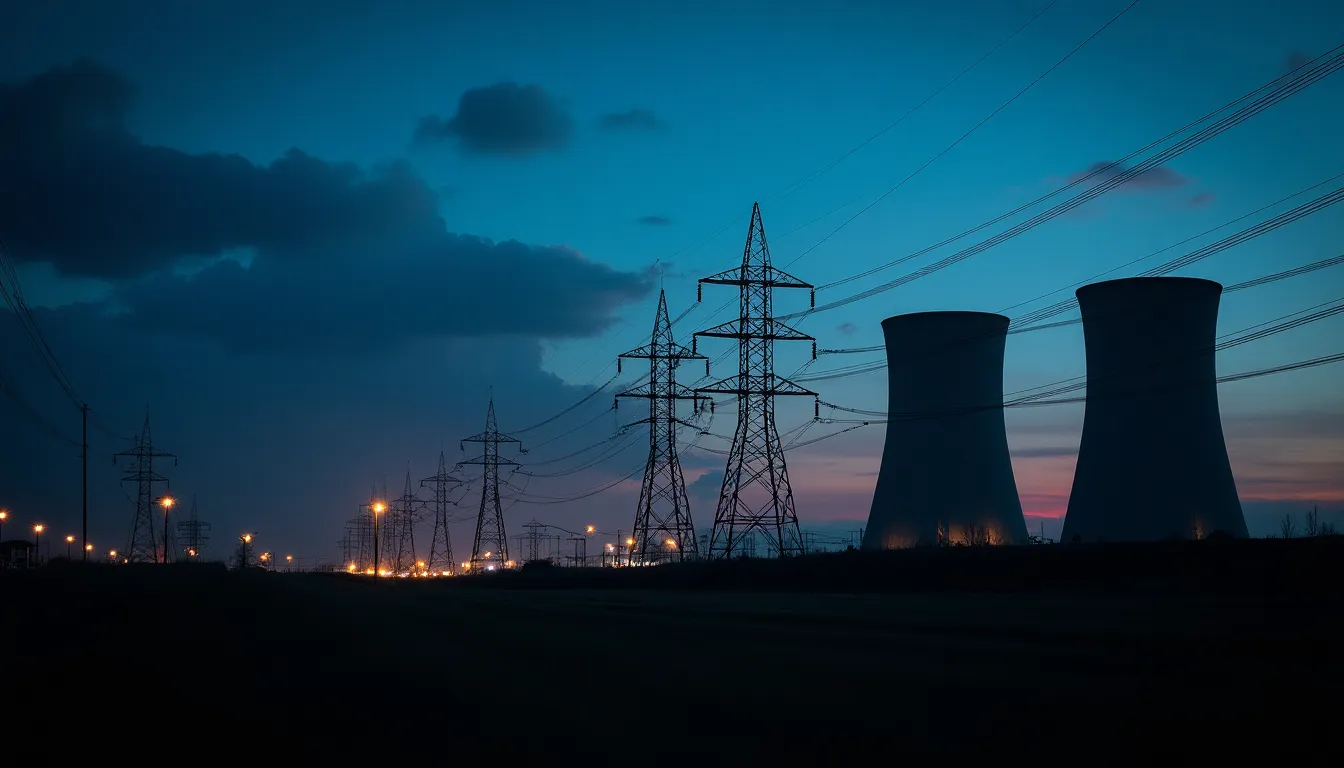
Overstated data center demand forecasts are raising Ohio electricity bills, and a shuttered Iowa nuclear plant has secured a $1.9B federal loan to restart.
Key Takeaways
- Ohio utilities used inflated data center load forecasts to justify grid spending now appearing in residential power bills.
- Dominion Energy is arguing Virginia's Clean Economy Act contains a loophole that excuses fossil fuel use amid data center demand growth.
- A shuttered Iowa nuclear plant secured a $1.9B federal loan to fund its restart as part of US baseload capacity strategy.
- Solar-plus-storage co-deployments are accelerating globally, offering a market-led complement to policy-driven nuclear restarts.
- Carbon Brief's climate attribution Q&A found warming intensifies Himalayan flood precipitation but formal attribution for 2026 events requires dedicated study.
Overstated projections of data center electricity demand are translating directly into higher power bills for Ohio households, according to Canary Media, raising pointed questions about how utilities justify grid investment decisions - and who bears the cost when those projections miss.
What Happened
Canary Media's September 9 investigation found that Ohio utilities have used aggressive data center load forecasts to justify infrastructure spending that is then recovered through ratepayer bills. When data centers fail to materialise at projected scale or timelines slip, the costs do not disappear - they are spread across residential and commercial customers. The report highlights a structural problem in utility planning: forecasts that serve as the basis for capital spending are rarely subject to independent verification before construction begins, and utilities face limited financial consequences when projections prove wrong.
A separate story from Canary Media reported that Dominion Energy, Virginia's dominant utility, is seeking to exploit a loophole in the state's landmark Virginia Clean Economy Act. Despite the law's renewable energy mandates, Dominion has argued that surging data center demand - Virginia hosts more data center capacity than any other US state - gives it grounds to delay clean energy commitments and pursue additional fossil fuel generation. The development illustrates how hyperscale computing growth is actively straining state-level climate frameworks designed before AI infrastructure demand was a significant grid factor.
On the supply side, Canary Media reported on September 8 that a shuttered nuclear plant in Iowa has received a $1.9 billion federal loan to fund its restart. The facility, which had been offline, is positioned as part of a broader federal push to restore nuclear baseload capacity at a moment when grid operators are warning that electricity demand from AI data centers and manufacturing reshoring could outpace new renewable additions within this decade. The loan reflects the US Department of Energy's growing view that nuclear restarts represent a faster path to firm, low-carbon capacity than constructing new plants from scratch.
Beyond the US grid, Canary Media reported that solar-plus-storage deployments are accelerating globally, with co-located battery systems increasingly being contracted alongside photovoltaic projects across multiple continents. Meanwhile, Carbon Brief published a detailed Q&A on September 8 examining what climate attribution science can and cannot conclude about global warming's contribution to the 2026 Himalayan floods, noting that while warming increases precipitation intensity, definitive attribution for specific events requires formal study.
Why It Matters
The Ohio and Virginia stories share a common thread: corporate energy sourcing decisions made at scale by technology companies are reshaping grid economics and climate policy outcomes for millions of people who never signed a data center lease. When hyperscalers commit to a region, utilities respond by building - and when demand projections are padded or deals fall through, ratepayers absorb stranded costs. This is not a hypothetical risk; it is already appearing in Ohio billing cycles.
The Dominion case is particularly significant for corporate sustainability commitments. Major cloud providers have signed power purchase agreements promising clean energy delivery in Virginia, yet the state's own climate law is now being weakened by the utility that serves them, citing their demand as justification. Investors tracking energy transition risk - including those using commodity and energy market analysis to assess utility exposure - should note that regulatory loopholes exploited today create long-term liability in carbon-constrained policy environments.
The Iowa nuclear loan signals that federal energy policy is increasingly treating AI-driven demand as a national infrastructure challenge requiring direct intervention, not just market signals.
Background
Hyperscale cloud providers have increasingly relied on Power Purchase Agreements - How Hyperscalers Source Clean Energy for AI to meet internal net-zero commitments while driving new renewable capacity construction. These long-term contracts, typically spanning 10 to 20 years, allow companies like Microsoft, Google, and Amazon to claim clean energy procurement against their data center loads. The mechanism works when grid capacity and renewable supply keep pace with actual demand growth - but the Ohio and Virginia cases suggest that utility planning processes and state regulatory frameworks are not always equipped to handle the pace and scale of AI infrastructure expansion.
Nuclear restarts, explored further in the MachineHours entry on Small Modular Reactors - How SMRs Could Power the AI Economy, represent one policy response to baseload gaps that renewables alone cannot fill on short timelines. Grid-scale storage, covered in the Grid-Scale Battery Storage entry, is the other, and the global solar-plus-storage growth trend suggests both pathways are advancing simultaneously.
What to Watch
Three developments merit close attention in the coming months. First, whether Ohio utility regulators move to impose stricter verification requirements on load forecasts before approving capital spending - other states with heavy data center activity, including Georgia and Texas, face the same structural exposure. Second, whether Dominion's loophole argument survives legal and regulatory challenge in Virginia, since the outcome will set a precedent for how other utilities in clean-energy-mandate states handle data center demand spikes. Third, the Iowa nuclear restart timeline: a $1.9 billion federal loan is a commitment, but nuclear restarts have historically faced construction and licensing delays that push operational dates years beyond initial projections. The degree to which that plant can deliver firm capacity before the next demand peak will be a real-world test of the federal nuclear restart strategy.
- Power Purchase Agreements typically run 10 to 20 years, locking in energy prices and supply commitments for hyperscale buyers.
- Microsoft, Google, and Amazon are among the largest corporate PPA buyers globally, each committing to multi-gigawatt renewable portfolios.
- PPAs drive construction of new renewable capacity that would not otherwise be financed on merchant power market revenues alone.
- Virginia hosts more operational data center capacity than any other US state, making Dominion's clean energy compliance decisions nationally significant.
Sources
- Canary Media: Questionable data center forecasts are driving up Ohio power bills
- Canary Media: Virginia kept its climate law. Dominion sees a loophole.
- Canary Media: Shuttered nuclear plant in Iowa gets $1.9B federal loan to restart
- Canary Media: Solar-plus-storage is having a global growth spurt
- Carbon Brief: Q&A: What can – and cannot – be said about global warming's role in the 2026 Himalayan floods
- MachineHours Encyclopedia: Power Purchase Agreements — How Hyperscalers Source Clean Energy for AI
- MachineHours Encyclopedia: Small Modular Reactors — How SMRs Could Power the AI Economy
- MachineHours Encyclopedia: Grid-Scale Battery Storage — Technologies, Costs, and the Energy Transition
Frequently Asked Questions
Why are Ohio power bills rising because of data centers?
Ohio utilities used aggressive data center load forecasts to justify infrastructure investment. When those data centers did not materialise at projected scale, the capital costs were recovered from residential and commercial ratepayers rather than from the developers who drove the forecasts.
What loophole is Dominion Energy using in Virginia's climate law?
Dominion has argued that surging data center electricity demand gives it grounds to delay clean energy commitments under the Virginia Clean Economy Act and pursue additional fossil fuel generation, despite the law's renewable energy mandates.
How large is the federal loan for the Iowa nuclear plant restart?
The US Department of Energy issued a $1.9 billion federal loan to fund the restart of a shuttered Iowa nuclear facility, part of a broader effort to restore firm low-carbon baseload capacity quickly.
What is solar-plus-storage and why is it growing?
Solar-plus-storage pairs photovoltaic panels with co-located battery systems to smooth out generation intermittency. Canary Media reported deployments are accelerating globally as project economics improve and grid operators demand firmer renewable delivery.
Can climate science link global warming to the 2026 Himalayan floods?
Carbon Brief's Q&A found that warming demonstrably increases precipitation intensity in the Himalayas, but attributing specific 2026 flood events definitively to climate change requires formal attribution studies not yet completed.
Get MachineHours in your inbox
AI compute and the machine economy in your inbox.