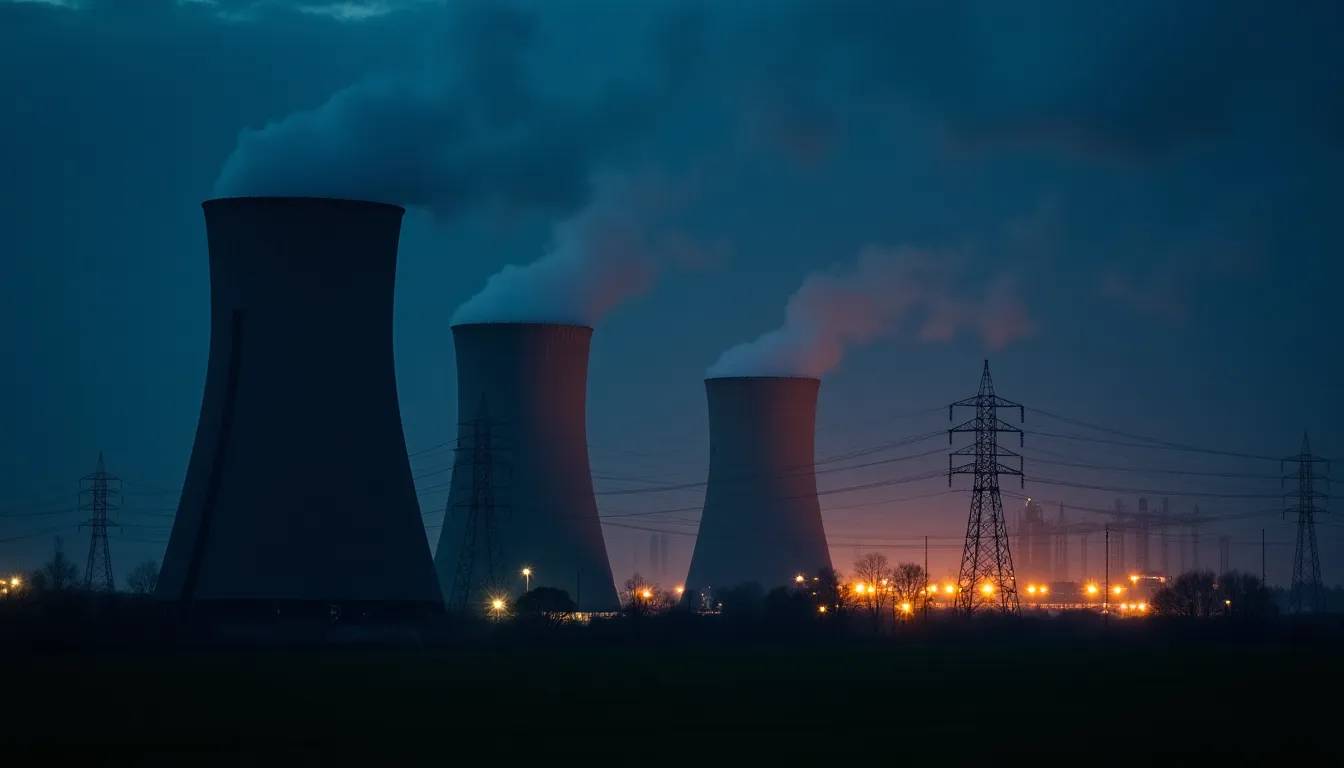
Nuclear plants are being pushed to their output limits as AI data centers demand more power, while new battery tech and hydrogen hubs face grid and political hurdles.
Key Takeaways
- MIT Technology Review reports utilities are uprating existing nuclear reactors to meet AI data center power demand.
- A nuclear and gas-powered data center project backed by Valar faces opposition in Carbon County, Utah.
- Canary Media reports a new battery class aims to help data centers absorb grid interruptions without destabilizing local power networks.
- Pennsylvania's federally backed hydrogen hub projects remain delayed, per Canary Media reporting published Oct. 15, 2026.
- Wired reports solar energy politics are shifting, with some conservative voices now backing residential solar for energy independence.
Nuclear power plants across the United States are being asked to squeeze out more electricity than they were ever designed to produce, according to MIT Technology Review, as utilities scramble to meet surging demand from AI data centers. The Oct. 15, 2026 report lands alongside a cluster of other stories this week showing just how strained the grid has become, from a contested nuclear and gas project in Utah to a new wave of batteries designed to keep data centers from destabilizing local power networks.
What Happened
MIT Technology Review's reporting examines the practice of uprating, in which operators modify existing reactors to generate more power than their original licenses allowed. The piece frames this as one of the fastest available levers utilities have to add capacity without building new plants, a tactic gaining urgency as AI data center campuses sign long-term power contracts with aging nuclear fleets.
That urgency is visible on the ground in Utah, where Canary Media reports that Two separate data center developments in Carbon County are facing opposition: a nuclear project (Project Beehive) backed by Valar Atomics involving 456 small modular reactors, and a separate gas-powered project, 'Jurassic Spark,' backed by Altigen Energy., a region built on a coal mining legacy. The pushback illustrates that even communities accustomed to heavy industry are wary of new large-load power projects tied to AI infrastructure.
On the technology side, Canary Media also reports on a new class of batteries designed to let data centers absorb short grid interruptions without tripping backup diesel generators or causing damaging demand spikes.
Meanwhile, the politics of clean energy are shifting in unexpected directions. Wired describes a increasingly polarized and personal fight over solar power, with some conservative-aligned voices now championing residential solar for energy independence even as utility-scale projects face local opposition similar to what nuclear and data center developers are encountering.
Why It Matters
Taken together, these stories describe a grid under pressure from a single source: AI data center demand that is growing faster than new generation can reasonably be built. Uprating existing nuclear reactors is attractive precisely because it is faster than constructing new plants, but MIT Technology Review's reporting suggests there are physical and regulatory ceilings on how far that can go. Battery buffering technology addresses a narrower but immediate problem, smoothing the mismatch between data center load swings and grid stability rather than adding new supply. The Utah opposition case shows that even regions dependent on extraction industries are not automatically receptive to nuclear-plus-gas data center deals, which complicates siting plans for hyperscalers. For readers tracking how this demand surge ripples into commodity and power markets, commodity and energy market analysis is increasingly treating data center electricity demand as a distinct category worth watching alongside traditional industrial load.
Background
Hydrogen has long been pitched as a flexible energy carrier capable of storing renewable power and decarbonizing heavy industry, a vision detailed in MachineHours' encyclopedia entry on the hydrogen economy.
What to Watch
Watch whether more nuclear operators pursue uprating approvals through 2026 and 2027, and whether regulators move quickly enough to keep pace with data center contracting timelines. The Utah dispute over the Valar project is likely to become a template other communities cite when nuclear or gas-fired data center proposals arrive nearby. Battery buffering technology for data centers could see faster adoption than hydrogen hubs simply because it solves an immediate operational problem rather than requiring years of infrastructure buildout. Related developments in small modular reactors and hyperscaler power purchase agreements will likely intersect with all of these stories in coming months.
Sources
- MIT Technology Review: How much more can nuclear power plants give?
- Canary Media: Nuclear-powered data centers? It's a tough sell in Utah coal country.
- Canary Media: A new class of batteries helps data centers play nicely with the grid
- Canary Media: What's up with Pennsylvania's hydrogen hubs?
- Wired: The Politics of Solar Energy Are Getting Weird, Mean, and a Little MAGA
- MachineHours Encyclopedia: The Hydrogen Economy — Fuel Cells, Green Hydrogen, and Industrial Decarbonisation
Frequently Asked Questions
What does 'uprating' a nuclear plant mean?
Uprating refers to modifying an existing nuclear reactor to safely generate more electricity than its original license allowed, a faster alternative to building new nuclear capacity, as described by MIT Technology Review.
Why is there opposition to the Valar data center project in Utah?
According to Canary Media, residents of Carbon County, Utah, a region with a coal mining legacy, have pushed back against a proposed nuclear and gas-powered data center backed by the company Valar.
How do new batteries help data centers work with the power grid?
Canary Media reports a new class of batteries lets data centers absorb brief grid interruptions without triggering backup generators or causing demand spikes that can strain local electricity networks.
What is happening with Pennsylvania's hydrogen hubs?
Canary Media reports the state's federally backed regional hydrogen hub projects are facing delays and funding uncertainty, slowing their contribution to the broader clean energy transition.