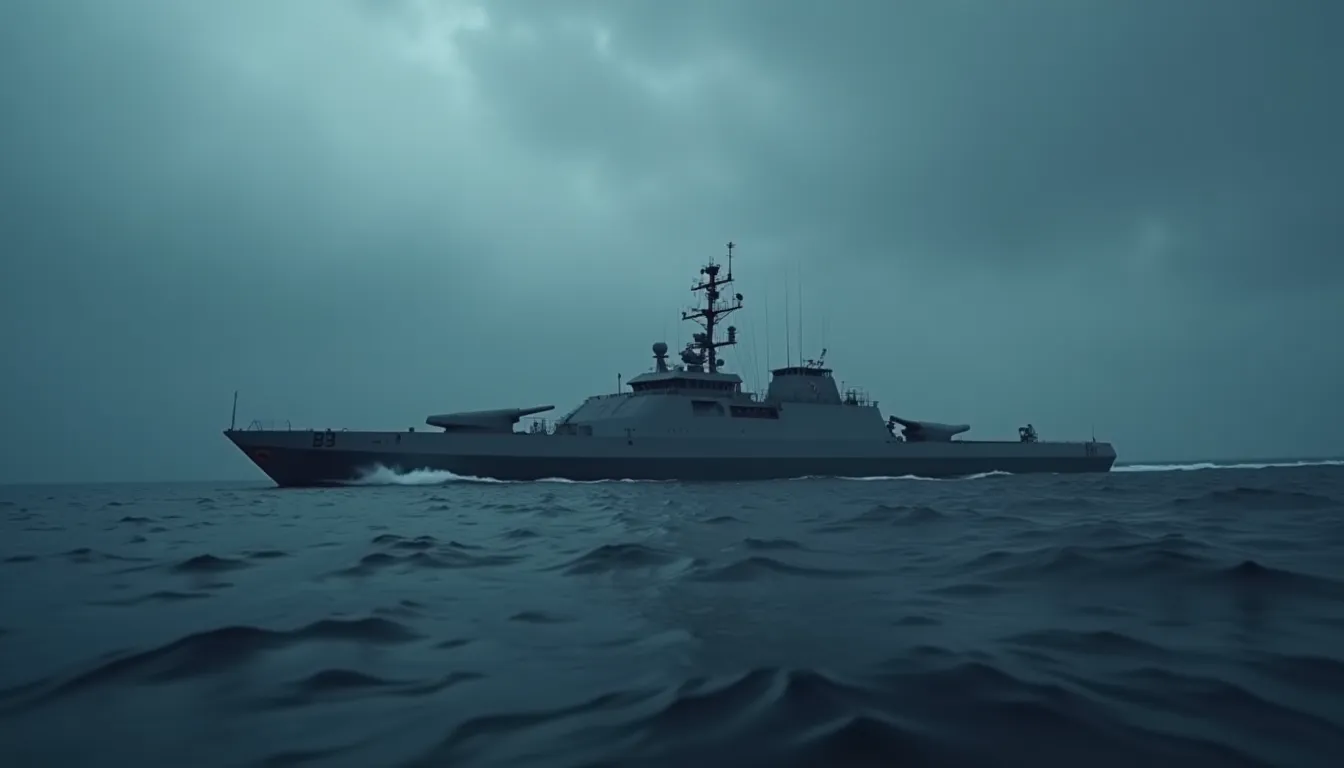
The U.S. Navy has opened Phase II of its medium unmanned surface vessel program, seeking autonomous solutions from industry with requirements for at least 10 days of unmanned operations and two 20-foot shipping container payloads. The advancement comes as senior officials warn that cyber capabilities can be rapidly depleted in sustained conflict, raising questions about whether autonomous platform
Key Takeaways
- Navy Phase II MUSV program seeks vessels capable of 10+ days autonomous operations with modular design and open-architecture autonomy compatibility to enable rapid procurement and operational flexibility
- Senior Navy cyber commander warns that cyber capabilities are 'quickly expended and slow to replenish' in sustained conflict, creating asymmetric vulnerability for autonomous platforms dependent on secure networks
- Cyber exploit tools cannot be regenerated like traditional munitions and become obsolete once adversaries patch vulnerabilities, complicating long-term autonomous vessel resilience planning
- Navy's $200 billion shipyard modernization program creates competing budget pressures that may force tradeoffs between industrial base investment and new autonomous platform development
- Autonomous vessel success depends on pairing Phase II platform investments with adequate cyber resilience funding, as the Navy's cyber command has requested an additional $229 million to sustain cyber effects at scale
The U.S. Navy is ushering in a new phase of integrating and testing medium unmanned surface vessels (MUSV), marking a shift from early experimentation toward a more structured acquisition pipeline for uncrewed ships. The Navy posted a solicitation notice on September 23 seeking vendors with expertise in "innovative solutions to complex problems, vessel construction, autonomy, perception systems, and general maritime experience."
Phase II Requirements and Marketplace Integration
The Navy is looking for vessels capable of completing at least 10 days of unmanned operations, accommodating a payload capacity of at least two standard 20-foot shipping containers, and measuring no longer than 90 meters. This represents a refinement from earlier guidance issued earlier in 2026, which had called for designs holding at least two 40-foot shipping containers.
Approved platforms will be included on a maritime marketplace website where the Pentagon hopes to "rapidly configure and issue funded delivery orders for vetted maritime autonomous systems without redundant procurement cycles." The Navy announced plans for an MUSV Marketplace in March as part of a new procurement model to acquire production-ready, mission capable platforms already available, with the marketplace described as the first iteration of a recurrent marketplace approach.
Autonomy Architecture as Core Capability
The Phase II solicitation signals that the Navy views autonomous capability not as a side project but as fundamental to future fleet operations. Vendors will be evaluated on "platform maturity, open-architecture autonomy compatibility, endurance, payload integration capacity, and rapid-production scalability," indicating the service expects these vessels to operate with reduced human oversight during extended missions. The emphasis on "open-architecture autonomy compatibility" suggests the Navy intends to maintain flexibility in integrating different autonomous systems and sensor packages across multiple platforms, rather than locking in proprietary designs.
This approach reflects a procurement philosophy that prioritizes rapid iteration and competition. "This open call will allow new entrants to compete and existing vendors to submit updated product blocks and modular payload configurations," according to the solicitation notice. The modular design principle allows the Navy to adapt vessels to evolving threats without replacing entire platforms.
Cyber Vulnerability as Strategic Risk
However, Phase II advancement occurs at a moment when Navy officials are publicly acknowledging significant vulnerabilities in cyber capabilities—the systems upon which autonomous vessels fundamentally depend. Vice Admiral Heidi Berg, commander of Fleet Cyber Command/10th Fleet, warned that "your cyber magazine of these exquisite fires is empty pretty damn quick," citing lessons from recent military operations including Russia's invasion of Ukraine and U.S. operations in the Middle East and Venezuela.
Berg elaborated: "How are you going to regenerate and continue to develop accesses and effects to be able to deliver over the course of what will almost always be against a peer competitor, a longer-term sustained conflict?" Her comments underscore a critical challenge: cyber capabilities and exploit tools are not easily replenished. Once an adversary patches a flaw in a system, the tactic can become obsolete, and exploits cannot be replenished like traditional munitions with an infusion of money and production lines, given it requires time and skill to discover exploits and develop the tools to take advantage of them.
A former senior Pentagon official, speaking on condition of anonymity, noted that China is most likely watching how U.S. cyber operators are performing and observing their tactics. This intelligence gathering creates compounding risk: as the U.S. employs cyber techniques in ongoing operations, adversaries gain visibility into American capabilities, potentially rendering them obsolete more rapidly.
Autonomous Vessels and Network Dependency
The vulnerability Berg identified directly implicates the MUSV program. Autonomous vessels depend entirely on secure, functioning networks for navigation, communication, targeting, and autonomous decision-making at sea. A medium unmanned surface vessel operating independently for 10 days must maintain continuous data links with command centers, integrate real-time threat intelligence, and execute tactical decisions based on networked sensor data. If cyber access is "quickly expended and slow to replenish," as one former cyber operator told Breaking Defense, autonomous platforms operating in contested environments face an asymmetric problem: they require sustained cyber protection while the tools to provide that protection are finite and difficult to regenerate.
Budget Pressures and Competing Priorities
The Phase II announcement also arrives amid significant budget pressures that could constrain the program's expansion. A Government Accountability Office report found that the Navy's Shipyard Infrastructure Optimization Program (SIOP), launched in 2018 to upgrade the Navy's four public shipyards, could take 50 years and cost $200 billion—nearly ten times the initial $21 billion estimate. The initial estimate "omitted key costs," and factors including commodity price increases and seismic concerns at Puget Sound Naval Shipyard that require "needed retrofits and construction" are driving up costs and adding time to the SIOP initiative.
The magnitude of the shipyard modernization burden raises strategic questions about competing priorities. While MUSV Phase II represents the Navy's commitment to autonomous capability as a core requirement for future fleets—particularly for operations with reduced crew presence in contested waters—the $200 billion shipyard cost presents a competing claim on a limited defense budget. The Navy must simultaneously invest in maintaining and modernizing the industrial base that will build these autonomous vessels, upgrade existing surface combatants and submarine fleet support, and develop the cyber resilience infrastructure that autonomous systems require to function safely.
What to Watch
Contractors' responses to the Phase II solicitation will provide early visibility into the autonomy architectures the defense industrial base believes are viable at this scale and cost point. The specific technical proposals will indicate what level of independent decision-making the Navy expects these vessels to handle without human intervention, and whether vendor solutions address the cybersecurity challenges Berg and others have flagged. Equally important is whether the $200 billion shipyard estimate forces the Navy to make explicit budget tradeoffs against newer autonomous programs in upcoming budget requests—or whether the service seeks supplemental appropriations to maintain both legacy industrial base modernization and next-generation autonomous platforms simultaneously.
Navy Phase II MUSV Program Faces Cyber Resilience ChallengeSources
- Breaking Defense: Navy launches Phase II for medium robo-ship project, seeks 'innovative solutions'
- Breaking Defense: Navy's shipyard revamp could cost more than $200 billion: GAO
- Breaking Defense: 'Cyber magazine' can run out 'pretty damn quick' in modern conflict: Admiral
- Breaking Defense: South Korea inducts first locally developed fighter jet into air force
- Breaking Defense: Building logistics networks that survive contested environments
- MachineHours Encyclopedia: Roomba: First Mass-Market Consumer Robot
Frequently Asked Questions
What is the Navy's medium robo-ship program?
It is a Navy initiative, now entering Phase II, seeking autonomous solutions for a mid-sized class of unmanned surface vessels, according to Breaking Defense.
How much could the Navy's shipyard revamp cost?
The Government Accountability Office estimates the effort could exceed $200 billion, per Breaking Defense.
What did the admiral say about cyber capacity?
A senior admiral warned that 'cyber magazine', or offensive cyber capacity, can run out quickly during modern conflict, as reported by Breaking Defense.
What fighter jet did South Korea induct?
South Korea inducted its first locally developed fighter jet into its air force, marking a milestone in domestic defense manufacturing, per Breaking Defense.
Get MachineHours in your inbox
AI compute and the machine economy in your inbox.