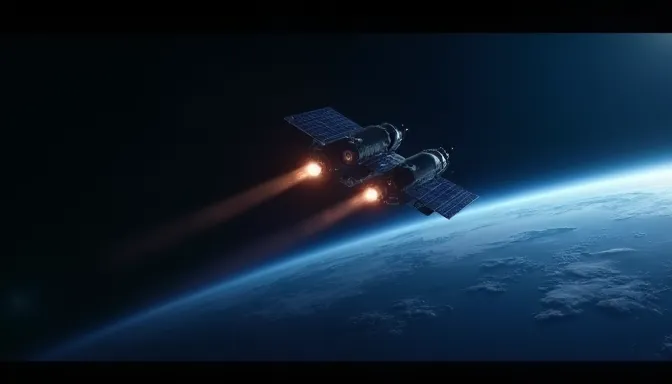
NASA's twin ESCAPADE spacecraft completed powered Earth flybys on Nov. 7 and 9, 2026, setting course for Mars orbit insertion in September 2027.
Key Takeaways
- ESCAPADE's twin spacecraft completed first-ever NASA powered Earth flybys on Nov. 7 and Nov. 9, 2026
- Spacecraft passed within 1,600 km (Blue) and 1,050 km (Gold) of Earth using Oberth-effect engine burns
- Mars orbit insertion is scheduled for Sept. 7 and Sept. 9, 2027, after a 10-month cruise
- Rocket Lab built the spacecraft; they launched on Blue Origin's New Glenn in November 2025
- ESCAPADE is the last surviving mission in NASA's SIMPLEx low-cost planetary program
NASA's two ESCAPADE smallsats are now racing toward Mars after executing a maneuver the agency has never attempted before: a powered Earth gravity assist. According to SpaceNews, the second spacecraft, nicknamed Gold, flew within about 1,050 kilometers of Earth on Nov. 9, roughly 48 hours after its twin, Blue, completed a similar pass at an altitude of about 1,600 kilometers. The back-to-back maneuvers mark the first time NASA has used powered Earth flybys to redirect a spacecraft toward Mars.
What Happened
The two Escape and Plasma Acceleration and Dynamics Explorers, built by Rocket Lab, launched together on Nov. 13, 2025, aboard the second flight of Blue Origin's New Glenn rocket from Cape Canaveral Space Force Station in Florida. Rather than head straight for Mars during one of the narrow launch windows that open roughly every two years, the spacecraft executed an unconventional trajectory designed by Advanced Space. According to NASA, both spacecraft entered a loiter orbit around the Earth-Sun L-2 Lagrange point, a gravitational balancing point roughly a million miles from Earth on the opposite side from the Sun. They traced a kidney-bean-shaped path through this region for nearly a year before swinging back toward Earth for the powered gravity-assist maneuver.
The first spacecraft made its closest approach around 5 a.m. EST on Nov. 7 at roughly 1,000 miles above Earth's surface, firing its engine for about nine minutes during the pass. The second followed two days later at around 6 a.m. EST on Nov. 9, at an altitude of about 650 miles, also executing a nine-minute burn. During both flybys, the Rocket Lab-built spacecraft use the Oberth effect, a principle that maximizes engine performance when a spacecraft fires its thrusters at the point of closest approach to a gravitational body.
MachineHours analysis: Cross-referencing the altitudes reported by both SpaceNews and NASA shows that Gold's closest approach, at roughly 1,050 kilometers, was about 550 kilometers lower than Blue's roughly 1,600-kilometer pass two days earlier. Despite that altitude gap, both spacecraft fired their main engines for approximately the same duration — about nine minutes each — indicating that mission planners calibrated each burn to the specific geometry of its individual flyby rather than applying a uniform altitude-and-burn template across the pair.
Asal Naseri, acting associate flight director in NASA's Heliophysics Division, described the accomplishment in a NASA statement, noting that the agency executed the maneuver twice flawlessly within two days. Rob Lillis, ESCAPADE's principal investigator at UC Berkeley's Space Sciences Laboratory, told attendees at the Nov. 9 Mars Exploration Program Analysis Group meeting that the burns were as critical as a Mars orbit insertion burn and were executed perfectly, according to SpaceNews.
MachineHours analysis: Lillis's comparison of the Earth-flyby burns to a Mars orbit insertion burn is worth measuring against the mission's own published figures. Both NASA and SpaceNews report that the Earth-flyby trans-Mars injection burns lasted about nine minutes each, while the planned Mars orbit insertion burns in September 2027 are set to run about 11 minutes — roughly two minutes, or about 20 percent, longer. That both burn types are described as comparably critical, despite the shorter duration of the Earth-flyby maneuvers, suggests that criticality in this mission profile is driven less by burn length than by the precision of timing and pointing at closest approach, consistent with the Oberth-effect mechanics both sources describe.
Jeff Parker of Advanced Space, lead mission designer, explained that the loiter-orbit approach deliberately decouples Mars missions from planetary alignment constraints. According to NASA's release, this method gives mission planners the flexibility to launch nearly anytime and then use Earth's gravity for a boost toward Mars, rather than waiting for the roughly biennial direct-transfer windows that have governed Mars launch schedules for decades. The trajectory design allows future missions to escape the binary choice of launching on time during a favorable window or waiting up to two more years for the next opportunity.
Both spacecraft are now on a 10-month cruise toward Mars, with orbit insertion burns planned for Sept. 7 and Sept. 9, 2027. Each will fire its main engine for about 11 minutes to enter orbit, then spend several months maneuvering into a shared science formation. Science operations are expected to begin in June 2028, when the spacecraft will fly up to 30 minutes apart to measure how the solar wind interacts with Mars's magnetosphere and atmosphere over time. This coordinated observation phase will last six months before the spacecraft split into separate orbits for a five-month campaign studying incoming solar wind and its effects on the planet.
MachineHours analysis: The mission's full timeline spans roughly three and a half years from launch (Nov. 2025) to the end of primary science (~mid-2029), based on the dates provided. The spacecraft launched Nov. 13, 2025, spent nearly a year in the L-2 loiter orbit before the Nov. 7–9, 2026 flybys, then face a 10-month cruise to Mars orbit insertion in September 2027. Notably, NASA's release indicates science operations do not begin until June 2028 — roughly nine months after Mars orbit insertion — Note that NASA's release — not SpaceNews — describes the 'several months' formation-maneuvering phase. State that these duration figures (six months and five months) come from NASA's release, not from both sources.
Why It Matters
Yet ESCAPADE is also a cautionary tale about program sustainability. According to SpaceNews, it is the last surviving mission of NASA's SIMPLEx (Small Innovative Missions for Planetary Exploration) program. Janus, an asteroid flyby spacecraft, was canceled in 2023 after delays in the launch of the Psyche asteroid mission prevented it from carrying out its planned flybys. Lunar Trailblazer malfunctioned shortly after its February 2025 launch, and NASA formally ended the mission five months later after recovery efforts failed. Two earlier cubesat-class SIMPLEx missions, LunaH-Map and Q-PACE, also failed after their launches. SpaceNews reported that NASA, citing budget pressures, has not solicited proposals for new SIMPLEx missions and has not stated any plans to do so for the foreseeable future. The program's four-out-of-five mission failure rate casts doubt on whether this low-cost model, despite ESCAPADE's success, will receive continued institutional backing.
MachineHours analysis: Tallying the SIMPLEx missions named in SpaceNews's reporting — Janus, Lunar Trailblazer, LunaH-Map, and Q-PACE — against the program's original five-mission roster (which includes ESCAPADE) produces a failure rate of 80 percent, with ESCAPADE as the sole mission to reach its intended science phase. That ratio frames the program's record more starkly than a simple count of failures: four distinct failure modes are represented across the four lost missions — a launch-manifest delay (Janus), a post-launch malfunction (Lunar Trailblazer), and two unspecified post-launch failures (LunaH-Map and Q-PACE) — suggesting the program's difficulties were not concentrated in a single technical area such as propulsion or communications, but spread across different mission phases and spacecraft classes. Set against NASA's confirmation that no new SIMPLEx solicitation is planned, ESCAPADE's successful flyby sequence stands as the program's only data point for how a low-cost planetary mission performs when its cruise and orbital-mechanics design — rather than its spacecraft bus or launch vehicle — is the primary innovation being tested.
What to Watch
The next critical milestone is a 10-month cruise culminating in Mars orbit insertion burns on Sept. 7 and Sept. 9, 2027, each an 11-minute main engine firing. Watch for trajectory correction maneuvers along the way and confirmation that both spacecraft maintain the precise course needed for that rendezvous. If the insertion burns succeed, science operations begin in June 2028, marking what NASA describes as the first mission to coordinate two orbiters simultaneously observing the Martian space weather environment from different locations. The coordinated formation flight itself will test operational techniques for multi-spacecraft science at Mars, a capability that could inform larger, more expensive future missions. Whether NASA revives SIMPLEx-style low-cost planetary missions, given the program's mixed track record and current budget constraints, remains an open question. ESCAPADE's success may demonstrate the viability of the approach, but institutional momentum and funding often depend on political and budgetary factors beyond technical achievement.
MachineHours analysis: The two-day gap between Blue's and Gold's Earth flybys (Nov. 7 and Nov. 9) and the two-day gap between their respective Mars orbit insertion burns (Sept. 7 and Sept. 9, 2027) are identical in length, as reported by both NASA and SpaceNews. That consistency implies the spacecraft have maintained their original relative spacing since launch, through nearly a year of loiter orbit and a 10-month transfer cruise, without mission controllers needing to close or widen the gap between them — a detail that, if it holds through the insertion burns, would indicate the trajectory design has kept both spacecraft synchronized closely enough that no major differential correction has been necessary across more than 20 months of flight.
- ESCAPADE launched Nov. 13, 2025, on the second flight of Blue Origin's New Glenn rocket with both spacecraft aboard
- Spacecraft Blue and Gold completed powered Earth flybys at ~1,600 km and ~1,050 km altitude on Nov. 7 and Nov. 9, 2026, each firing engines for approximately 9 minutes using the Oberth effect
- Mars orbit insertion burns planned for Sept. 7 and Sept. 9, 2027, each an 11-minute main engine burn, with science operations beginning June 2028
- ESCAPADE is the last surviving NASA SIMPLEx mission; four of five SIMPLEx missions have failed, and NASA has not solicited new proposals for the program amid budget pressures
Further reading and context
Sources
- SpaceNews: ESCAPADE on its way to Mars after Earth flybys
- NASA: NASA's ESCAPADE Completes Powered Earth Flybys, Now En Route to Mars
- MachineHours Encyclopedia: Robotics in Property
- Figure Humanoid Robot
- Roomba: First Mass-Market Consumer Robot
- Cybersecurity in the Age of AI — Threats, Defences, and Investment Opportunities
Frequently Asked Questions
What is a powered Earth flyby and why did ESCAPADE use one?
A powered Earth flyby combines a close pass by Earth's gravity with a sustained engine burn (the Oberth effect) to maximize velocity gain. NASA used it for ESCAPADE to send the spacecraft to Mars without waiting for a traditional launch window, the first time the agency has used this technique for a Mars-bound mission.
When will ESCAPADE reach Mars?
The two spacecraft are on a 10-month cruise to Mars, with Mars orbit insertion burns scheduled for Sept. 7 and Sept. 9, 2027, arriving two days apart.
Who built the ESCAPADE spacecraft and how were they launched?
Rocket Lab built the twin ESCAPADE spacecraft, which launched on Nov. 13, 2025 aboard the second flight of Blue Origin's New Glenn rocket, with trajectory design by Advanced Space.
What will ESCAPADE study once at Mars?
The two spacecraft will study how the solar wind interacts with Mars's magnetosphere and atmosphere, flying in formation to measure space weather variations before splitting into separate orbits for a dedicated five-month science campaign.
What is NASA's SIMPLEx program and what is its status?
SIMPLEx (Small Innovative Missions for Planetary Exploration) supports low-cost planetary science missions. ESCAPADE is its last surviving mission after Janus was canceled and Lunar Trailblazer failed; NASA has not solicited new SIMPLEx proposals due to budget pressure.
Get MachineHours in your inbox
AI compute and the machine economy in your inbox.