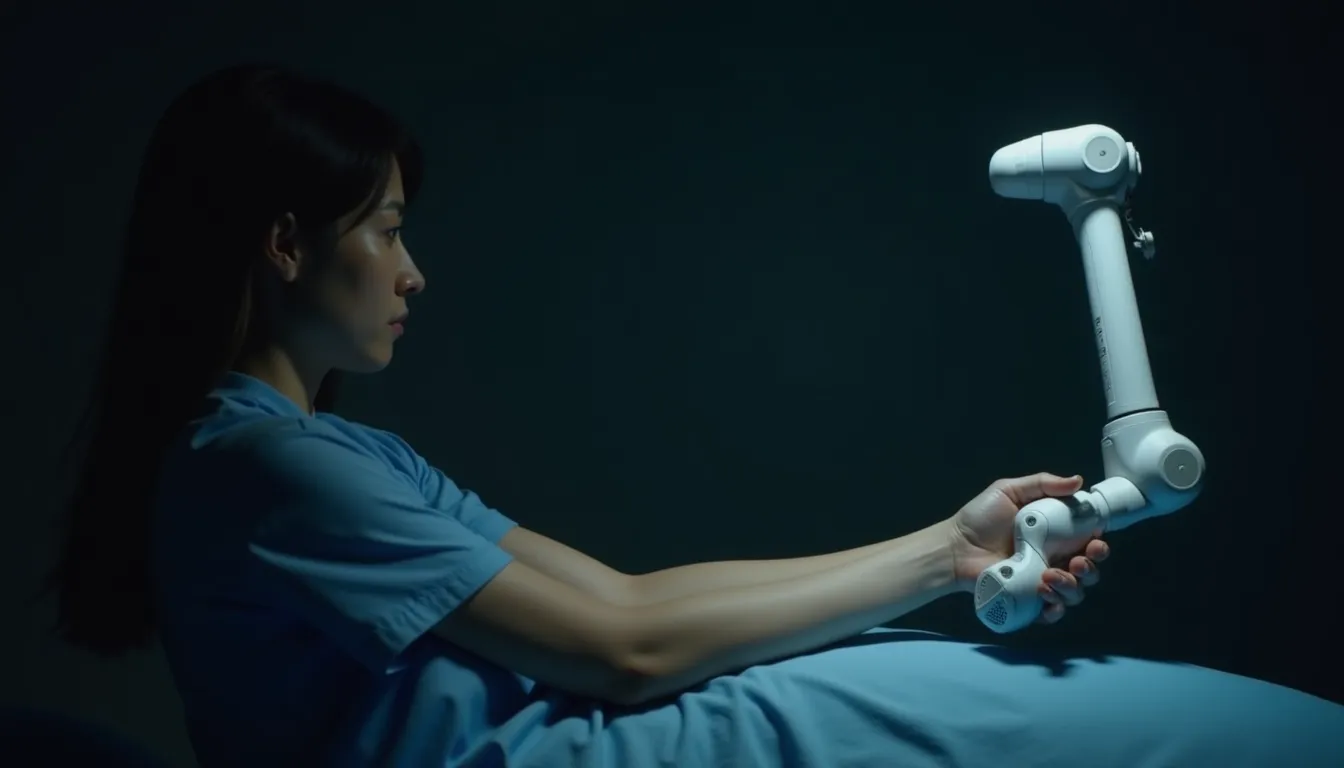
A robotic physical therapy system developed by Purdue assistant professor Johannes Lachner and former MIT student Noah Geiger uses generative AI and real-time force feedback to learn from human therapists and help treat stroke patients, addressing a critical shortage of rehabilitation professionals.
Key Takeaways
- A robotic arm system developed by Purdue's Johannes Lachner and former MIT student Noah Geiger uses generative AI to learn from physical therapists and deliver personalized rehabilitation assistance to stroke patients
- The system aims to address a critical workforce shortage: approximately 5 million stroke survivors annually need long-term rehabilitation, but insufficient therapists are available to meet demand
- Developers frame the robot as an extension of therapist capacity rather than a replacement, which affects how healthcare institutions, insurers, and labor representatives may respond to deployment
- Initial feasibility experiments have shown the approach works; the next phase involves developing therapist-specific AI models tested in a long-term clinical study comparing robotic and manual therapy outcomes
- The underlying technology could eventually apply to other labor-constrained fields including manufacturing and industrial settings, though medical rehabilitation is the current focus
How the Robotic System Works
Lachner, a former MIT postdoc, and Geiger built a robotic arm system that learns directly from how real therapists move and adjust force during exercises. According to MIT Technology Review, the system observes therapists performing rehabilitation exercises such as reaching, lifting, and simulating daily-task activities. By studying these clinical techniques, the robot absorbs patterns about how much assistance patients need at different stages of recovery.
The system then offers patients a calibrated level of assistance based on what it has learned from trained clinicians. This approach differs fundamentally from conventional robotics that operate on pre-programmed routines or simple feedback loops. Instead, the generative AI component allows the robot to adapt its assistance in ways that mirror human decision-making—understanding when to push patients harder and when to provide more support based on individual recovery patterns.
The Workforce Crisis Driving Innovation
The impetus for this project lies in a critical mismatch between patient need and therapist availability. Stroke is among the leading causes of long-term disability in the United States. The 5 million people annually who experience strokes and develop long-term impairments require intensive physical rehabilitation to regain motor function and independence. However, the physical therapy workforce cannot meet this demand. Therapists are overextended, patient wait times are long, and many stroke survivors receive suboptimal or interrupted care.
This bottleneck has profound consequences. Rehabilitation outcomes depend heavily on the frequency and consistency of therapy sessions. When therapists are unavailable or stretched thin, patients miss sessions or receive less individualized attention, which can limit their recovery potential. The shortage is particularly acute in rural areas and underserved communities where therapist-to-patient ratios are even less favorable.
Extension, Not Replacement
Lachner's framing of the technology is deliberate and consequential. The goal is "not to replace therapists, but to extend their reach," he told MIT Technology Review. This distinction matters significantly for how the technology might be adopted by healthcare institutions, insurers, and labor representatives.
If positioned as a therapist replacement, the system could face resistance from clinicians concerned about job displacement, labor unions protective of member employment, and advocacy groups worried about care quality. Conversely, framing it as an extension of existing therapist capacity—allowing one therapist to oversee more patients or to dedicate more time to complex cases while robots handle routine exercises—creates a different narrative. Instead of reducing jobs, the technology could theoretically enable therapists to reach more patients without requiring clinic expansions or hiring freezes.
This distinction also aligns with how physical therapy actually works. Therapy is not monolithic; it involves assessment, hands-on technique, exercise instruction, progress monitoring, and patient motivation. A robot might excel at delivering consistent, repetitive assisted exercises with precise force feedback, but clinical decision-making, patient assessment, and motivational support remain fundamentally human tasks. By positioning the robot as handling the former while therapists focus on the latter, the model preserves the clinical hierarchy and professional judgment that patients and institutions expect.
Research Progress and Next Steps
Lachner reports that "initial robotic experiments have already demonstrated the feasibility of this approach." These early trials show that the system can successfully learn from therapist demonstrations and apply that knowledge to deliver appropriate assistance to patients.
However, the research is at an early stage. The next phase aims to "develop therapist-specific models and evaluate them in a long-term clinical study with the same patients who previously received manual therapy." This design is methodologically rigorous: by following the same patients over time and comparing their outcomes with and without robotic assistance, researchers can measure whether the robot actually improves recovery trajectories. Therapist-specific models acknowledge that clinicians have different styles and techniques; one therapist's approach might emphasize aggressive resistance to build strength, while another prioritizes gentle movement to prevent pain. By building individual models, the system can preserve therapeutic diversity rather than flattening all interventions into a single protocol.
Broader Applications Beyond Stroke
Lachner envisions possible applications in contact-rich industrial settings or collaborative workspaces beyond medical rehabilitation. This suggests the underlying technology—learning from human experts via force feedback and generative AI—could apply wherever skilled manual tasks are in short supply. Manufacturing, ergonomic training, apprenticeship programs, and other fields facing labor scarcity might eventually benefit from similar systems.
For now, the focus remains on stroke rehabilitation, a domain where unmet clinical need is clear and the stakes for patients are high. Success in this initial application could serve as a proof-of-concept that establishes both the technical viability and the institutional acceptance needed for broader deployment.
Sources
- MIT Technology Review: Robotic therapy for stroke patients
- Wired: Meet Mori, a Cute Robot Mushroom That Doesn't Really Say (or Do) Anything
- The Verge: Eiliko maker says it's hiring an 'independent security firm' after Verge report on its insecure robots
- MachineHours Encyclopedia: Surgical Robotics — How Robots Are Transforming Medicine
Frequently Asked Questions
Who developed the robotic stroke therapy system?
Johannes Lachner, a former MIT postdoc now an assistant professor at Purdue University, and Noah Geiger, a former MIT visiting student, developed the system, according to MIT Technology Review.
What problem is the robotic therapy system trying to solve?
It addresses a shortage of physical therapists relative to the roughly 5 million people who suffer long-term impairments from strokes each year, per MIT Technology Review.
How does the robot provide therapy?
It uses generative AI and real-time force feedback to learn techniques from real physical therapists, then delivers calibrated assistance during exercises like reaching and lifting.
Will the robot replace physical therapists?
Lachner says the intent is to extend therapists' reach rather than replace them, with a planned clinical study to evaluate therapist-specific models on returning patients.
Are other robotics stories relevant to this one?
Wired reported on a $649-$849 consumer robot lamp called Mori, and The Verge covered security failures at Eiliko toy maker Energize Lab, both reflecting different, consumer-focused robotics priorities this week.
Get MachineHours in your inbox
AI compute and the machine economy in your inbox.