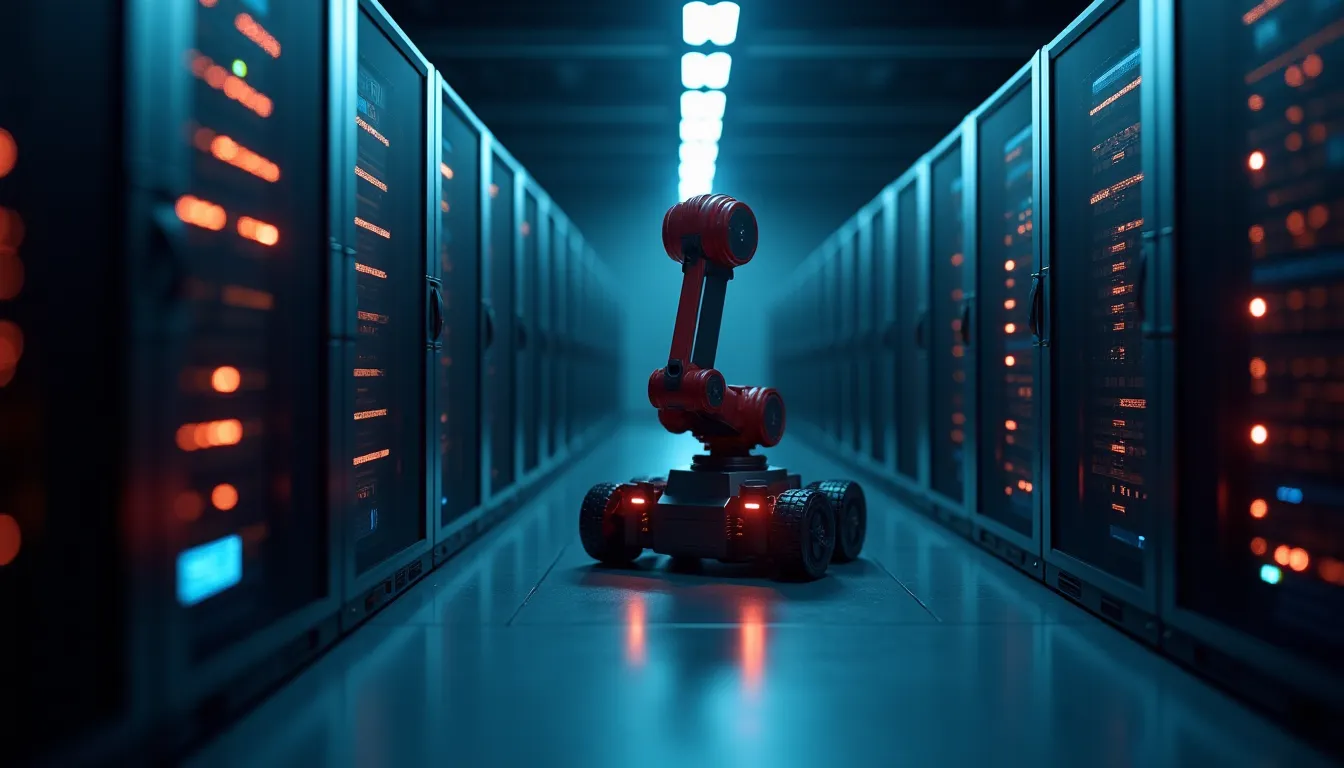
Meta is conducting active operational tests of robots inside its data centers to handle cable management, server resets, and hardware inspection—tasks currently performed by technicians. The company is evaluating equipment from vendors including Kinova, ABB, and Watney Robotics, signaling a potential shift in how hyperscalers manage labor costs as AI infrastructure spending accelerates.
Key Takeaways
- Meta is actively testing robots from vendors including Kinova, ABB, and Watney Robotics inside its data centers to handle cable management, server resets, and hardware inspection tasks.
- One Meta worker estimates successful cable-swapping robots could replace up to 80 percent of some technicians' workloads, raising workforce concerns especially in facilities like Altoona, Iowa.
- While robot hardware has become cheaper and AI capabilities more sophisticated, technical limitations remain—robots struggle with color differentiation, battery recharging, and complex cabling for advanced hardware like Nvidia GB300 supercomputers.
- Microsoft, Google, and Amazon have also announced or are pursuing robotics programs for their data center operations, suggesting broad industry momentum toward automation.
- Meta is offering workforce training and relocation programs while company leadership frames automation as inevitable, but local communities have given little policy attention to potential job displacement from robotics deployment.
Meta is deploying robots inside its data centers to perform physical maintenance and infrastructure tasks, according to Wired reporting, in one of the most detailed accounts yet of a major tech company automating its own physical operations at scale. The move signals a shift in how AI infrastructure companies are thinking about the labor required to keep their compute facilities running.
Active Operational Testing Underway
Wired's investigation reveals that Meta has been running experiments with robots designed to take over repetitive and physically demanding tasks inside its data centers—facilities that house the GPU clusters powering its AI research and production systems. The robots are being evaluated for jobs such as cable management, server rack inspection, and routine hardware checks, all tasks that currently require large numbers of human technicians working in hot, loud, and physically demanding environments.
According to current and former Meta workers familiar with the projects, the company is using robots and related hardware from several different vendors, including Watney Robotics, Kinova, and ABB. In one experiment, Meta is evaluating whether a Kinova Gen3 robotic arm could be used for power cycling or cutting off electricity to servers, while the company is also testing a different robot to swap networking cables. At some facilities, Meta has also adopted another, relatively simple robot that looks like a finger or pointy stick, capable of pressing the power button on a Mac Mini or other device to restart it when remotely prompted by a human.
One Meta data center worker estimates that if the cable-swapping bot proves successful, it could replace up to 80 percent of some people's workloads. The reporting confirms active operational testing rather than purely research-stage prototyping. The scale of Meta's data center footprint—among the largest in the world—gives the company both strong incentive and substantial opportunity to refine robotic systems across many facility types before any wider rollout.
Technical Capability and Real-World Deployment
Until recently, robots largely weren't well suited for the delicate work happening in data centers because they were expensive, and in earlier trials in the industry they sometimes crushed servers while attempting simple tasks. However, the landscape has shifted. The hardware has gotten cheaper, and the AI models powering robots are now far more capable than they were a few years ago.
Meta's approach reflects confidence in current hardware reliability thresholds. The tugger and inventory robots are now operating in a number of Meta's data centers, including in Iowa and Virginia. According to workers familiar with the projects, the robots generally work well, though there are limitations—the inventory bot can't differentiate between green and red indicator lights on equipment because its camera only detects grayscale, meaning human checks are still required to assess some breakdowns, and it struggles with corners and traversing cables that are often in the path of its wheels.
Since last June, Meta has been trying out a pair of dual-armed Watney robots for some cabling work at one of its Altoona buildings. The robots are supervised by humans and can't work as fast as people yet, but they show promise. Four-wheel robots with a scissor-lift-style riser and a six-axis arm on top made by the automation giant ABB are being used at Meta's newest data center campus in New Albany, Ohio, known as Prometheus, to reseat parts and, eventually, they may take on other tasks with diminishing human oversight.
Data center robots must operate with a level of precision that warehouse or manufacturing units do not always require. Mishandling a server rack or pulling the wrong cable can cause significant outages. Some workers have complained about the amount of downtime the robots need to recharge their batteries, and Meta has acknowledged internally that robots aren't equipped for certain tasks, such as the intense cabling work required to run an Nvidia GB300 supercomputer.
Economic and Strategic Implications
Meta's data center robotics program is notable precisely because the company is not a robotics firm. It is a compute consumer that has decided the physical labor costs and reliability risks of human-only data center operations are large enough to justify building internal robotics capability. Robots could offer more consistent output at a lower cost than human labor, especially in less populous regions where data centers are plentiful but qualified workers are scarce.
The economic argument matters not only for Meta but also for its competitors. If a company running AI at Meta's scale finds robotic automation worthwhile for infrastructure maintenance, the calculation becomes easier to justify at other hyperscalers. Last year, Microsoft and Google unveiled separate investments in robots for their data centers, and Amazon discussed using robots to help recycle parts at its facilities. Ashley Llorens, a managing director for Microsoft's research accelerator, told Wired that pursuing robotics for "economically valuable tasks," like "replacing a faulty server rack," is "absolutely something we're looking into at Microsoft".
Workforce and Community Concerns
The prospect of automation has begun to reshape workplace culture at Meta's facilities. In Altoona, Iowa, where Meta operates what is now its largest data center campus employing hundreds of workers, worker group chats have taken on a demoralized tone, with some saying they're all going to be gone in a few years because of the robots.
Some workers also worry that the quality of jobs available is trending downward, with Meta developing AI software and other technologies that would allow it to hire lower-skilled—and thus, lower-paid—workers and centralize some roles in areas such as Denver, Colorado, that are more financially advantageous to the company. One Meta data center worker said, "They no longer want people who can think independently, come up with creative solutions, or perform complex troubleshooting. They want 'smart hands,' people who are just capable enough to follow AI instructions and not mess anything up".
Meta declined to comment on the testing, but company spokesperson Francis Brennan said in a statement that Meta is investing heavily in training and hiring workers to build and operate its data centers. "America is in the middle of its biggest infrastructure boom since World War II, and there's a major shortage of skilled workers to fill the roles; we need more workers, not fewer," he said. This year, the company launched a long-term program to train thousands of people annually from any background in electrical, mechanical, and plumbing work at no cost to them, and even guarantees employment in states such as Louisiana, Ohio, Indiana, and Texas for those who complete the training.
The Longer-Term Vision
Longer term, getting workers out of the picture could make it more feasible to run data centers underwater, in space, or in other environments potentially inhospitable to living, breathing species. Paul Golding, who oversees so-called physical intelligence at the chipmaker Analog Devices, said more and more customers are telling them "we want to run our data centers using humanoid robots because you can run them at higher temperatures, in the dark, and all these things".
However, significant technical hurdles remain. According to Helen Oleynikova, CEO of Exclaim Robotics, which is developing prototypes to replace broken parts and reset cables in data centers, "There's been a lot of pilots and demos, but no provable working solution". One former Meta employee noted that "Things have been designed for human hands forever to make everything a five-minute repair. Redesigning everything will take time".
The growing use of robots in data center operations has received little public attention despite potential workforce implications. In Altoona, the company has had its property tax break, which allows it to save tens of millions of dollars annually, viewed by the city as a worthwhile trade-off for having its cachet boosted by Meta jobs. Altoona Mayor Dean O'Connor told Wired he hasn't given much thought to robots taking jobs at Meta's data center, though he frames automation as inevitable, saying "We will deal with it as it comes". As communities rethink data center tax breaks and weigh new regulations on the industry, the prospect of robots replacing at least some jobs may need to become a bigger concern in local policy discussions.
Sources
Frequently Asked Questions
What tasks are Meta's data center robots performing?
According to Wired, the robots are being evaluated for tasks including cable management, server rack inspection, and routine hardware checks - physically demanding jobs currently done by human technicians.
Which robots is Meta using in its data centers?
Meta has not disclosed the specific robot vendors or models involved in its data center experiments, nor the number of units currently deployed.
What is the Ollobot?
The Ollobot is an AI companion robot for home use, profiled by IEEE Spectrum, designed to hold sustained conversations, recognise household members, and provide companionship, particularly for elderly users.
Why would Meta automate its data centers with robots?
Meta's data centers are among the world's largest, creating strong economic incentive to reduce reliance on human technicians for repetitive and physically demanding maintenance tasks at scale.
How does data center robotics differ from warehouse robotics?
Data center robots must operate with higher precision because errors - such as pulling the wrong cable - can cause significant outages. The environment is structured but the tasks are varied and the cost of mistakes is high.
Get MachineHours in your inbox
AI compute and the machine economy in your inbox.