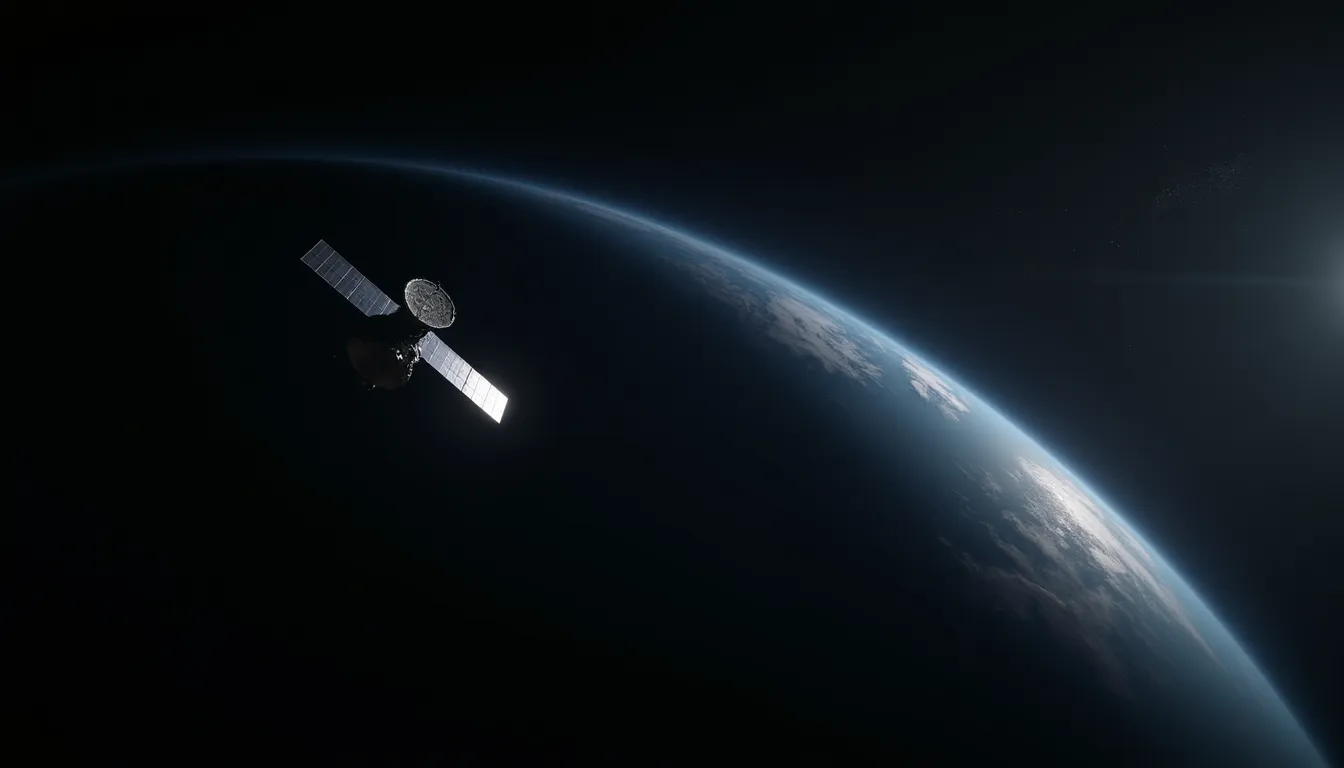
Jena-Optronik joins MDA Space's first ASTRO HP mission as sensor partner, while Breaking Defense reports on ground autonomy, loitering munitions, and Army acquisition changes.
Key Takeaways
- Jena-Optronik will supply sensors for MDA Space's first ASTRO HP mission, contract value undisclosed.
- Breaking Defense reports a new procurement split between commercial-derived AGVs and purpose-built UGVs.
- US-Norwegian startup Heaviside has launched its Tyr loitering munition.
- The US Army has again restructured its acquisition process to remove a bureaucratic layer.
- The IDF reports roughly 100,000 targets struck over three years of conflict.
- The Roomba, launched in 2002, established the autonomous navigation template now scaling into orbit.
Jena-Optronik announced on October 12 that it will supply its ASTRO HP star sensor for MDA Space's first ASTRO HP mission., according to SpaceNews, a deal that quietly advances the market for autonomous satellite servicing. Neither company disclosed a contract value or launch window for the mission. The announcement landed alongside four other autonomy-focused stories from Breaking Defense, a reminder that machine autonomy is moving from pilot programs into operational hardware across multiple domains at once.
What Happened
The partnership centers on a star sensor used for attitude determination aboard MDA Space's satellite. SpaceNews specified the mission is in low Earth orbit (LEO) but did not name the customer.
On the ground, Breaking Defense detailed how autonomous ground vehicles are splitting into distinct categories, with militaries now distinguishing commercial-derived AGVs from purpose-built uncrewed ground vehicles designed for combat conditions. The report frames this as a new procurement reality rather than a single uniform robotics category.
Separately, Breaking Defense
On the acquisition side, Breaking Defense also reported that the US Army has again revised its acquisition structure, this time to eliminate what officials described as an unnecessary bureaucratic layer, Part of a continuing effort to streamline Army acquisition processes generally, not specifically tied to autonomous or AI-enabled systems..
Finally, Breaking Defense reported that the Israel Defense Forces released new data marking three years of conflict, stating that roughly 100,000 targets have been struck during that period, a figure the IDF is using to characterize the scale and tempo of the campaign.
Why It Matters
The ASTRO HP sensor deal matters less for its size than for what it represents: satellite servicing missions require spacecraft to make real-time navigation decisions without ground intervention, effectively running AI inference in orbit. That same autonomy logic now threads through ground vehicles, loitering munitions, and targeting pipelines described in the Breaking Defense reports. Each domain is converging on the same requirement, machines that sense, decide, and act with less human latency. For investors tracking defense primes and space servicing contractors, this convergence is becoming a recognizable theme in defence and space sector equity analysis, where autonomy-adjacent suppliers are drawing increasing attention. The Army's acquisition restructuring and the IDF's targeting data both point to institutions trying to keep procurement and oversight pace with that shift.
Background
The lineage of today's autonomous hardware traces back to simpler consumer systems that first proved machines could navigate unpredictable environments without constant supervision. The Roomba established that template in 2002, demonstrating that affordable autonomous navigation could work reliably in uncontrolled spaces. The sensing and decision-making principles that let a vacuum map a living room scaled, over two decades, into the proximity sensors now steering spacecraft and the perception stacks guiding ground vehicles and loitering munitions.
What to Watch
Watch for MDA Space to disclose a launch date, orbit, and customer for the ASTRO HP mission, details that will clarify whether this is a one-off demonstration or the start of a recurring servicing line. On the ground, expect procurement documents to show whether the AGV/UGV split reported by Breaking Defense becomes a formal acquisition category. Heaviside's Tyr production volume and the Army's latest acquisition reshuffle will both signal how quickly autonomy programs can move from announcement to fielded units.
Sources
- SpaceNews: Jena-Optronik is proud to partner with MDA Space for its first ASTRO HP mission
- Breaking Defense: AGVs vs. UGVs: A new class of ground autonomy takes the field
- Breaking Defense: US-Norwegian startup Heaviside launches Tyr loitering munition
- Breaking Defense: Army again tweaks acquisition structure to remove unwanted layer of bureaucracy
- Breaking Defense: Three years of war, 100,000 targets struck: IDF releases new conflict data
- MachineHours Encyclopedia: Roomba: First Mass-Market Consumer Robot
Frequently Asked Questions
What is the ASTRO HP mission?
It is MDA Space's first mission under the ASTRO HP program, for which Jena-Optronik is supplying rendezvous and proximity sensors. Launch date and orbit have not been disclosed.
Why does satellite servicing require AI autonomy?
Close-proximity maneuvers like rendezvous and docking happen too fast for constant ground control, so spacecraft increasingly rely on onboard sensing and decision-making to navigate safely.
What is the difference between AGVs and UGVs according to Breaking Defense?
AGVs are generally commercial-derived autonomous ground vehicles, while UGVs are purpose-built for combat conditions, representing a new procurement distinction militaries are now making.
What is Heaviside's Tyr?
Tyr is a loitering munition launched by US-Norwegian startup Heaviside, joining a growing field of low-cost autonomous strike systems.
How does this connect to the Roomba?
The Roomba's 2002 launch proved autonomous navigation could work reliably in unpredictable environments, establishing sensing and decision-making principles that have since scaled into spacecraft, ground vehicles, and munitions.