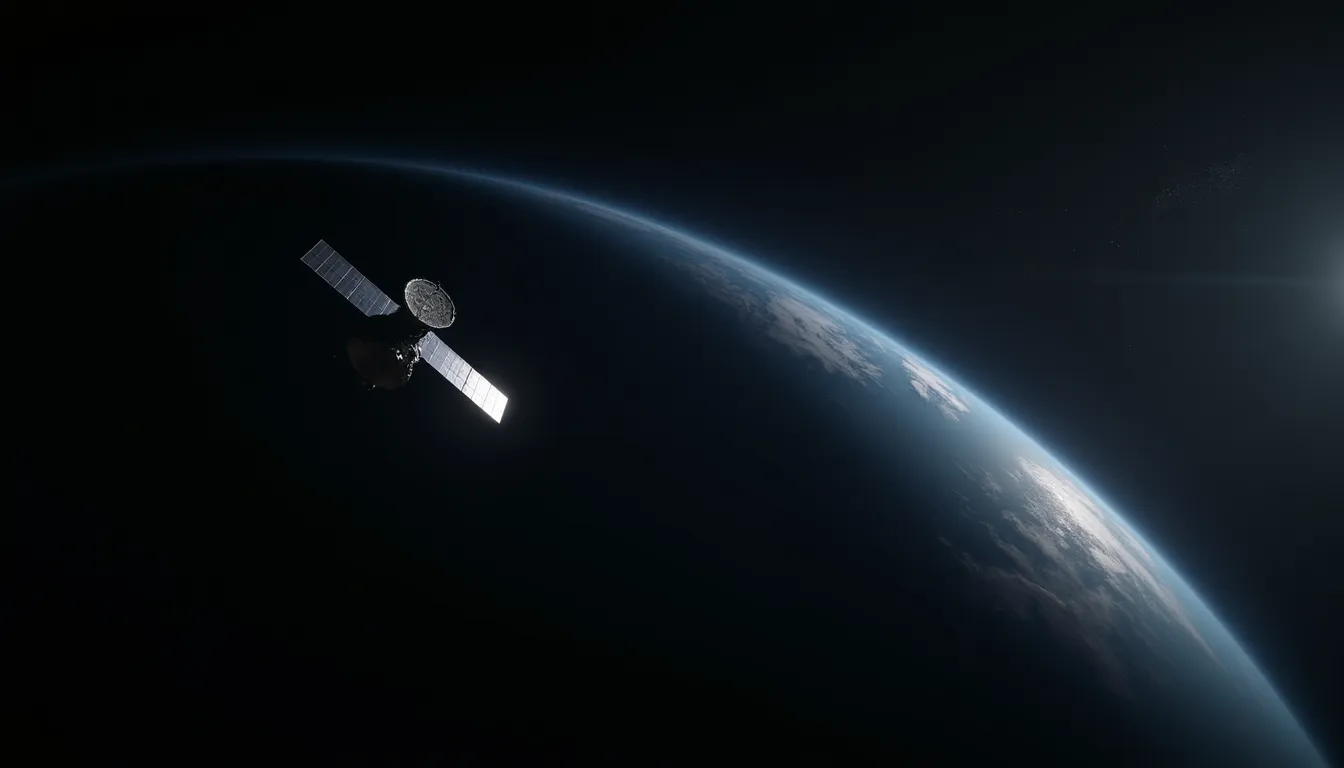
Jena-Optronik announced it will supply its ASTRO HP star sensor for MDA Space's first satellite servicing mission in low Earth orbit. The partnership represents a quiet advance in autonomous on-orbit systems that require real-time navigation decisions without ground intervention, a capability increasingly central across defense and space sectors.
Key Takeaways
- Jena-Optronik's ASTRO HP star sensor will enable MDA Space to conduct autonomous satellite servicing in low Earth orbit, using real-time attitude determination without ground intervention
- Satellite servicing requires onboard autonomy because signal latency makes ground teleoperation impractical for precise orbital rendezvous and maneuvering
- The sensing and decision logic enabling autonomous spacecraft operation mirrors the autonomy architecture now being deployed across ground vehicles, drones, and loitering munitions
- ASTRO HP combines proven sensor technology with a compact, modular design optimized for small and medium-sized satellites performing autonomous missions
- Deployment timeline and customer identity remain undisclosed, but successful operation would likely catalyze follow-on adoption of autonomous servicing across commercial and military operators
Satellite Servicing Partnership Marks Autonomy Milestone in Orbit
Jena-Optronik announced on October 12 that it will supply its ASTRO HP star sensor for MDA Space's first satellite servicing mission. The partnership centers on a star sensor used for attitude determination aboard MDA Space's spacecraft operating in low Earth orbit (LEO). Neither company disclosed a contract value or launch window for the mission, and SpaceNews did not name the customer.
The ASTRO HP optical head represents an evolution of Jena-Optronik's existing sensor technologies, combining proven heritage components into a new platform. According to the company's technical specifications, the sensor integrates the precision and agility of the ASTRO APS3 detector with flight-proven electronics and software from the ASTRO CL, unified by ASTROlib integration software. The optical head uses a radiation-hard Faintstar2 detector paired with very fast optics in a compact, lightweight design optimized for small and medium-sized satellites. The modular approach allows tailoring of performance and cost to mission-specific requirements, and the advanced ASTROlib software enables specialized space situational awareness (SSA) capabilities.
Why Autonomous Attitude Control Matters for Satellite Servicing
The significance of this partnership lies less in the contract size than in what the technology represents: satellite servicing missions fundamentally require spacecraft to make real-time navigation and attitude control decisions in orbit without constant ground intervention. This operational autonomy—the ability to sense the local environment, process that data, and make corrective maneuvers at orbital speeds—is a form of machine autonomy that runs continuously during a mission. Jena-Optronik's star sensor is the primary sensory input that enables that closed-loop autonomous operation.
Star sensors function as celestial navigation systems, detecting and tracking known star patterns to determine a spacecraft's precise orientation in three-dimensional space. By comparing observed star positions against a catalog of known stellar coordinates, the sensor generates attitude reference data that guides the spacecraft's control systems. For a satellite servicing mission—where one spacecraft must approach, dock with, or manipulate another in orbit—this real-time attitude knowledge is not optional; it is the foundation of safe approach and rendezvous operations.
The autonomy requirement becomes more acute when communication latency is factored in. Ground stations controlling spacecraft typically experience signal delays measured in seconds, making remote teleoperation of precise maneuvers impractical. A servicing spacecraft must instead execute its approach sequence using onboard sensor data and pre-programmed decision logic, adjusting course and orientation based on what its star sensor and other instruments report about its position and the target's location. The machine must sense, decide, and act without waiting for ground approval on each micro-correction.
The Broader Autonomy Convergence
This satellite servicing partnership is one manifestation of a wider institutional shift toward autonomous systems across multiple domains. The timing of the Jena-Optronik announcement alongside other autonomous hardware announcements illustrates a convergence pattern: military and space organizations are simultaneously moving autonomous systems from experimental programs into operational procurement. The sensing and decision-making principles that enable a satellite to navigate autonomously in orbit are the same principles now being deployed in ground-based autonomous vehicles, loitering munitions with AI-assisted targeting, and other platforms that require machines to operate with reduced human latency.
Each system—whether orbital, aerial, or terrestrial—faces a shared design problem: how to equip a machine with enough onboard intelligence to handle navigation, obstacle detection, target recognition, and engagement decisions when human operators cannot supervise every action in real time. The technical solutions differ in detail—space systems use star sensors and inertial measurement units, ground vehicles use lidar and cameras, drones use electro-optical and infrared sensors—but the underlying autonomy architecture is similar. Sense, fuse the sensor data, run inference logic, output a command, repeat at high frequency.
For MDA Space, this convergence creates both opportunity and risk. Opportunity because satellite servicing is an expanding market; commercial and military operators increasingly want on-orbit repair, refueling, and maneuvering services, all of which depend on autonomous spacecraft. Risk because the technology is still maturing, and failures in autonomy systems—whether a satellite misidentifies its target or a servicing spacecraft executes a maneuver incorrectly—can result in mission loss or on-orbit collisions.
Technical Lineage and Evolution
The evolution of today's autonomous systems in space and on the ground traces back further than might be obvious. The principles of autonomous navigation that now guide satellite servicing were preceded by simpler autonomous consumer systems that first proved machines could navigate uncontrolled environments reliably. The Roomba, introduced in 2002, established an early commercial template for autonomous navigation, demonstrating that affordable autonomous systems could map and clean unpredictable indoor spaces without constant human supervision. The Roomba's sensing and decision-making architecture—using proximity sensors, bump sensors, and simple heuristics to navigate—provided a proof of concept that scaled, over two decades, into the sophisticated sensor stacks and inference pipelines now operating in orbit and on the battlefield.
Star sensors themselves have a decades-long heritage in space. Their use in attitude determination has been validated across thousands of satellites. What is new with ASTRO HP is the specific combination of performance, power efficiency, and compact form factor optimized for small and medium-sized platforms. As satellite servicing missions demand more maneuverability and precision from smaller vehicles, sensor manufacturers like Jena-Optronik have responded by tightening the performance-to-weight trade-off.
What Happens Next
The market and timeline signals to watch are clear. First, MDA Space will eventually disclose a launch date, the target orbit, and the identity of the customer. Those details will clarify whether this is a one-off demonstration of satellite servicing capability or the beginning of a recurring servicing line. A named customer and published launch window would suggest sustained demand; a delayed or undisclosed launch would suggest the technology remains experimental. Second, look for follow-on orders for the ASTRO HP sensor from other satellite operators. If the first servicing mission succeeds, other companies pursuing on-orbit servicing—including commercial startups and government operators—will likely adopt proven components to reduce technical risk in their own programs. Third, monitor whether the Space Force or other U.S. military space organizations formally adopt autonomous satellite servicing for their own spacecraft; military interest in this capability has been steady, and a procurement announcement would signal a new budget category dedicated to autonomous orbital operations.
Jena-Optronik Star Sensor Powers MDA Space Autonomous Satellite MissionSources
- SpaceNews: Jena-Optronik is proud to partner with MDA Space for its first ASTRO HP mission
- Breaking Defense: AGVs vs. UGVs: A new class of ground autonomy takes the field
- Breaking Defense: US-Norwegian startup Heaviside launches Tyr loitering munition
- Breaking Defense: Army again tweaks acquisition structure to remove unwanted layer of bureaucracy
- Breaking Defense: Three years of war, 100,000 targets struck: IDF releases new conflict data
- MachineHours Encyclopedia: Roomba: First Mass-Market Consumer Robot
Frequently Asked Questions
What is the ASTRO HP mission?
It is MDA Space's first mission under the ASTRO HP program, for which Jena-Optronik is supplying rendezvous and proximity sensors. Launch date and orbit have not been disclosed.
Why does satellite servicing require AI autonomy?
Close-proximity maneuvers like rendezvous and docking happen too fast for constant ground control, so spacecraft increasingly rely on onboard sensing and decision-making to navigate safely.
What is the difference between AGVs and UGVs according to Breaking Defense?
AGVs are generally commercial-derived autonomous ground vehicles, while UGVs are purpose-built for combat conditions, representing a new procurement distinction militaries are now making.
What is Heaviside's Tyr?
Tyr is a loitering munition launched by US-Norwegian startup Heaviside, joining a growing field of low-cost autonomous strike systems.
How does this connect to the Roomba?
The Roomba's 2002 launch proved autonomous navigation could work reliably in unpredictable environments, establishing sensing and decision-making principles that have since scaled into spacecraft, ground vehicles, and munitions.
Get MachineHours in your inbox
AI compute and the machine economy in your inbox.