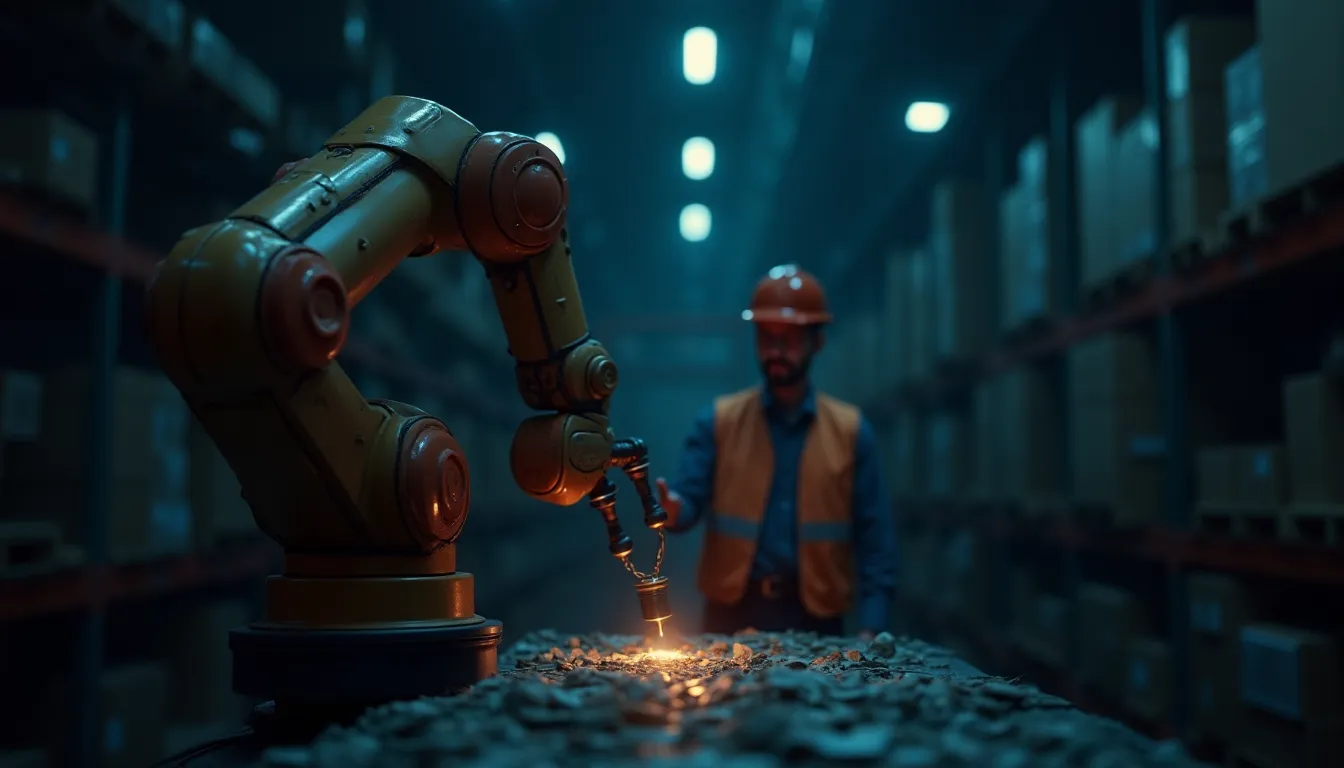
Maven Robotics, founded by former Apple and automotive engineers, has raised $100 million to compete for enterprise robot deployment contracts by focusing on end-to-end workflow integration rather than hardware sales. The startup's approach signals a shift in robotics economics toward capturing value through deployment services and operational expertise.
Key Takeaways
- Maven Robotics has raised $100 million to compete for enterprise robot deployment contracts by focusing on end-to-end workflow integration rather than hardware sales
- The company's wheeled robots with dual arms specialize in mixed palletization—automating the warehouse task of creating custom product pallets based on real-time retail demand
- Maven's leadership brings deep expertise from autonomous vehicle development and automotive engineering, distinguishing it from research-focused robotics competitors
- The company's business model creates demand for hybrid labour spanning systems integration, operational technology, and workforce training—a skills category without yet-scaled formal training pipelines
- Maven's strategy of solving one customer problem at a time, with each targeting multibillion-dollar market opportunities, prioritizes ROI over generalist robotics capabilities
Maven Robotics is positioning itself to pull clients away from incumbent robot deployment providers by focusing on end-to-end workflow integration rather than hardware sales alone, according to TechCrunch. The startup has emerged from stealth after raising $100 million from RoboStrategy, LocalGlobe, Vine Ventures, and XTX Ventures, a funding round that signals growing commercial competition over who manages enterprise robot deployments and the specialist labour roles that accompany them.
Maven's Approach: Integration Over Hardware
Maven does not position itself as a robot manufacturer competing on hardware specifications. Instead, CEO and co-founder Hamza Derbas told TechCrunch the company's strategy is to solve complete warehouse and logistics workflows end-to-end. "We're not trying to solve a single robot problem," Derbas explained. "We're trying to autonomously take on the task end to end: It hooks in from one side to a warehouse management system; product goes on trucks on the other side."
The company demonstrated this approach in its first major contract win. In 2024, when Maven was nascent—described as having "nothing" but "a cartoon of a robot and a team of people"—a large consumer goods company with significant logistics needs was meeting with four rival robot companies about automation. Rather than pitching generic robotics capabilities, Derbas requested access to the company's factories and warehouses. "We saw how people were working; we zeroed in on flows we could immediately bring value to," he said.
Maven won that contract, beating established competitors with existing robot platforms. After two years of work with that initial customer and several other partners, Maven reports operating as many as eight robots working 16 hours a day, with 99% or higher uptime.
Maven's Hardware and Capabilities
Maven's robots are wheeled platforms capable of moving 10 miles per hour, equipped with two arms that can lift up to 30 kilograms. Their primary application is mixed palletizing—taking wooden pallets carrying boxed goods from different factories to a distribution center and creating new pallets containing mixed goods for delivery to retail stores.
The workflow these robots automate currently relies on manual labor. As Derbas described it: "Within 48 hours of them putting the stuff on the shelves, they want to change the mix based on real-time demand. Here's an order with different mixed [products] going to that retail store; please build it out. It's all done with human labor today, running around the warehouse picking one of this, one of that."
Maven's operating model differs markedly from traditional robotics vendors. Rather than selling robots and maintenance contracts, Maven is building a business around continuous operational optimization. The company relies on data pipelines that return information from operating robots within minutes or hours, enabling rapid retraining and redeployment of the system's learned behaviors.
Leadership and Technical Foundation
Maven's founders bring deep expertise in autonomous systems and industrial operations. CEO Hamza Derbas spent his career in automotive engineering focused on electric vehicles. Before founding Maven, he spent nine years at Apple's special projects group—widely understood to have been developing autonomous vehicle technology before disbanding in 2024. His co-founder and CFO brother, Khalid, brings a background in private equity.
Like other physical AI companies, Maven relies on veterans of self-driving car efforts, which have developed the most sophisticated approaches to training autonomous hardware from real data. This technical foundation distinguishes Maven from roboticists trained primarily in academic or research environments.
Market Positioning and Competitive Differentiation
Jack Pearson, an investor at RoboStrategy, characterizes Maven's competitive advantage as rooted in industrial systems expertise rather than research culture optimized for learning or focused on a specific architecture. The company's primary competitor positioned similarly is Agility Robotics, which is preparing for a public listing in a $2.5 billion SPAC deal, also focused on safety and specific industrial workflows.
Derbas expressed skepticism about alternative robotic form factors pursued by competitors, noting that Agility's bipedal robots—while respecting the company's approach—"make zero sense for anything they're doing…they are very complex, unreliable, and add unnecessary cost. ROI is the name of the game here."
Near-Term Growth and Scaling Plans
Maven plans to build 250 of its third-generation robots and begin design on a fourth-generation platform. The company's expansion strategy remains grounded in task-specific deployment rather than pursuing a general-purpose robotics vision simultaneously across multiple workflows.
"We're grounded in solving one customer problem at a time," Derbas told TechCrunch. "If you focus on solving problems and you pick sizeable problems, each problem is a multibillion-dollar market. If you do that, there's plenty of data to master these skills."
While palletization represents a substantial market opportunity, Maven has identified broader automation targets. The company's next major push is to collect more data and train robots to handle materials fabrication and manipulation—capabilities that don't yet exist at production scale. To develop these capabilities, Maven is drawing on its own systems, tapping third-party providers, and has even developed pincer-like gloves allowing humans to emulate the gripper form factors the company wants to develop.
Strategic Context: The Emergence of Deployment Services as a Business Layer
Maven's model reflects a pattern familiar from infrastructure sectors. Once underlying hardware commoditizes, specialist service firms emerge to compete on configuration, support, and workflow integration expertise. In cloud computing, this dynamic produced a thriving ecosystem of systems integrators and implementation specialists alongside infrastructure vendors. The deployment services layer for robotics may follow a similar trajectory.
The economics of this shift matter significantly for workforce development and labour distribution. Traditional robotics business models—where manufacturers control deployment—concentrate both capital returns and operational decision-making. A distributed deployment services model, if Maven's approach succeeds, could create demand for hybrid labour: part systems integrator, part operational technologist, part workforce trainer. This category of work doesn't yet have formal training pipelines scaled to meet emerging demand.
The success or failure of Maven's model will depend partly on whether the company can attract and retain talent at the scale deployment services require, and whether enterprise customers prefer to work with independent deployment specialists or continue relying on direct relationships with hardware manufacturers. Derbas emphasized that Maven is "not in the race for models—we're in the race to solve industrial labor and make this work possible at the scale the world needs."
This positioning suggests Maven views itself not as a robotics company in the traditional sense, but as a labour-optimization company that happens to deploy robots as its execution mechanism. Whether that framing proves sufficient to build a durable, scalable business remains an open question—one that will become clearer as Maven reports on named customer wins and operational uptime metrics across its expanding fleet.
Sources
- TechCrunch: Maven Robotics wants to steal your robot deployment deal
- Breaking Defense: Israeli military creates new branch focused on AI, drones and robotics
- Wired: Best Robot Lawn Mowers (2026): 12+ Models Tested Over 3 Years
- Financial Times: Uber picks a side in driver vs robotaxi wars: its own
- MachineHours Encyclopedia: AI and Wealth Concentration — Who Captures the Gains
Frequently Asked Questions
What does Maven Robotics actually do?
Maven Robotics manages the full operational lifecycle of robot deployments for businesses, covering installation, maintenance, and human-robot workflow coordination. It is pitching faster setup and more flexible service terms to win clients from existing providers.
Why did Israel create a new military AI and robotics branch?
The Israeli military formed the branch to consolidate AI systems, autonomous drone operations, and ground robotics under one command, formalising capabilities previously distributed across existing units and creating a dedicated talent and training pipeline.
How does Uber's robotaxi strategy affect its drivers?
Uber is positioning to develop or license its own autonomous vehicle capacity using its platform data, which could reduce reliance on its roughly 5.4 million global contracted drivers over time.
What new jobs are emerging from robot deployment growth?
The deployment services sector requires workers who combine systems integration, operational technology, and workforce training skills - a hybrid role category that formal training programs have not yet scaled to supply at pace with demand.
Is robot lawn mower servicing becoming a real industry?
Wired's 2026 roundup covering 12-plus models tested over three years indicates the consumer robotics category has matured enough to require a growing base of technicians for installation, calibration, and ongoing maintenance.
Get MachineHours in your inbox
AI compute and the machine economy in your inbox.