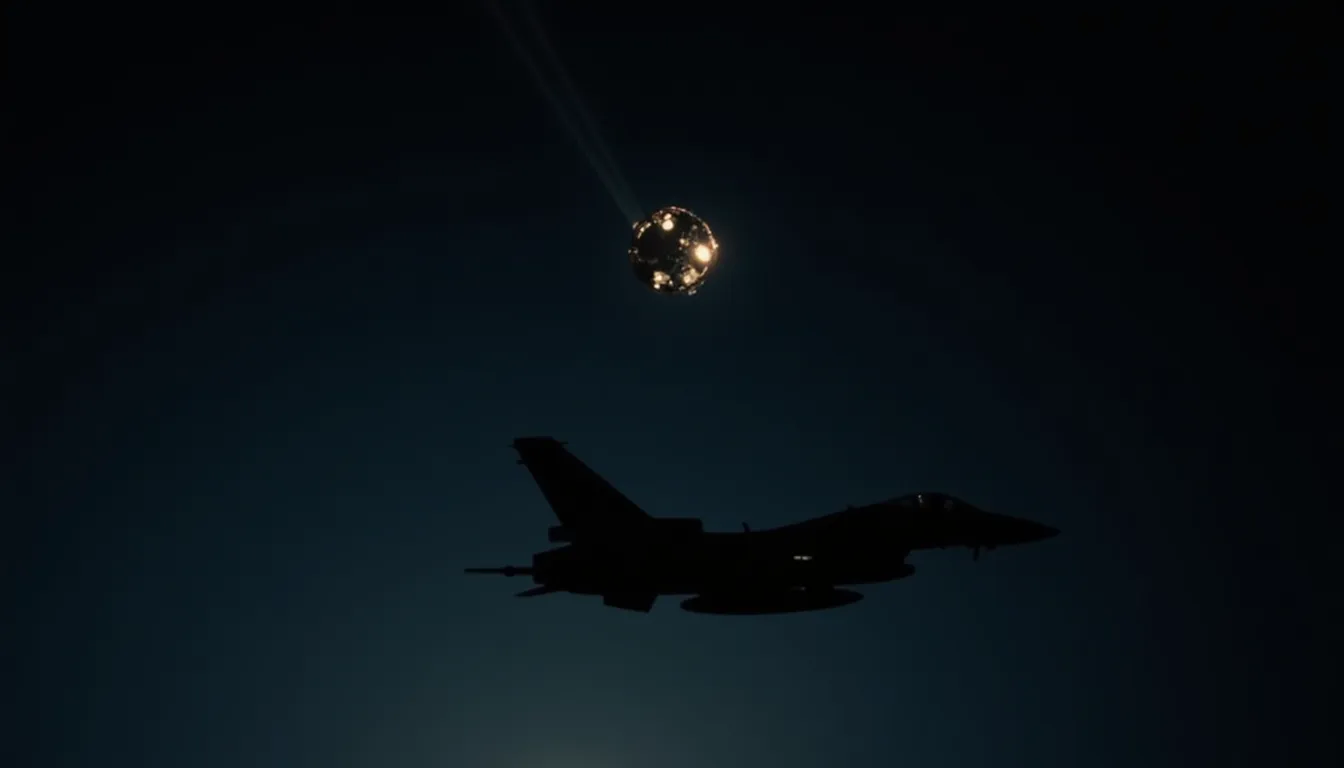
Italian Eurofighter jets destroyed an unidentified drone over Lithuania on September 15, 2026, in a NATO air-policing mission—the second such intercept in a month. The incident underscores how drone proliferation is forcing NATO to deploy expensive crewed aircraft against low-cost uncrewed threats and highlights the operational challenges of airspace defense in the Baltic region.
Key Takeaways
- Italian Eurofighter jets shot down an unidentified, armed drone over Lithuanian airspace on September 15, 2026, marking the second such NATO intercept in 30 days
- The incident underscores a cost-asymmetry problem: deploying expensive crewed fighters against potentially low-cost unmanned systems is operationally unsustainable at scale
- NATO air forces are moving to address the challenge by integrating lower-cost precision-guided munitions like the APKWS onto existing fighter platforms; the US approved a $364 million APKWS sale to Italy in August 2026
- Lithuanian authorities suspect the drone originated from Belarus but have not publicly identified the actor responsible; forensic investigation is ongoing
- The Baltic region has become NATO's most closely watched airspace since Russia's 2022 invasion of Ukraine, with multiple member states rotating combat air patrols to detect and intercept unauthorized incursions
Two Italian Eurofighter F-2000 jets assigned to NATO's Baltic Air Policing Task Force destroyed an unidentified drone over Lithuanian airspace shortly after midnight on September 15, 2026, according to the Italian Ministry of Defense. The incident marked the second time in 30 days that Italian pilots operating from Šiauliai Air Base in northern Lithuania shot down an unauthorized unmanned aircraft, having previously responded to a similar incursion over Latvian airspace on August 14.
The Italian crews intercepted the aircraft and "neutralized it in compliance with the operational procedures established by the Alliance," the Italian Ministry of Defense stated. Lithuanian Defense Minister Robertas Kaunas confirmed that the drone was carrying an explosive device. Lithuanian authorities did not publicly identify the source of the incursion but reportedly suspect it entered the country's airspace from Belarus.
The intercept operation reveals a persistent tension in modern air defense: the cost-asymmetry problem. It remains unclear what specific weapon system the Italian pilots used to down the drone, but the deployment of a Eurofighter—an advanced multirole combat aircraft worth hundreds of millions of dollars—to counter a target that may have been commercially sourced or relatively inexpensive illustrates why NATO air forces are urgently seeking lower-cost intercept solutions.
Addressing the Cost-Asymmetry Problem
The Italian Air Force may soon have access to more cost-effective options. In August 2026, the US State Department approved a possible Foreign Military Sale to Italy worth $364 million for 5,031 Advanced Precision Kill Weapon System (APKWS) II guidance systems and related equipment manufactured by BAE Systems. The APKWS kit would offer a cheaper alternative for Italian pilots to neutralize low-cost drones, rather than firing considerably more expensive missiles such as the AMRAAM.
Other NATO air forces are already operationalizing similar solutions. In May 2026, the UK Ministry of Defense announced that it had integrated the APKWS onto the Eurofighter and was using it in operations in the Middle East against cheap drones. This pattern—integrating precision-guided, lower-cost munitions onto existing fighter platforms—reflects a broader reorientation within Western air forces toward countering unmanned systems at a sustainable operational and financial scale.
The Baltic Air-Policing Mission
The Lithuanian incident places NATO's enhanced air-policing mission under sharp focus. Since Russia's full-scale invasion of Ukraine in February 2022, Baltic airspace has become one of the alliance's most closely watched zones. Multiple member states have been rotating combat air patrols throughout the region, and the September 15 intercept represents one of the most visible operational responses to an airspace violation in recent years.
NATO's air-policing framework requires scrambled fighters to intercept aircraft that enter member-state airspace without authorization. The protocol is straightforward in principle: identify the contact, establish communication through standard radio procedures, and if the aircraft fails to comply or identify itself, guide it to an airfield or out of airspace. In cases where the aircraft poses an immediate threat—such as when it is armed, as this drone reportedly was—NATO procedures authorize interception and, if necessary, destruction.
The recurrence of such incidents—two in thirty days—suggests that NATO's enhanced air patrols are encountering a rising volume of incursions. This could reflect increased probing by Russian or proxy forces, attempts by regional actors to test NATO responses, or a combination of both. The geographical pattern is telling: both incidents occurred in the northern Baltic, where Lithuania and Latvia border Belarus and Russia, respectively.
Drone Proliferation and Attribution Challenges
The broader context for the Lithuanian intercept is the proliferation of unmanned systems across military and commercial supply chains. Drones capable of carrying payloads have become cheap and widely available. Commercial off-the-shelf platforms can be modified for military use, and determining the origin of an unmanned system in real time is often impossible. In the Lithuanian case, authorities were investigating the drone's origin, a forensic process that may take weeks or longer.
This identification gap creates an operational dilemma for NATO. If a drone fails to respond to intercept and communication procedures, defending commanders must assume it poses a threat and act accordingly. Yet the use of crewed fighters—a scarce and costly resource—to neutralize potentially low-cost targets is operationally unsustainable at scale. If the volume of incursions continues to rise, NATO air forces will need to scale their response capabilities accordingly, which the APKWS integration across the fleet partially addresses.
NATO Command Notification and Follow-Up
NATO command was notified immediately following the intercept. While the incident did not trigger formal consultations under NATO's Article 4 (which allows any member to request consultations if it believes its territorial integrity, independence, or security is threatened), it reinforced the alliance's shared assessment that the Baltic operating environment has become persistently contested.
The questions now are whether the wreckage will yield forensic clues about the drone's origin, whether subsequent incidents will follow a similar pattern, and whether NATO will accelerate investment in drone-defense systems specifically designed to handle multiple intercepts without depleting crewed fighter availability. The approved APKWS sale to Italy suggests that NATO's defense industrial base is already moving to address the cost-asymmetry problem, but scaling such solutions across the alliance will require sustained procurement investment and integration efforts on multiple fighter platforms.
The Lithuanian intercept, in this sense, is not an isolated event but a concrete operational moment illustrating the challenges that NATO faces in an environment where unmanned systems have become ubiquitous and identification and attribution capabilities lag behind the speed of airspace violation.
Sources
- Breaking Defense: Italian fighter jets shoot down unidentified drone over Lithuania
- Breaking Defense: Why the US is talking about space weapons now
- SpaceNews: Iceye's global presence expands to address sovereign demand
- Breaking Defense: A new era of uncrewed airpower — GA-ASI's lineup for high-tech warfare
- Breaking Defense: EXCLUSIVE — Pratt licenses Hermeus to build F100 fighter jet engine
- MachineHours Encyclopedia: Roomba: First Mass-Market Consumer Robot
Frequently Asked Questions
Why did Italian jets shoot down a drone over Lithuania?
Italian aircraft assigned to NATO's enhanced air-policing mission intercepted the drone after it failed to identify itself or respond to contact procedures. Lithuanian authorities were investigating the drone's origin as of September 15, 2026.
Why is the US now openly talking about space weapons?
Breaking Defense reports that senior Pentagon and Space Force officials argue deterrence now requires visible capability, prompted by China and Russia developing kinetic kill vehicles and directed-energy counter-space systems.
What does Iceye's global expansion mean for defence customers?
Iceye is building local ground infrastructure and partnerships to give national governments independent, persistent SAR satellite coverage, reducing reliance on commercial data brokers for sensitive intelligence needs.
What is the significance of Pratt and Whitney licensing Hermeus to build the F100?
It gives hypersonic aircraft developer Hermeus access to a proven, flight-qualified turbofan engine, potentially accelerating its Mach 5 Quarterhorse demonstrator programme without requiring a clean-sheet propulsion development effort.
How is GA-ASI changing its uncrewed aircraft strategy?
General Atomics Aeronautical Systems is moving beyond persistent surveillance roles and designing next-generation platforms to operate in contested airspace alongside crewed fighters, reflecting lessons from drone warfare in Ukraine and the Middle East.
Get MachineHours in your inbox
AI compute and the machine economy in your inbox.