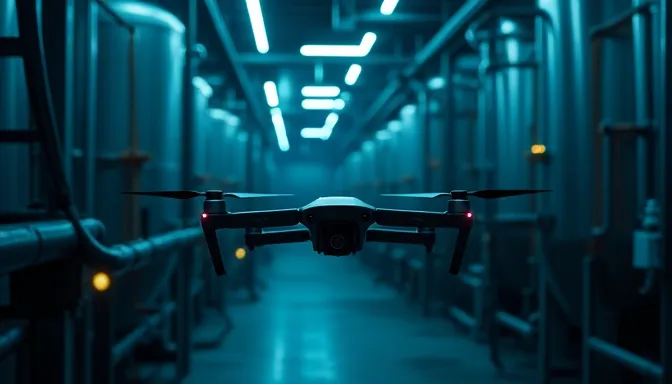
The Robot Report details how combined sensor failures, not single faults, undermine autonomous drone inspections at industrial sites.
Key Takeaways
- The Robot Report (Nov 19, 2026) details how combined sensor failures, not single faults, undermine industrial drone autonomy.
- RTK GPS positioning does not eliminate obstruction, multipath interference or cycle slips near industrial structures.
- A braking-distance model shows doubling flight speed quadruples the idealized braking-distance term, exposing latency risks.
- Navigation accuracy and inspection-data accuracy are described as related but distinct problems for commercial drone deployment.
- MachineHours' AI Acceleration Index shows adoption at 52 versus capability at 38, consistent with deployment outpacing validated reliability.
A drone that flies a flawless inspection route in a lab can still falter at a real steel plant when GNSS signals drop, reflective pipework scrambles depth sensors, and a wind gust pushes it off course at the same time. According to The Robot Report, published November 19, 2026, this kind of compounding failure, not any single malfunction, is the core obstacle standing between industrial drone autonomy demonstrations and dependable commercial deployment.
What Happened
According to The Robot Report, industrial facilities create conditions that are difficult to reproduce in controlled testing: metallic surfaces, repetitive structural patterns, narrow corridors, moving equipment and changing illumination can degrade multiple sensors at once. The report walks through a hypothetical UAV inspecting pipework next to a steel-framed processing facility, where GNSS reliability drops as the aircraft approaches the structure, repetitive pipe geometry confuses visual feature matching, and reflective surfaces generate inconsistent depth readings while the flight controller simultaneously fights aerodynamic disturbance from the nearby structure.
The Robot Report details how Real-Time Kinematic (RTK) positioning, often treated as a fix for GNSS weakness, does not eliminate obstruction, multipath interference, cycle slips or poor satellite geometry, meaning a fixed-ambiguity RTK solution should not be read as a guarantee of accurate positioning. The piece also cites published localization approaches such as VINS-Mono for visual-inertial odometry and LIO-SAM for lidar-inertial mapping, noting that visual methods depend on illumination and image quality while lidar methods can struggle with weak geometric returns.
On obstacle avoidance, The Robot Report frames the challenge as an end-to-end timing problem rather than a pure detection problem, offering a simplified braking-distance model (d ≈ vT + v²/(2a)) to show that doubling a drone's flight speed doubles the distance covered during processing delay and quadruples the idealized braking-distance term. The report also stresses that sensor fusion techniques like the extended Kalman filter can become overconfident if noise models poorly represent correlated GNSS multipath errors, and that navigation accuracy does not guarantee that collected inspection data, whether photogrammetric, thermal or lidar, is actually fit for engineering decisions.
Why It Matters
This is MachineHours analysis. The Robot Report's breakdown reads less like a warning against drone autonomy and more like an engineering checklist for what commercial deployment actually requires: predictable behavior within a defined operational envelope, including when that envelope is exceeded, rather than uninterrupted autonomy under every condition. That distinction matters directly for market adoption. MachineHours' AI Acceleration Index currently shows an adoption sub-index of 52 against a capability sub-index of 38, a gap consistent with systems that work well enough to attract deployment interest but still require the kind of validation rigor described here before they can be trusted at scale on energized infrastructure or confined industrial sites. For companies selling autonomous inspection as a service, the commercial pitch increasingly rests on demonstrating fault-handling logic, not just flight demos, which has implications for how investors should weigh equity market implications of robotics deployment across the broader autonomy supply chain. The report's emphasis on human oversight and FAA-aligned procedures also signals that regulatory compliance, not just technical capability, will gate how fast industrial drone autonomy scales commercially.
Background
Autonomous flight sits within a broader push to commercialize physical AI, a trend MachineHours has tracked in its drone technology entry, which projects the sector growing from $43.6 billion to $109.8 billion by 2030 as autonomous systems take on inspection, logistics and surveillance tasks previously requiring human access. The underlying engineering tensions described in The Robot Report, balancing sensor fusion, latency and control authority, echo challenges also seen in ground robotics, as covered in MachineHours' background on Figure's humanoid robot and Boston Dynamics, both of which have had to prove reliability in unstructured environments before scaling deployment. The lineage traces back to foundational automation concepts established by Unimate, the first industrial robot arm, which demonstrated that machines could handle repetitive and hazardous tasks reliably, a bar industrial drones are still working to clear in dynamic, GNSS-degraded settings.
What to Watch
The Robot Report's validation framework calls for simulation, hardware-in-the-loop testing, controlled flight trials and progressively representative operating environments before any system is declared deployment-ready, explicitly rejecting the idea that a single successful demonstration establishes readiness. Expect operators and vendors to publish more granular acceptance criteria tied to estimator consistency, measurement rejection rates and defined fallback behaviors such as pause, return or operator handoff, rather than headline autonomy claims. Watch also for how FAA requirements intersect with these engineering standards, since the report notes autonomous execution does not remove regulatory responsibility. MachineHours' adoption indicator, currently at 52, will be worth tracking as a proxy for whether commercial buyers are accepting this slower, validation-heavy deployment path.
Key Facts
- RTK positioning does not eliminate GNSS obstruction, multipath interference or cycle slips, per The Robot Report.
- Simplified braking model: d ≈ vT + v²/(2a); doubling flight speed quadruples the idealized braking-distance term.
- Industrial hazards cited include steel structures blocking GNSS, reflective surfaces distorting depth sensing, and wind gusts near buildings creating variable disturbance.
- The Robot Report recommends combining simulation, hardware-in-the-loop testing and progressively representative field trials rather than relying on single demonstrations.
Sources
- The Robot Report: What industrial drone deployments reveal about real-world autonomy challenges
- MachineHours Encyclopedia: Drone Technology — Autonomous Flight and Its Economic Impact
- MachineHours: AI Acceleration Index
- MachineHours Encyclopedia: Humanoid Robot Commercial Deployment — The Race to Scale Physical AI
- Unimate — The First Industrial Robot Arm
- Figure Humanoid Robot
- Boston Dynamics — Engineering the World's Most Advanced Robots
Frequently Asked Questions
Why do industrial drones fail even after passing lab tests?
According to The Robot Report, industrial sites create multiple simultaneous sensor disturbances, such as GNSS blockage, reflective-surface depth errors, and wind gusts, that rarely occur together in controlled lab demonstrations.
Does RTK GPS solve GNSS reliability problems for drones?
No. The Robot Report states RTK improves accuracy using carrier-phase measurements but does not eliminate obstruction, multipath interference, cycle slips, or poor satellite geometry.
How does flight speed affect obstacle avoidance safety margins?
Using a simplified braking model (d ≈ vT + v²/(2a)), The Robot Report notes that doubling flight speed doubles the distance covered during processing delay and quadruples the idealized braking-distance term.
Can a drone fly accurately but still collect unreliable inspection data?
Yes. The Robot Report distinguishes navigation accuracy from inspection-data accuracy, noting a drone can hold a stable position while capturing blurred imagery or poorly calibrated thermal and lidar data.
What does this mean for commercial drone deployment timelines?
The Robot Report argues readiness requires simulation, hardware-in-the-loop testing and progressively representative field trials rather than a single successful demo, suggesting slower, validation-heavy commercial rollouts.
Get MachineHours in your inbox
AI compute and the machine economy in your inbox.