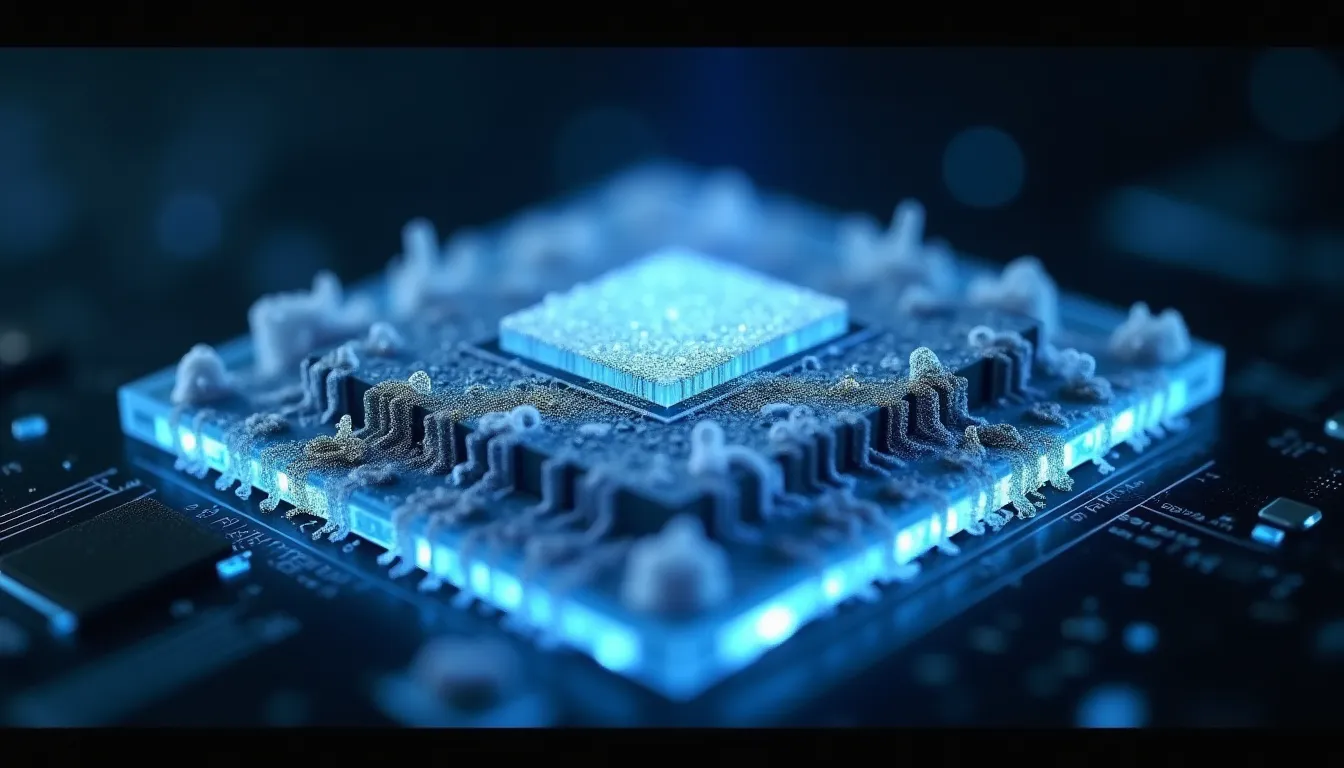
Hong Kong University engineers have developed the world's first cryogenic neuromorphic chip operating at -269°C. The advance could advance quantum computing and deep-space applications.
Key Takeaways
- Hong Kong University created the world's first neuromorphic chip operating at -269°C for quantum computing applications
- The cryogenic chip eliminates thermal management problems between quantum processors and control systems
- Arkeon Technologies raised $691,000 to commercialize post-fabrication quantum chip optimization technology
- The advance could reduce quantum computer power consumption by eliminating temperature differential overhead
- Applications may first appear in deep-space exploration where natural cold environments support cryogenic operation
What Happened
The University of Hong Kong's engineering team created a neuromorphic processor specifically designed to function in cryogenic environments where quantum computers operate. The Quantum Insider reports that the chip mimics neural network structures while maintaining functionality at temperatures approximately 0.01 degrees above absolute zero. This represents a significant engineering achievement, as conventional semiconductors typically fail at such extreme temperatures.
The development addresses power consumption challenges that have plagued quantum computing systems. Traditional quantum computers require separate room-temperature control electronics, creating thermal management problems and energy inefficiencies. By integrating neuromorphic processing directly into the cryogenic environment, the HKU team has eliminated the need for constant warming and cooling cycles between quantum processors and their control systems.
Meanwhile, Arkeon Technologies secured $691,000 USD in seed funding to commercialize post-fabrication quantum chip trimming technology.
Why It Matters
The cryogenic neuromorphic advance tackles one of quantum computing's most persistent engineering challenges: the massive energy overhead required to bridge quantum processors with classical control systems. Current quantum computers consume enormous amounts of power maintaining the temperature differential between quantum processors operating at millikelvin temperatures and room-temperature control electronics.
This development signals a shift toward more integrated quantum architectures, potentially reducing the infrastructure requirements for quantum systems by orders of magnitude. The approach could accelerate quantum computing deployment beyond research laboratories into practical applications. The convergence of neuromorphic computing with quantum systems also points to emerging opportunities in semiconductor market concentration and bubble risk as new specialized chip categories emerge.
Background
The development builds on Nvidia's AI dominance in specialized computing architectures, though quantum neuromorphic chips represent a different approach to processing. While Nvidia's GPU architecture has dominated AI training and inference, quantum neuromorphic processors could enable entirely new computing paradigms that combine quantum speedup with brain-inspired efficiency.
Traditional semiconductor fabrication has focused on room-temperature operation, but quantum computing demands have pushed manufacturers toward cryogenic-compatible designs. This trend represents a significant departure from conventional chip design principles established over decades of silicon innovation.
What to Watch
The successful demonstration of cryogenic neuromorphic chips could accelerate development of hybrid quantum-classical systems. Watch for major quantum computing companies like IBM and Google to explore similar integrated approaches that reduce system complexity and power consumption.
Commercial applications may first appear in space exploration, where the extreme cold environment naturally supports cryogenic operation without additional cooling infrastructure. Deep-space missions could benefit from neuromorphic processors that maintain functionality in the vacuum of space while providing advanced computational capabilities.
Key Facts
- Nvidia's GPU architecture processes over 95% of all large-scale AI model training globally
- The company's CUDA software ecosystem creates switching costs exceeding $100 billion for major tech companies
- Nvidia's H100 chips cost $25,000-40,000 each with 6-12 month delivery delays
- Five companies control 80% of global AI chip demand: Meta, Microsoft, Google, Amazon, and ByteDance
Sources
Frequently Asked Questions
What makes the HKU neuromorphic chip different from regular computer chips?
The HKU chip is designed to function at -269°C, mimicking brain neural networks while operating in the extreme cold required for quantum computers, unlike conventional chips that fail at such temperatures.
Why do quantum computers need cryogenic temperatures?
Quantum computers require temperatures near absolute zero to maintain quantum states and prevent thermal noise from disrupting delicate quantum operations.
How does this solve quantum computing's power consumption problem?
By placing neuromorphic processors directly in the cryogenic environment, the system eliminates the massive energy overhead of constantly warming and cooling signals between quantum and classical components.
What applications could benefit from cryogenic neuromorphic chips?
Deep-space exploration missions could use these chips since space naturally provides the extreme cold environment, while quantum computing systems could become more energy-efficient.
Get MachineHours in your inbox
AI compute and the machine economy in your inbox.