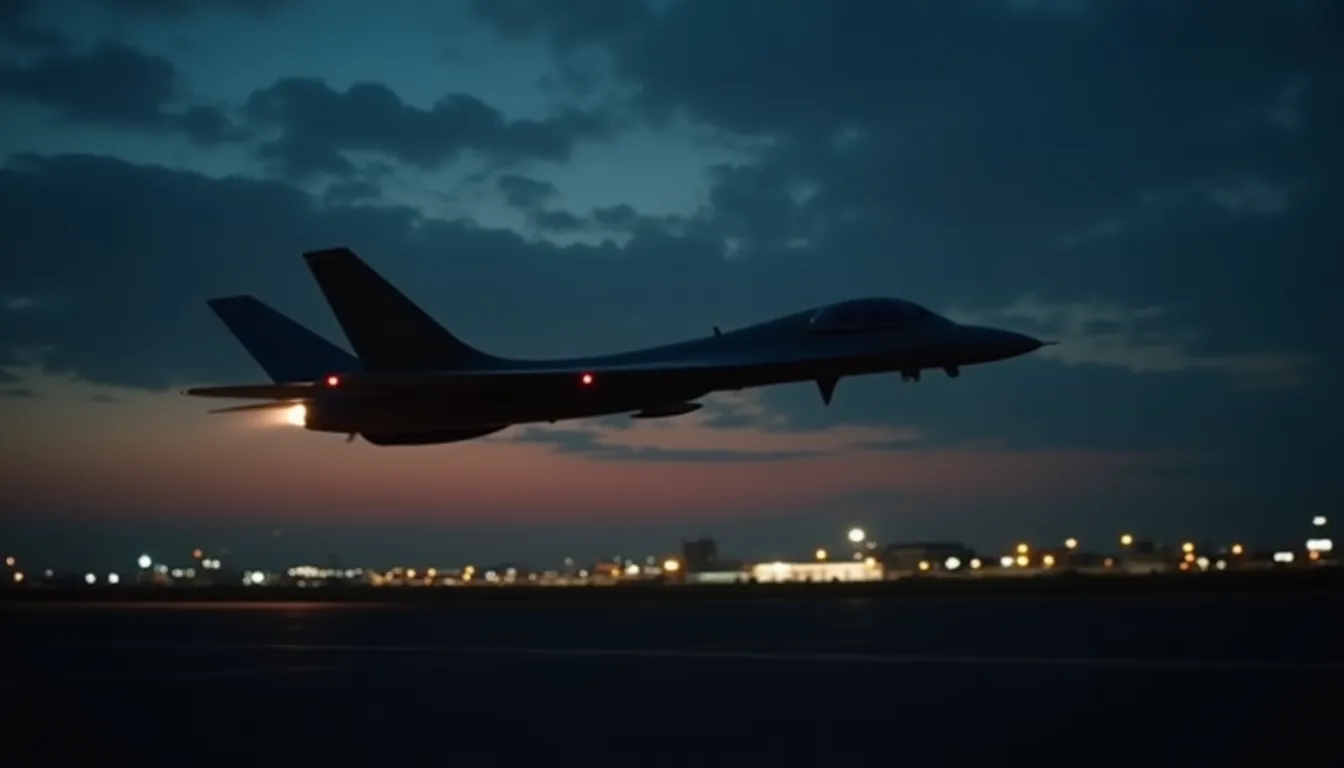
Hermeus has partnered with Anduril Industries to supply autonomy systems for its Quarterhorse hypersonic drone, marking the first collaboration between the two venture-backed defence firms. Anduril's Lattice AI platform will handle flight controls and ground operations for the high-speed testbed, which aims to demonstrate speeds up to Mach 3 and beyond.
Key Takeaways
- Hermeus and Anduril have partnered to integrate Anduril's Lattice AI autonomy platform into the Quarterhorse hypersonic drone, which aims to demonstrate speeds up to Mach 3 in flight tests beginning next year.
- The modular procurement approach—with Hermeus handling airframe development and Anduril providing autonomy—represents a faster, more competitive alternative to traditional monolithic prime-contractor defence contracts.
- At hypersonic speeds, human-in-the-loop control becomes operationally impractical, making onboard AI autonomy a mission-critical requirement for safe and effective flight.
- The global drone market is projected to grow from $43.6 billion to $109.8 billion by 2030, with military autonomous systems among the primary growth drivers.
- Success in this partnership could establish a template for modular defence procurement that reshapes how future hypersonic and autonomous systems are developed across the US defence industrial base.
Hermeus and Anduril Form Partnership for Autonomous Hypersonic Flight
Hermeus, the hypersonic aircraft startup, has selected Anduril Industries to provide the autonomy stack for its Quarterhorse drone programme, according to reporting by Breaking Defense. The pairing marks the first time these two closely watched venture-backed defence companies have collaborated on a single platform, signalling a broader shift in how hypersonic capability is being assembled across the US defence industrial base.
The Quarterhorse Programme and Anduril's Lattice Platform
The Mk 2 Quarterhorse is Hermeus's high-speed drone being developed with funding from the Pentagon's Defense Innovation Unit, with a goal to fly the aircraft at speeds as fast as Mach 3. Under the teaming arrangement, Anduril's mission autonomy suite, Lattice, will be paired with the Quarterhorse for flight testing that will kickoff next year.
To date, Hermeus has been developing the Quarterhorse iteratively through a series of flight tests, which have been remotely controlled. The transition to autonomous operations represents a significant step in the programme's maturity. Hermeus CEO Zach Shore explained that the company "now needs to automate a lot of those flight controls," adding that "I want to be able to push a button, have the aircraft spin up, have the aircraft auto takeoff, all those basic features that allow one person to manage multiple platforms."
Anduril's Lattice platform is designed to handle this expanded operational envelope. Brett Darcey, Anduril's general manager and vice president for mission autonomy in air dominance and strike, told Breaking Defense that Anduril will provide an "end-to-end" solution for autonomous operations, from the software needed for flying to the ground control systems used by operators. Darcey emphasized that "This isn't just a mission autonomy science project. This is really readying the Quarterhorse for live operations in a way that really accelerates here."
Strategic Value for Both Companies
For Hermeus, the partnership addresses a critical capability gap. Shore noted that the partnership can dovetail with ongoing work for the government to develop the Quarterhorse, particularly as it relates to integrating an autonomous solution using a government reference architecture. The collaboration also signals strong government backing; Shore stated that "There is tremendous alignment, support, and backing for this effort within the government."
The arrangement also delivers substantial benefits to Anduril. While the company's Lattice solution is currently in the mix for the Air Force's Collaborative Combat Aircraft program, partnering with Hermeus offers a chance to test out the technology's performance on a large, high-speed platform. Darcey noted that "It's really about the mission envelope that opens up there. This is expanding the addressable market for our mission autonomy solution," and that the partnership can "increase the diversity of our experience, so that our product is better."
Neither company disclosed financial terms of the agreement, though Shore stated: "This is a partnership with a contract, with funds exchanged." Darcey described the partnership as one "of mutual economic and probably future economic benefit."
Modular Procurement and Integration Challenges
The Hermeus-Anduril teaming illustrates a structural shift in how the US defence industrial base is assembling hypersonic capability. Rather than relying on a single prime contractor to build every system component, emerging programmes are stacking specialist firms—Hermeus for the airframe, Anduril for the autonomy layer. This modular procurement approach is faster and more competitive than traditional monolithic contracts, but it also creates new integration risks that programme offices will need to manage carefully.
At hypersonic speeds, the demands on autonomous systems become uniquely challenging. Autonomous drones operating at speeds exceeding Mach 3 make human-in-the-loop control operationally impractical, since reaction times become orders of magnitude shorter than human decision cycles. This creates a mission-critical requirement for onboard AI autonomy—the aircraft must make decisions at machine speed to operate safely and effectively. Anduril's Lattice platform, which is designed to fuse multi-sensor data and automate decision-making for autonomous defence systems in real time, must handle this compressed operational timeline reliably.
Shore noted that there's "really no horizon" on the partnership, while noting that customers like the Pentagon reserve the ability to integrate the autonomy vendors they want if they decide to acquire the Quarterhorse as a weapon system. Nonetheless, Shore expressed optimism about long-term collaboration, saying "In a dream scenario, as these aircraft become more real and higher volume, and they're out there in the world, there's all sorts of go-to-market opportunities together to team and say, you know, 'This airplane and this brain.'"
Market Context and Growth Drivers
The autonomous systems market that underpins both companies' businesses is expanding rapidly. The global drone market is projected to grow from $43.6 billion to $109.8 billion by 2030, driven in part by military demand for autonomous platforms that can operate in contested environments without direct human piloting. Hypersonic platforms represent one of the highest-priority procurement categories for the US military heading into the late 2020s, making this partnership particularly strategically significant.
Anduril's previous deployments of Lattice have focused on border surveillance and counter-drone missions, but the Hermeus partnership would represent its first application to a hypersonic vehicle. This expansion into the hypersonic domain broadens Anduril's addressable market and demonstrates the scalability of its autonomy architecture across different mission sets and speed regimes.
What Comes Next
The key near-term milestone is whether the Hermeus-Anduril integration progresses to a powered Quarterhorse flight demonstration with autonomous autonomy handling critical flight functions. A successful hypersonic autonomous flight would validate both companies' approaches and likely attract further US Air Force or DARPA contract interest. Such a demonstration would also provide crucial data about how well Lattice performs under the extreme conditions of hypersonic flight—sustained high speeds, intense aerodynamic stresses, and the need for split-second autonomous decisions.
The partnership represents a test case for the modular defence procurement model that acquisition officials across the Pentagon are increasingly advocating for as a faster, more flexible alternative to traditional prime-contractor-led programmes. Success here could establish a template for how future hypersonic and high-speed autonomous systems are developed and integrated, potentially reshaping procurement practices across the defence industrial base in the years ahead.
Sources
- Breaking Defense: Hermeus picks Anduril autonomy for Quarterhorse drone
- Breaking Defense: GE Aerospace to provide marine gas turbine engines for South Korea's KDDX destroyers
- SpaceNews: Galaxia Takes Next Step in Earth Observation with purchase of Simera Sense Hyperspectral Imager
- Breaking Defense: Winning the information war is as much about ideas and perception as it is about data
- Breaking Defense: Estonian Defense Minister resigns following Ukrainian ammunition procurement scandal
- MachineHours Encyclopedia: Drone Technology — Autonomous Flight and Its Economic Impact
Frequently Asked Questions
What is the Hermeus Quarterhorse drone?
The Quarterhorse is an unmanned hypersonic testbed built by Hermeus, designed to demonstrate speeds above Mach 5. It is now using Anduril's autonomy software for its flight systems.
What is Anduril's Lattice platform?
Lattice is Anduril's AI-powered autonomy platform that fuses sensor data and automates decision-making for unmanned defence systems. It has previously been used in border surveillance and counter-drone missions.
Why did Estonia's Defence Minister resign?
Estonia's Defence Minister resigned following a scandal involving Ukrainian ammunition procurement. The incident highlights governance risks associated with accelerated wartime contracting.
What is the KDDX programme?
The KDDX is South Korea's next-generation destroyer programme, described as Seoul's most ambitious naval shipbuilding effort in a generation. GE Aerospace has been selected to supply marine gas turbine engines for the ships.
What is hyperspectral imaging used for in defence?
Hyperspectral imaging captures data across hundreds of wavelength bands simultaneously, giving military operators far greater target discrimination than conventional optical satellite sensors.
Get MachineHours in your inbox
AI compute and the machine economy in your inbox.