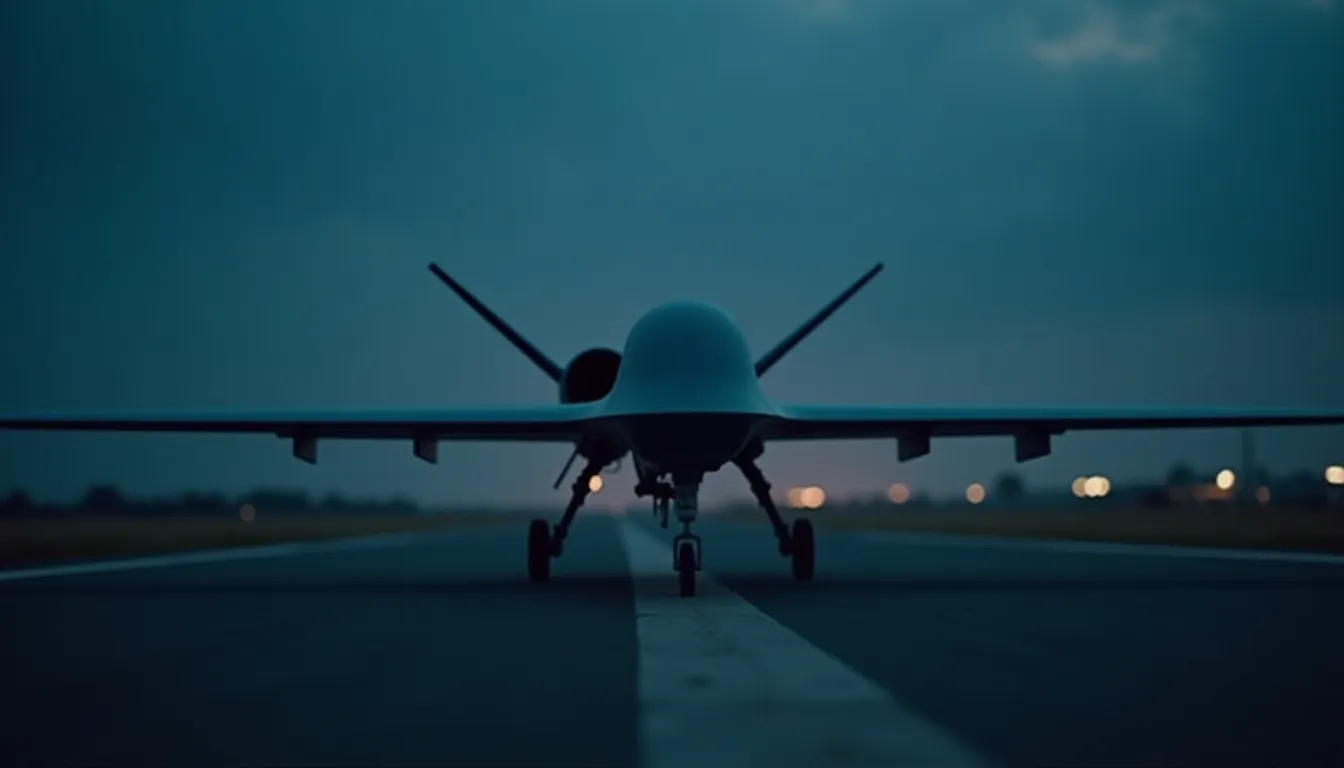
General Atomics has unveiled the Wildfire drone as a successor to the MQ-9 Reaper. The Pentagon is simultaneously reworking FY27 budget priorities and signalling a more aggressive posture in offensive cyber operations.
Key Takeaways
- General Atomics unveiled the Wildfire drone on September 10, 2026, as a direct replacement for the MQ-9 Reaper with a focus on contested-airspace survivability.
- The Pentagon is working with Congress on contingency plans to retool FY27 defence priorities amid unresolved budget reconciliation.
- DoD's updated cyber strategy calls for a more assertive offensive posture, described internally as 'something big, something muscular.'
- A Breaking Defense analysis warns that AI enabling conventional attack planning by non-state actors is a more immediate threat than autonomous weapons scenarios.
- UAE's EDGE Group delivered six unmanned helicopters to the Angolan navy, reflecting the global spread of autonomous military platforms beyond NATO.
General Atomics has publicly unveiled its Wildfire drone as a direct replacement for the aging MQ-9 Reaper, according to Breaking Defense, marking one of the most significant shifts in US combat drone capability in over two decades. The unveiling arrives as the Department of Defense juggles an uncertain budget process and a newly aggressive cyber strategy, signalling a broad repositioning of American autonomous weapons doctrine.
What Happened
General Atomics - the San Diego-based defence contractor that built the Reaper - introduced the Wildfire platform on September 10, 2026. Breaking Defense reported that the aircraft is designed to surpass the Reaper's performance envelope, with an emphasis on survivability in contested airspace, a capability the MQ-9 has historically lacked. The Reaper has been the backbone of US strike and intelligence, surveillance, and reconnaissance missions for nearly two decades, but combat losses in increasingly sophisticated threat environments have accelerated the search for a successor. The Wildfire is positioned as General Atomics' answer, though specific performance figures and unit cost details were not disclosed at launch.
Alongside the Wildfire announcement, the DoD's evolving force posture is being complicated by fiscal uncertainty. Breaking Defense also reported that the Pentagon is actively working with Congress on contingency plans to retool its fiscal year 2027 priorities, given that budget reconciliation remains unresolved. Senior officials are reported to be identifying which autonomous systems and next-generation platforms could absorb or redirect funding if the reconciliation bill fails to pass. Drone acquisition programmes are among the areas under review.
On the offensive side, Breaking Defense reported that the DoD's updated cyber strategy calls for a substantially more assertive posture in offensive cyber operations, with officials describing the ambition internally as pursuing "something big, something muscular." The framing signals a departure from primarily defensive cyber doctrine and raises questions about how AI-enabled tools will be integrated into offensive operations at scale.
A separate analysis published the same day by Breaking Defense warned that the defence community is focused on speculative AI-enabled attack vectors while potentially underestimating the more immediate risk: AI lowering the operational planning and logistics threshold for non-state actors carrying out conventional attacks. The piece argues this mundane application of AI, optimising targeting, timing, and coordination, poses a more near-term threat than autonomous weapons in the hands of adversaries.
Meanwhile, the UAE's EDGE Group delivered six unmanned helicopters to the Angolan navy on September 10, a transaction that underscores the accelerating global spread of autonomous military platforms beyond NATO and traditional defence export relationships. EDGE Group, the Abu Dhabi-based defence conglomerate, is positioning itself as a major supplier of unmanned systems to African and developing-world militaries.
Why It Matters
The Wildfire unveiling is not just a product announcement. It represents a doctrinal admission that the Reaper-era model of persistent, low-threat-environment drone operations is no longer sufficient. Peer and near-peer adversaries have developed counter-drone and air defence systems capable of defeating platforms like the MQ-9, and the US military's reliance on relatively slow, non-stealthy drones has become a recognised vulnerability. The Wildfire's emphasis on contested-airspace survivability suggests General Atomics is designing for a different operating environment.
The convergence of a new drone platform, an aggressive cyber strategy, and a restructured FY27 budget reflects a Pentagon recalibrating around the assumption that future conflict will be faster, more electronic, and more autonomous than previous planning cycles anticipated. Investors tracking this shift can find relevant context in defence and space sector equity analysis, where autonomous systems and cyber capability spending are emerging as durable budget priorities regardless of reconciliation outcomes.
The EDGE Group-Angola deal adds a geopolitical dimension: the unmanned systems market is globalising rapidly, and US competitors including Emirati, Turkish, and Chinese manufacturers are filling demand in regions where Washington has historically been cautious about arms transfers.
Background
The MQ-9 Reaper entered US Air Force service in 2007 and became the defining platform of post-9/11 counterterrorism operations, valued for its endurance and sensor payload capacity. Its design, however, predates the proliferation of advanced air defence systems and electronic warfare capabilities now deployed by adversaries including Russia, China, and Iran. Replacing it has been a long-standing USAF priority, with multiple programmes exploring higher-speed, lower-observable alternatives.
AI integration in autonomous defence systems is increasingly central to how defence contractors and military planners approach next-generation platforms. From autonomous target acquisition to mission planning, the computational architectures underlying these systems trace directly to foundational computing concepts detailed in the MachineHours encyclopedia entry on Von Neumann Architecture - The Blueprint of Every Computer, which describes the processor-memory design that still underlies the vast majority of defence computing hardware today.
What to Watch
The Wildfire will need to move from unveiling to a formal USAF acquisition competition, and General Atomics will face competition from other platforms already in development. Whether the FY27 budget process provides stable funding for next-generation drone acquisition is the near-term variable: a failed reconciliation could delay procurement timelines. On the cyber front, watch for how the DoD's "muscular" offensive posture translates into doctrine, rules of engagement, and interoperability with allied cyber commands. The EDGE Group-Angola deal is worth monitoring as a data point in the broader trend of Gulf state defence exporters establishing footholds in African military markets, a space where US influence has historically been limited.
- The MQ-9 Reaper has been in US Air Force service since 2007, making it nearly two decades old as a primary strike and ISR platform.
- General Atomics, the Reaper's manufacturer, is also the developer of the Wildfire replacement, maintaining its position as the DoD's primary MALE drone supplier.
- The UAE's EDGE Group has delivered autonomous military platforms to a non-NATO African navy, illustrating the expanding global market for unmanned systems outside traditional Western supply chains.
- The DoD's updated cyber strategy signals a shift toward offensive operations at a scale not previously articulated in public defence posture documents.
Sources
- Breaking Defense: General Atomics unveils 'Wildfire' drone to replace Reaper
- Breaking Defense: With reconciliation uncertain, Pentagon eyeing plan to retool FY27 priorities with Congress
- Breaking Defense: DoD cyber strategy aims for 'something big, something muscular' in offensive ops
- Breaking Defense: Overlooking the obvious: The most likely way AI can enable terror attacks
- Breaking Defense: Emirati EDGE Group delivers six unmanned helicopters to Angolan navy
- MachineHours Encyclopedia: Von Neumann Architecture — The Blueprint of Every Computer
Frequently Asked Questions
What is the General Atomics Wildfire drone?
The Wildfire is a next-generation combat drone unveiled by General Atomics on September 10, 2026, designed to replace the aging MQ-9 Reaper. It emphasises survivability in contested airspace, a capability the Reaper lacks against modern air defence systems.
Why is the US replacing the MQ-9 Reaper?
The Reaper entered service in 2007 and was designed for permissive airspace in counterterrorism operations. Adversaries including Russia, China, and Iran have since deployed air defence and electronic warfare systems capable of defeating it, making a more survivable successor necessary.
What is the DoD's new cyber strategy about?
The Pentagon's updated cyber strategy calls for a more assertive offensive posture, with officials describing the goal as pursuing operations that are 'big' and 'muscular,' signalling a departure from primarily defensive cyber doctrine.
What is the EDGE Group drone deal with Angola?
The UAE's EDGE Group, an Abu Dhabi-based defence conglomerate, delivered six unmanned helicopters to the Angolan navy on September 10, 2026, illustrating how autonomous military systems are spreading to African and developing-world militaries through non-Western suppliers.
How could AI enable terror attacks, according to Breaking Defense?
A Breaking Defense analysis argues the most likely near-term risk is AI lowering the planning and logistics threshold for conventional attacks by non-state actors, rather than the more speculative scenario of adversaries deploying autonomous weapons systems.
Get MachineHours in your inbox
AI compute and the machine economy in your inbox.