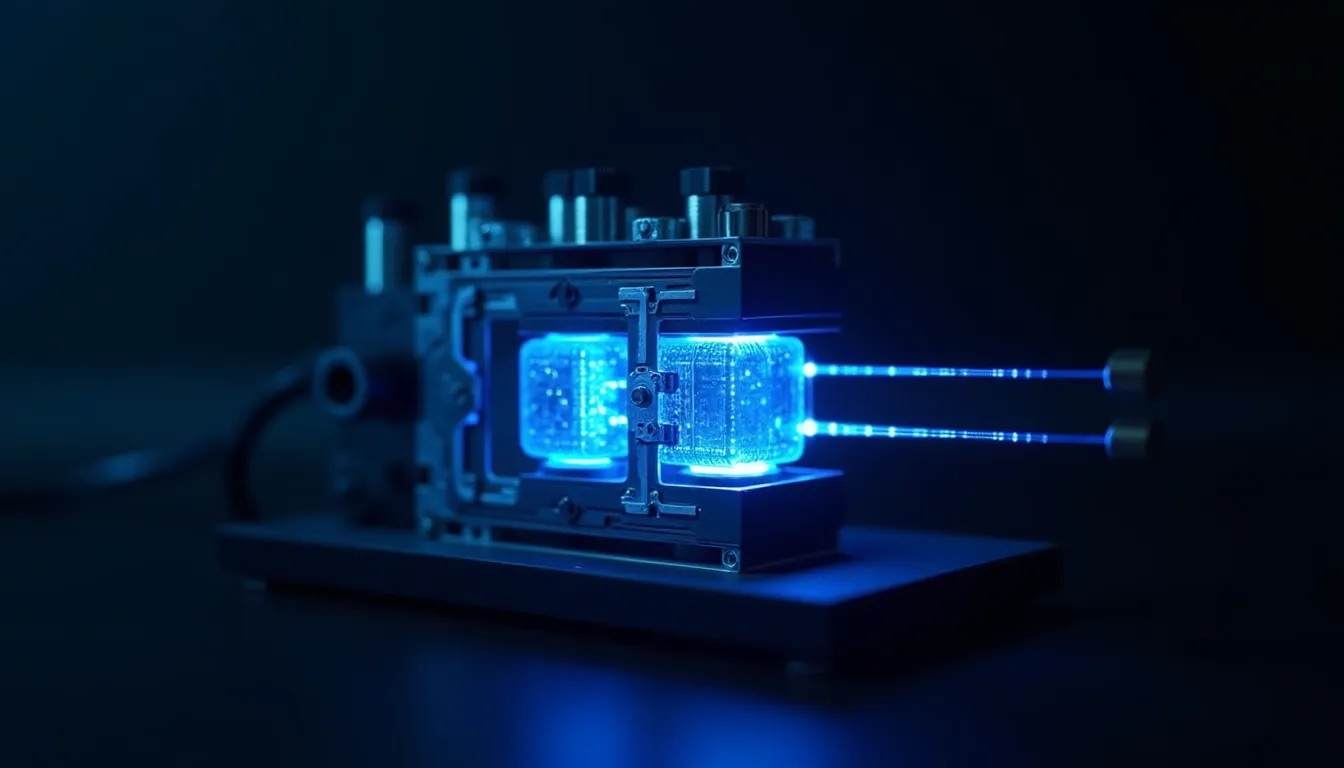
Municipal utility EPB has commissioned the IonQ Forte Enterprise trapped-ion quantum computer at its downtown Chattanooga facility, establishing the first commercial hub in the U.S. to integrate production-grade trapped-ion quantum processing alongside photonics-based quantum networking infrastructure. The deployment serves eight NIST-funded graduate researchers initially, with commercial access o
Key Takeaways
- EPB's Chattanooga facility is the first U.S. commercial hub integrating trapped-ion quantum processing with photonics-based quantum networking infrastructure in a single operational facility, representing a shift from lab-only deployments to municipal infrastructure contexts.
- The initial workload focus—grid optimization for circuit topologies and power loss reduction—aligns trapped-ion quantum computing with practical near-term applications suitable for NISQ-era hardware operating above fault-tolerance thresholds.
- Trapped-ion systems produce lower per-gate error rates than superconducting alternatives, making them better-suited to circuits prioritizing depth over speed, though they sacrifice raw gate speed in exchange for longer quantum state coherence times.
- EPB's fiber network infrastructure provides the low-latency classical communication required for hybrid quantum-classical workflows, suggesting that future quantum hubs may preferentially locate in cities with existing advanced infrastructure.
- The hybrid deployment model—combining municipal utility operations, NIST-funded academic research, commercial access, and regional workforce development—creates network effects that distributed commercial deployments cannot replicate.
EPB Deploys Production-Grade Trapped-Ion Quantum Computer in Chattanooga
EPB, the Chattanooga-based utility and fiber network provider, has officially commissioned an IonQ Forte Enterprise trapped-ion quantum computer at the downtown EPB Quantum Center. This deployment marks a significant milestone: the facility becomes the first commercial hub in the United States to integrate trapped-ion quantum processing units alongside photonics-based quantum networking infrastructure under a single operational roof. The activation represents the first time production-grade trapped-ion hardware has been placed within a municipal infrastructure context at this operational scale, moving quantum computing beyond research laboratories into an environment designed to support practical commercial and academic workloads.
Initial Deployment and Research Focus
The IonQ Forte Enterprise system is IonQ's highest-tier commercial system, designed for enterprise workloads rather than research prototyping. Initial computational access is prioritized for the EPB Quantum Computing Fellows—an eight-member graduate research team supported by a $4 million National Institute of Standards and Technology (NIST) grant. This research cohort will run algorithms designed to optimize circuit topologies, reduce power losses, and enhance resilience across EPB's automated smart grid.
The focus on grid optimization reflects both EPB's core operational expertise and a practical near-term application for trapped-ion systems. Quantum computers operating on noisy, intermediate-scale quantum (NISQ) hardware—the current state of the field—show promise for combinatorial optimization problems where classical solutions become computationally expensive as problem size grows. Smart grid circuit topology optimization presents exactly this type of problem: the number of possible configurations grows exponentially, making it difficult for classical computers to explore the entire solution space efficiently, while the relatively modest problem sizes remain within reach of current quantum systems without requiring fault tolerance.
Commercial and Academic Access Model
Commercial service access, branded as EPB Quantum Computing℠, opens in early October 2026, with the University of Tennessee at Chattanooga (UTC) and Vanderbilt University serving as anchor academic clients. This hybrid model—where municipal infrastructure, academic research, and commercial users share access to the same hardware—distinguishes Chattanooga's approach from earlier quantum computing hubs concentrated in national laboratories or corporate research centers.
The partnership ecosystem supporting the deployment is substantial. EPB, Oak Ridge National Laboratory (ORNL), NVIDIA, and IonQ have established a Hybrid Quantum-Classical Computing Hub featuring an on-premises NVIDIA DGX supercomputer for smart grid circuit loss minimization and high-performance hybrid algorithm testing. This infrastructure addresses a critical requirement for near-term quantum computing: most practical algorithms cannot run on quantum hardware alone. They require tight integration between classical preprocessing, quantum subroutines, and classical post-processing. By co-locating quantum and classical resources with low-latency networking, EPB's fiber network provides the low-latency classical communication that can support hybrid quantum-classical computation workflows.
Regional Workforce and Academic Initiatives
The quantum deployment is accompanied by workforce development efforts. The hardware launch includes the Energy and Quantum Industries Academy at the Franklin-Roberts Future Ready Center, targeting 400 high school students annually by 2028, and the state-piloted TN QuantumWorks K–12 curriculum. These programs suggest that EPB and its partners view the Chattanooga hub not merely as a facility for running quantum algorithms but as a regional innovation ecosystem anchor.
Vanderbilt University and UTC are establishing the Institute for Quantum Innovation as an academic hub, with 250+ researchers at the Vanderbilt campus and UTC serving as a quantum network research node. This academic infrastructure provides a talent pipeline and enables long-term research partnerships that commercial deployments alone could not sustain.
Technical Significance of Trapped-Ion Architecture
The choice of trapped-ion technology carries technical implications for the workloads Chattanooga can support. Trapped-ion systems use electromagnetic fields to suspend individual ions, then manipulate them with lasers, producing qubits with among the lowest error rates of any current platform. This architecture delivers substantially lower per-gate error rates than superconducting alternatives, though at the cost of slower gate speeds.
For NISQ-era applications, lower error rates per gate generally outweigh speed advantages. Algorithms optimized for current hardware prioritize circuit depth—the number of sequential gate operations—over total operation count, because each gate introduces noise that degrades the fidelity of quantum states. Trapped-ion systems' longer coherence times (the period during which quantum states remain stable) make them better-suited to circuits requiring dozens or hundreds of sequential operations. Superconducting systems, by contrast, operate at nanosecond gate speeds but must incorporate more aggressive error mitigation to achieve comparable output fidelity over circuits of similar depth.
Strategic Implications for Quantum Hardware Deployment
The EPB deployment signals growing confidence that trapped-ion hardware is operationally stable enough for environments outside controlled laboratory settings. Moving quantum computing from isolated research facilities into networked infrastructure reflects an implicit assessment by both EPB and IonQ that the technology has matured beyond the prototype stage. This does not mean trapped-ion systems are fault-tolerant—current error rates remain far above the thresholds required for logical qubit protection—but it does indicate that operational reliability is sufficient for sustained deployment in environments where downtime carries real cost.
The $15 million investment by IonQ in Chattanooga infrastructure, combined with EPB's commitment of fiber network resources and institutional capacity, also reflects a business model shift. Rather than selling quantum computers as standalone products delivered to customer sites, quantum vendors are increasingly establishing shared-access hubs where multiple users can queue algorithmic workloads. This model reduces per-user capital costs, improves hardware utilization rates, and creates network effects as users learn from shared access to the same systems.
Near-Term Viability and Open Questions
The success of the Chattanooga hub will ultimately depend on utilization rates and published results. The eight NIST-funded researchers have clear incentives to produce peer-reviewed output, and the grid optimization use case aligns naturally with EPB's operational priorities. Academic anchor clients (UTC and Vanderbilt) bring research traditions and access to talent pools. But sustained commercial adoption—the stated goal for October 2026 onward—requires demonstrating algorithmic advantage on problems customers actually care about solving.
The choice of Chattanooga as a deployment location also deserves attention. EPB already operates one of the fastest municipal fiber networks in the United States, which provides the low-latency classical communication backbone necessary for hybrid quantum-classical workflows. Chattanooga's prior investment in advanced infrastructure lowered the barrier to adding quantum capabilities. This suggests that future quantum hubs may preferentially locate in cities with existing fiber or data center infrastructure, rather than emerging as greenfield facilities.
Commercial Integration and Industry Outreach
EPB will host the Quantum in Business (QiB) conference on October 1 to demonstrate commercial QPU and quantum network integration for logistics, manufacturing, finance, and energy sectors. This outreach effort targets industries where optimization problems dominate: logistics route planning, manufacturing resource allocation, financial portfolio optimization, and energy grid balancing. These sectors represent the most realistic near-term application areas for NISQ hardware, and the conference signals that EPB intends to actively market the facility to potential commercial users rather than waiting for demand to emerge organically.
The Chattanooga deployment represents a meaningful inflection point in quantum computing's transition from research artifact to operational infrastructure. By placing production-grade hardware in a municipal context, combining it with strong classical computing resources, anchoring it with academic partnerships, and committing to commercial access, EPB and its partners are testing whether trapped-ion quantum computing can deliver practical value in real operational environments. The results over the next 12 to 18 months will provide important data on the realistic pace and scope of quantum computing's near-term commercial viability.
Sources
- Quantum Computing Report: EPB Commissions IonQ Forte Enterprise Quantum Computer in Chattanooga Hub
- The Quantum Insider: EPB Launches IonQ Forte Enterprise Quantum Computer in Chattanooga
- Quantum Computing Report: EigenQ and Silicon Valley Acquisition Corp. Secure $45M Committed Convertible Financing
- Quantum Computing Report: ICTK and Jiran Security Partner on Q-BRIDGE
- The Quantum Insider: This Roblox Game's Levels Are Generated by a Real Quantum Computer
- MachineHours Encyclopedia: Quantum Hardware — Superconducting, Trapped Ion, Photonic and Topological Approaches Compared
Frequently Asked Questions
What is the IonQ Forte Enterprise and why is the Chattanooga deployment significant?
The IonQ Forte Enterprise is IonQ's highest-tier commercial trapped-ion quantum computer, designed for enterprise workloads. Its deployment at EPB's Chattanooga hub is notable because it places production-grade quantum hardware in a municipal infrastructure setting rather than a national laboratory.
What is EigenQ's $45M financing for?
EigenQ secured $45M in committed convertible financing ahead of a planned $3B SPAC merger with Silicon Valley Acquisition Corp. The company focuses on quantum optimization and simulation software for near-term hardware.
What is Q-BRIDGE and who is behind it?
Q-BRIDGE is an end-to-end post-quantum cryptography migration framework developed through a partnership between South Korean firms ICTK and Jiran Security, aimed at helping enterprises shift to quantum-resistant encryption standards.
Why do trapped-ion quantum computers matter for error correction?
Trapped-ion qubits have longer coherence times and lower per-gate error rates than most superconducting systems. This makes them better candidates for near-term algorithmic work without the full overhead of fault-tolerant error correction.
What is post-quantum cryptography and why is it commercially urgent?
Post-quantum cryptography refers to encryption algorithms resistant to attacks from future fault-tolerant quantum computers. NIST finalized relevant standards in 2024, creating regulatory and security pressure for enterprises to begin migration now.
Get MachineHours in your inbox
AI compute and the machine economy in your inbox.