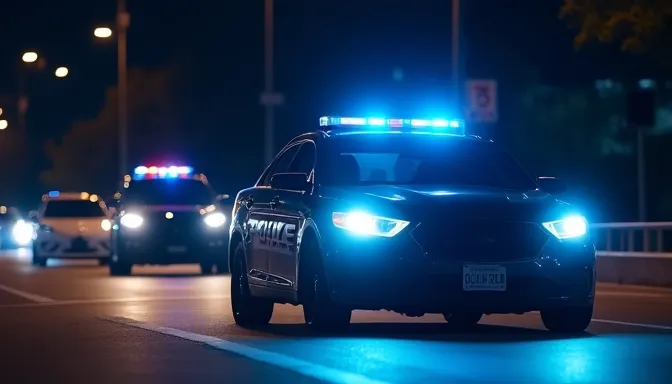
The Electronic Frontier Foundation, the ACLU and the ACLU of Ohio filed an amicus brief in the Sixth Circuit on 9 November 2026 in United States v. Sturdivant, asking the court to require a warrant for searches of automated licence-plate reader databases, according to an EFF post, the brief and an ACLU of Ohio statement.
Key Takeaways
- EFF, the ACLU and the ACLU of Ohio filed an amicus brief in the Sixth Circuit on 9 November 2026 in United States v. Sturdivant, asking the court to require a warrant for searches of ALPR databases, according to the EFF post, the brief and the ACLU of Ohio statement.
- The EFF says the Cleveland investigation used an open-ended search of Flock and ELSAG databases after footage showed a vehicle's make, model and colour but not its plate; the district court held there was no reasonable expectation of privacy in a publicly visible plate.
- The brief, citing Flock and other sources, says Flock has nearly 90,000 cameras in 49 states and more than 5,000 communities, and that the company boasts more than 20 billion US scans a month; it also says Ohio has no statewide limits on sharing ALPR data across state lines.
- In United States v. Kyle (N.D. Okla., 1 October 2026), cited in the brief, a federal district court held that querying an ALPR system was a Fourth Amendment search and described such systems as facilitating "a type of indiscriminate mass surveillance."
- The Sixth Circuit has not yet ruled; the 9 November filing seeks reversal of the Northern District of Ohio's decision denying suppression and is not itself a warrant requirement.
The Electronic Frontier Foundation, the American Civil Liberties Union and the ACLU of Ohio asked the US Court of Appeals for the Sixth Circuit on 9 November 2026 to treat warrantless searches of automated licence-plate reader databases as Fourth Amendment searches, according to an EFF post by Andrew Crocker published that day and the groups' amicus brief in United States v. Sturdivant. The filing is docketed as case no. 26-3426 and supports the defendant-appellant on appeal from the Northern District of Ohio at Cleveland, case no. 1:22-CR-00615, before Judge J. Philip Calabrese. The organisations argue that querying those databases without a warrant allows police to reconstruct a person's movements in a way that a single glance at a publicly visible plate never could. In a 10 November statement, the ACLU of Ohio said the groups urge the appeals court to reverse the lower court's ruling and require a warrant.
What Happened
Crocker's post describes the underlying investigation as a series of robberies in and around Cleveland, Ohio. Surveillance-camera footage, the EFF says, showed the make, model and colour of a vehicle but not its plate number. Investigators then ran what the organisation calls an open-ended search of Flock Safety and ELSAG automated licence-plate reader databases, which the post says was enough to place a car belonging to the defendant near the robbery sites and led to an arrest. The defendant later moved to suppress the evidence obtained from the ALPR search.
The district court denied that request. According to the EFF, the court held that there is no reasonable expectation of privacy in a licence plate displayed in public, and therefore no Fourth Amendment interest in not having a car tracked through public spaces. The amici's brief reports that decision as United States v. Sturdivant, 786 F. Supp. 3d 1098 (N.D. Ohio 2025). The brief's caption identifies the appeal as coming from that Cleveland court and that 2022 criminal docket.
EFF and the ACLU argue that the comparison to a passing officer who happens to see a plate is the wrong one. Crocker writes that the groups told the Sixth Circuit that ALPR systems do not merely record a plate in a single moment; they let investigators reconstruct a driver's movements over time. The brief, echoing language the EFF highlights, says those systems give police "the ability to enter a virtual time machine and view suspects', or anyone else's, past movements (and much more) '[w]ith just the click of a button'" — a formulation drawn from the US Supreme Court's 2018 decision in Carpenter v. United States, 585 U.S. 296.
The brief describes how modern ALPR systems operate. It says the cameras collect data on every vehicle that comes into view, whether or not the driver is suspected of a crime, and that a record typically includes not only the plate number but a photograph of the vehicle, its make, model, colour and distinctive features, plus location, time and date information that can later place the vehicle to within feet of the original scan. Newer systems, the brief says, are "supercharged with video capabilities and artificial intelligence" and can run continuously on solar power. Flock's Cleveland-area system, according to the brief, creates a "Vehicle Signature" that can recognise features such as paint colour, vehicle type, unique characteristics and even bumper stickers. Retention, the amici write, is a matter of ad hoc arrangements between agencies and vendors; depending on the period, users can query weeks, months or years of location data with a single request.
The same brief, citing Flock's own national network materials and an October 2025 ACLU of Massachusetts analysis, says Flock alone has nearly 90,000 cameras in 49 states and more than 5,000 communities. It reports that Cleveland operates a network of 100 of those cameras, and that Cuyahoga County has at least 1,717 ALPR cameras operated by government or private entities — nearly four cameras per square mile of land, according to the brief's citation of a June 2026 Cleveland.com tally. The district court opinion, the brief adds, reported 1,636 Flock cameras in Cuyahoga County in June 2025. Cleveland, the amici write, citing a 16 July 2026 Government Technology report, recently allocated $125,000 and extended its Flock contract for six months despite community pushback; the brief also cites an 2 October 2026 Cleveland.com report that the city's police commission wanted to pause Flock camera use.
Flock "boasts that it collects over 20 billion ALPR scans every month across the United States," the brief says, again citing the company's national network materials. Local figures in the filing are drawn from Flock transparency portals dated 27 October 2026: over a recent 30-day period, the North Royalton Police Department detected 201,536 unique plates and the Shaker Heights Police Department detected 317,302. During the same window, the brief says, hotlist hits accounted for less than 1% of vehicles captured by those two departments, meaning "nearly everyone whose ALPR information was collected and stored by these police departments was under no suspicion whatsoever at the time." The brief also states that Ohio has no statewide restrictions on sharing ALPR data across state lines, and that databases can be queried by federal, state and local agencies even when those agencies do not operate their own cameras.
David J. Carey, staff attorney at the ACLU of Ohio, said in the affiliate's statement that cities and highways are being blanketed with ALPRs, that the resulting databases are accessible to law-enforcement agencies across the country, and that the systems can reveal sensitive information about people's locations, movements and associations — all, he said, without a warrant. The EFF post adds that the organisation has already challenged ALPR use in lawsuits in San Jose and Wisconsin, and that it hopes the Sixth Circuit will reverse the district court and require a warrant for these searches.
Why It Matters
The legal question is not whether a licence plate on a public road can be seen, but whether a warrant should be required before police reconstruct a person's driving history from a networked archive of those sightings. The brief grounds that argument in Carpenter, which limited warrantless access to historical cell-site location information, and in United States v. Jones, 565 U.S. 400 (2012), on GPS tracking of a vehicle. In the amici's account, cars are indispensable to modern life — language they take from Carpenter — and an ALPR database can reveal the same sort of detailed movement history that those cases treated as protected.
The brief also points to a more recent trial-court decision that went the other way from the Cleveland ruling. In United States v. Kyle, No. 26-CR-00189-SEH, 2026 WL 2958728 (N.D. Okla. 1 October 2026), the Northern District of Oklahoma held that querying an ALPR system was a Fourth Amendment search. Crocker's 9 November post said that "just last month, a federal district court" described ALPRs as a "form of indiscriminate mass surveillance"; the brief, quoting Kyle, uses the phrasing "a type of indiscriminate mass surveillance" that the Fourth Amendment forbids, and closes by citing the Oklahoma court's line that it is "not too much to draw the line at indiscriminate mass surveillance." That October decision is the recent ruling the EFF is asking the Sixth Circuit to follow.
For operators of civic and commercial AI systems that governments are now trying to regulate, the Sturdivant appeal is a reminder that computer-vision infrastructure already in the field can raise constitutional questions as quickly as new model releases do. The brief's account of Vehicle Signatures and bumper-sticker recognition is a concrete illustration of how pattern-matching models change what a camera network can later be asked to reveal, which sits alongside the broader debate over what it means to keep powerful AI systems aligned with legal and social limits. None of that decides the Sixth Circuit case; it does explain why a warrant rule, if adopted, would matter far beyond one Cleveland investigation.
MachineHours analysis: the practical stakes are about retrospective reach and interstate sharing, not about whether a plate is visible on a public street. If the amici's description of retention and cross-border access is accurate, a search today can reach movements recorded weeks or years earlier, including in jurisdictions that never approved the query. A contrary holding would leave that capability, at least in the Sixth Circuit, on the same legal footing as a single officer noting a plate in real time. Readers should treat the camera counts, scan volumes and retention practices as the advocates' and cited vendors' figures, not as findings of the appeals court, which has not yet ruled.
What to Watch
The immediate question is whether the Sixth Circuit accepts the amici's invitation to reverse the Northern District of Ohio and hold that a warrant is required before police search ALPR databases. A published opinion, if one comes, would bind federal courts in Kentucky, Michigan, Ohio and Tennessee and would be closely read in other circuits. Watch also whether the court distinguishes a targeted plate query from the open-ended, vehicle-feature search the EFF says was used in Cleveland, and whether it engages the Oklahoma decision in Kyle.
This filing is not a ruling. The district court has already upheld the search in Sturdivant, and the Sixth Circuit has not said when it will hear or decide the appeal. The EFF's related cases in San Jose and Wisconsin, which Crocker mentions but does not detail in the 9 November post, are worth tracking separately for how other courts treat the same technology.
Key Facts
- Case: United States v. Sturdivant, 6th Cir. No. 26-3426, appeal from N.D. Ohio (Cleveland) No. 1:22-CR-00615 (J. Philip Calabrese), reported below at 786 F. Supp. 3d 1098 (N.D. Ohio 2025), according to the amicus brief filed 9 November 2026.
- Amici: EFF, the ACLU and the ACLU of Ohio, as stated in the brief and in the EFF and ACLU of Ohio announcements.
- Relief sought: Reversal of the district court's denial of suppression, and a warrant requirement for ALPR database searches, according to the EFF post and the ACLU of Ohio statement.
- Flock network, as cited in the brief: Nearly 90,000 cameras in 49 states and more than 5,000 communities; the company "boasts" more than 20 billion scans a month in the United States; Cleveland operates 100 cameras; Cuyahoga County has at least 1,717 ALPR cameras.
- Recent contrary trial-court ruling: United States v. Kyle (N.D. Okla., 1 October 2026) held that querying an ALPR system was a Fourth Amendment search, according to the brief.
Further reading and context
- The global landscape of AI regulation is the backdrop for courts deciding when computer-vision systems used by the state require a warrant.
- MachineHours' primer on AI safety and alignment covers the broader problem of keeping automated systems within legal and social bounds.
- How AI is reshaping the cybersecurity landscape is useful context for the same sensing and matching techniques, used here for location history rather than intrusion detection.
- The Acceleration Index tracks the wider pace of AI deployment of which civic camera networks are one part.
Frequently Asked Questions
What are EFF and the ACLU asking the Sixth Circuit to do?
According to the 9 November 2026 EFF post, the amicus brief filed the same day, and the ACLU of Ohio's 10 November statement, they are asking the court to reverse the district court in United States v. Sturdivant and hold that police need a warrant to search automated licence-plate reader databases.
What did the district court decide?
The EFF says the Northern District of Ohio held that there is no reasonable expectation of privacy in a licence plate displayed in public, and therefore no Fourth Amendment interest in not having a car tracked through public spaces. The brief reports that decision as United States v. Sturdivant, 786 F. Supp. 3d 1098 (N.D. Ohio 2025).
How large is the ALPR network described in the brief?
The brief, citing Flock and an ACLU of Massachusetts analysis, says Flock alone has nearly 90,000 cameras in 49 states and more than 5,000 communities, and that Flock boasts more than 20 billion scans a month in the United States. It reports 100 Flock cameras in Cleveland and at least 1,717 ALPR cameras in Cuyahoga County. MachineHours has not independently verified those vendor and local-media figures.
Has any court already treated an ALPR query as a Fourth Amendment search?
The brief cites United States v. Kyle, decided by the Northern District of Oklahoma on 1 October 2026, which held that querying an ALPR system was a Fourth Amendment search. That is a trial-court decision in another circuit, not a Sixth Circuit or Supreme Court holding, and it does not itself resolve Sturdivant.
Is this a final ruling that police must get a warrant?
No. The 9 November filing is an amicus brief seeking reversal. The district court denied the motion to suppress, and the Sixth Circuit has not yet decided the appeal.
Get MachineHours in your inbox
AI compute and the machine economy in your inbox.