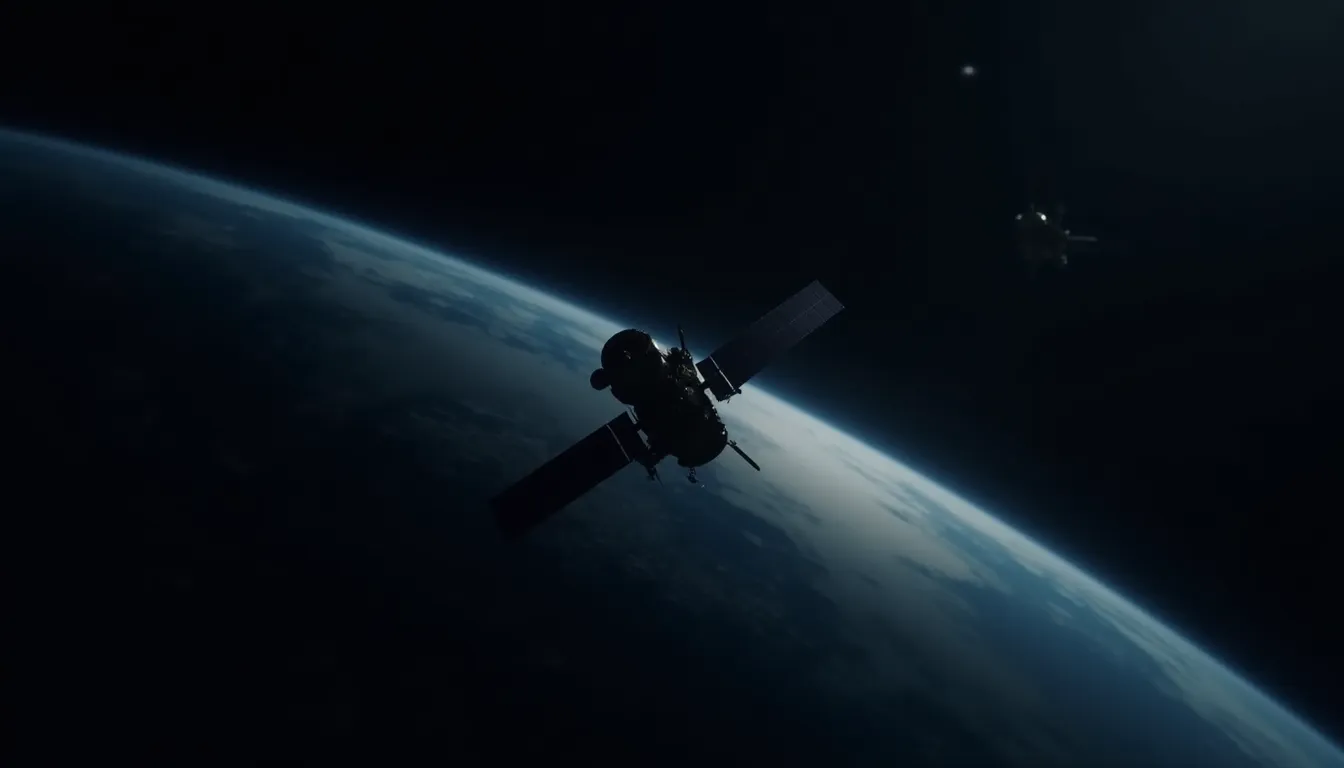
The Pentagon's Defense Innovation Unit and Space Force are accelerating commercial satellite purchases for monitoring geosynchronous orbit through a joint GHOST-R and RG-XX initiative. Two contractors—Northrop Grumman and True Anomaly—will develop and fly prototypes by 2028 to replace aging surveillance satellites and close critical gaps in U.S. orbital awareness.
Key Takeaways
- The Pentagon's DIU and Space Force are jointly accelerating commercial satellite development for geosynchronous orbit monitoring through the GHOST-R and RG-XX programs to replace aging GSSAP surveillance satellites
- Two contractors—Northrop Grumman and True Anomaly—have been selected to develop and fly operational prototypes by 2028, with successful designs transitioning directly to the RG-XX program of record
- The Andromeda umbrella program allocates $6.2 billion across a vendor pool of 14 companies over the next decade to build resilient GEO surveillance architecture
- The shift toward rapid commercial procurement reflects Pentagon strategy to close orbital awareness gaps faster than traditional government-developed systems allow
- Successful prototypes will enable the Space Force to operate a hybrid constellation architecture combining commercial and government-owned space domain awareness assets in geosynchronous orbit
The Pentagon's Defense Innovation Unit (DIU) and Space Force have joined forces to rapidly develop and deploy next-generation commercial satellites for monitoring geosynchronous Earth orbit (GEO), according to a Space Systems Command announcement. This joint effort represents a significant acceleration in U.S. efforts to maintain awareness of an increasingly contested orbital region that hosts critical communications, missile-warning, and intelligence satellites.
The GHOST-R and RG-XX Programs
Under the initiative, DIU's Geosynchronous High-Resolution Optical Space-Based Tactical Reconnaissance (GHOST-R) project will serve as a feeder for the Space Force's RG-XX program, which is designed to replace the Geosynchronous Space Situational Awareness Program (GSSAP) satellites. The GSSAP constellation has provided GEO surveillance for decades but is now aging.
Two companies have been selected to develop and fly prototypes by 2028: Northrop Grumman and True Anomaly. This two-contractor approach reflects Pentagon strategy to maintain competition while accelerating development timelines.
Funding and Program Scale
DIU announced the GHOST-R effort in February, while Space Systems Command established the RG-XX program in April as part of a broader GEO monitoring initiative called Andromeda, setting up a pool of 14 vendors to compete for $1.84 billion over the next decade. The scope of this effort expanded significantly in May. Space Systems Command added another $4.4 billion to Andromeda's indefinite delivery/indefinite quantity contract vehicle, bringing the total ceiling for awards up to $6.2 billion from $1.8 billion.
An Space Systems Command spokesperson confirmed that the prototype contract funds were not provided via the Andromeda indefinite delivery/indefinite quantity contract, though the exact value and funding source for the individual GHOST-R prototype contracts were not disclosed at announcement.
Commercial Approaches and Contractor Strategies
True Anomaly will deliver its latest Jackal platform to serve as the prototype under GHOST-R. Jackal is already being tested under the Victus Haze demonstration, which is focused on rendezvous and proximity operations with uncooperative spacecraft. While True Anomaly will initially operate Jackal along with Space Force operators, if successful it will eventually transition to government-owned, government-operated status as an on-orbit asset for the RG-XX program.
Northrop Grumman is providing its ESPASat-L, a spacecraft the size of a small suitcase that integrates with the ESPAStar payload rideshare platform. Northrop Grumman noted that its GHOST-R operational prototype will provide commercial augmentation for existing space domain awareness systems, enabling the Space Force to operate a hybrid constellation architecture.
Strategic Rationale
The accelerated push for GEO monitoring reflects Pentagon recognition that orbital awareness has become strategically urgent. As more state and commercial actors place assets in geosynchronous orbit, the ability to independently verify what is positioned there and what it is doing becomes essential. This capability underpins any future space traffic management regime and provides a foundation for verifying compliance with potential arms-control frameworks that may govern military activity in orbit.
The shift toward rapid commercial buys for GEO monitoring signals that the U.S. military views this as a near-term procurement problem rather than a long-range research goal. The traditional approach of waiting years for government-developed systems has given way to a pattern of acquiring existing commercial space domain awareness capacity—a model that has accelerated across U.S. space acquisition in recent budget cycles. This approach allows the Defense Department to leverage the speed and iteration cycles of commercial space operators while reducing overall program risk through competitive prototype testing.
The broader context involves an international space environment that has grown increasingly congested and contested. Geosynchronous orbit hosts thousands of operational satellites belonging to multiple nations, making it difficult to track changes, assess threats, or detect hostile activity without dedicated surveillance capability. The new initiative directly addresses this gap by providing the Space Force with improved optical imaging from space-based platforms specifically designed for high-resolution characterization of resident space objects in GEO.
Timeline and Next Steps
The two prototype contracts call for operational prototypes to be delivered and flight-tested by 2028, providing the Space Force with a relatively compressed development timeline compared to traditional government satellite programs. This schedule positions successful prototypes to transition directly into the RG-XX program of record, which would then scale the capability across a proliferated constellation to replace the legacy GSSAP network.
The division of work between DIU and the Space Force reflects complementary institutional strengths: DIU's mandate to accelerate emerging commercial technology into military use pairs with Space Systems Command's responsibility for space weapon systems acquisition and deployment. This collaboration model allows rapid prototyping and technical validation while preserving the government's ability to integrate proven capabilities into operationally fielded systems.
Sources
- Breaking Defense: DIU, Space Force team up to kick-start buys of commercial sats for monitoring GEO
- SpaceNews: If AI cannot be trusted in a classroom, why should it be trusted in orbit?
- Breaking Defense: US, UK test SM-6, other missiles on SINKEX target frigate
- Breaking Defense: UK to gather defense CEOs for closed-door Russian security briefing
- Breaking Defense: How readiness stays ready: The F110 delivers power, reliability and scale for the F-15EX
- MachineHours Encyclopedia: Roomba: First Mass-Market Consumer Robot
Frequently Asked Questions
Why are DIU and Space Force buying commercial satellites for GEO monitoring?
According to Breaking Defense, the two agencies are working to speed procurement of commercial capabilities that track objects in geosynchronous orbit, aiming to close awareness gaps faster than traditional government-built systems allow.
What is the concern raised about AI in orbital operations?
SpaceNews argued that AI systems proposed for autonomous orbital tasks have not cleared the reliability standards being debated even for lower-stakes uses like classrooms, raising questions about trust in higher-consequence orbital decisions.
What was the SINKEX exercise?
The US and UK tested SM-6 and other missiles against a target frigate in a live-fire SINKEX exercise, according to Breaking Defense.
Why is the UK briefing defense CEOs on Russia?
Breaking Defense reported the UK is convening a closed-door session for defense industry leaders to discuss Russian security matters, reflecting closer government-industry coordination on threat assessment.
Get MachineHours in your inbox
AI compute and the machine economy in your inbox.