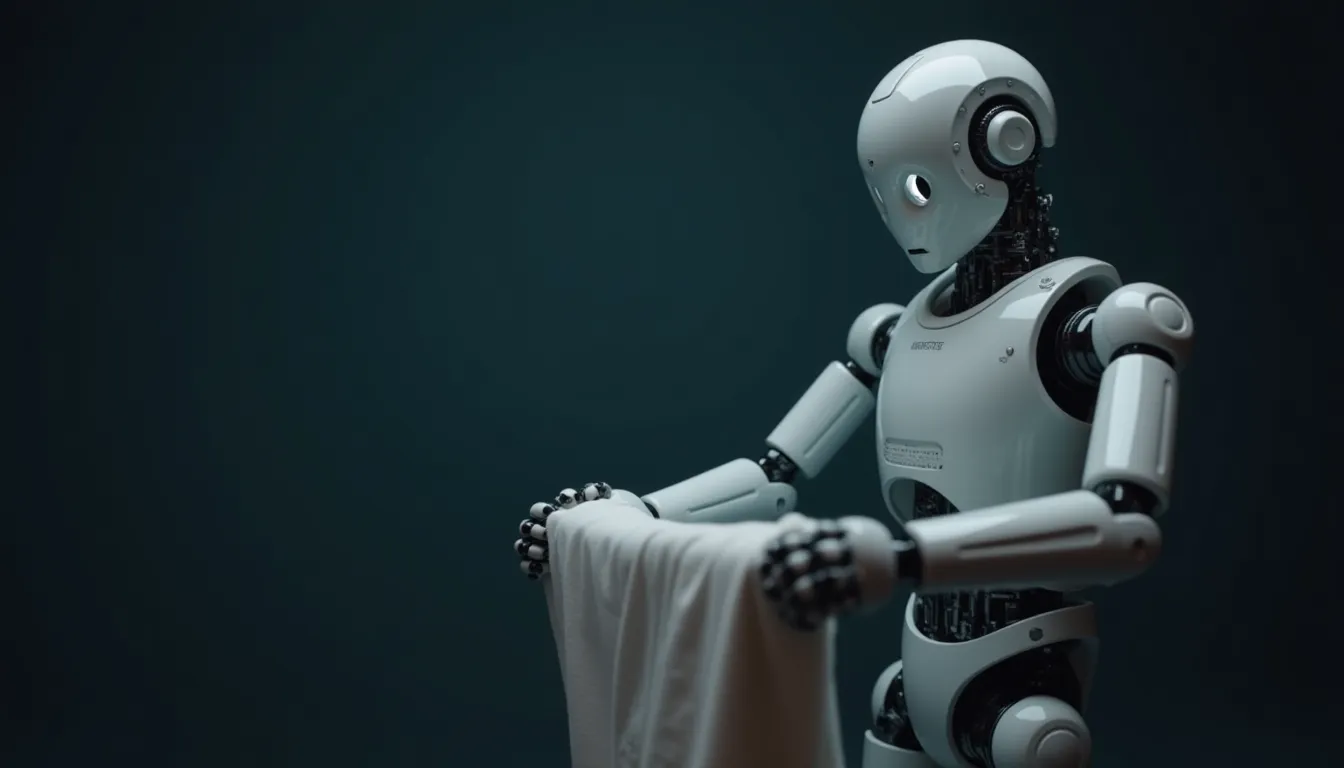
Chinese robotics companies are training AI systems to perform household tasks like folding laundry. Silicon Valley startups like Hello Robot are also developing domestic robots for consumer homes.
Key Takeaways
- Chinese companies are training AI systems to fold laundry and perform household tasks
- Hello Robot is developing domestic robots for Silicon Valley consumer markets
- Humanoid robots are simultaneously advancing in industrial manufacturing settings
- Laundry folding represents a key benchmark for robotic dexterity and manipulation
- Global competition is intensifying between Chinese and American robotics developers
Chinese companies are racing to develop AI-powered domestic robots capable of performing household tasks, with Rest of World reporting that firms are training robotic systems to fold clothes and handle other home chores. The development comes as global competition intensifies in the consumer robotics market, with Silicon Valley also making significant moves into domestic automation.
What Happened
Rest of World detailed how Chinese robotics companies are building vast datasets of domestic tasks, focusing particularly on laundry folding as a proving ground for more complex household automation. The training involves teaching AI systems to recognize fabric types, understand folding patterns, and manipulate textiles with precision - challenges that require significant advances in computer vision and dexterous manipulation.
Meanwhile, TechCrunch reported that Hello Robot, a Silicon Valley startup, is positioning itself to bring robotic assistants into American homes. The company is developing robots designed for domestic environments, targeting everyday tasks that current automation systems struggle to handle reliably.
The competitive field extends beyond home applications. According to the Financial Times, humanoid robots are also making inroads into industrial settings, bringing what the publication describes as "creative destruction" to manufacturing floors. This industrial adoption is creating pressure for companies to develop more sophisticated robotic systems across all applications.
Why It Matters
The parallel development of domestic robots in China and Silicon Valley signals a new phase in consumer robotics, moving beyond simple vacuum cleaners and lawn mowers to systems capable of complex manipulation tasks. The focus on laundry folding is particularly significant because it requires robots to handle variable, soft materials - a challenge that has long been considered a benchmark for advanced robotic dexterity.
These developments also highlight the global nature of robotics competition, with Chinese companies building substantial capabilities in AI training while American startups focus on hardware integration and user experience. The race to crack domestic automation could determine which regions capture value in what analysts expect to become a massive consumer market.
Background
The push toward domestic robotics builds on decades of technological development that began with companies like Amazon.
The current wave of domestic robots represents a convergence of improved AI models, more affordable sensors, and consumer acceptance of automated systems in personal spaces.
What to Watch
The next 18 months will likely determine whether domestic robots can move beyond tech demonstrations to reliable consumer products. Key indicators include how well Chinese companies can translate their training data into strong real-world performance, and whether Silicon Valley startups can achieve the cost points necessary for mass adoption.
The integration of household robots with existing smart home ecosystems will also be critical, as consumers expect seamless operation with voice assistants and mobile apps. Success in domestic robotics could accelerate adoption across other consumer applications, from elderly care to small business automation.
Key Facts
- Amazon was founded by Jeff Bezos in 1994 as an online bookstore
- The company went public in 1997 with an initial stock price of $18 per share
- Amazon Web Services launched in 2006, changing cloud computing
- The company achieved trillion-dollar market capitalization status in 2018
Sources
Frequently Asked Questions
What household tasks are Chinese robots being trained to perform?
Chinese robotics companies are focusing on laundry folding as a primary training task, along with other household chores that require precise manipulation of soft materials.
How is Hello Robot different from other robotics companies?
Hello Robot is specifically positioning itself to bring robotic assistants into American homes, focusing on domestic environments rather than industrial applications.
Why is laundry folding considered important for robot development?
Folding clothes requires robots to handle variable, soft materials with precision, making it a benchmark test for advanced robotic dexterity and manipulation capabilities.
Are domestic robots ready for consumer adoption?
The technology is advancing rapidly but the next 18 months will be critical to determine if domestic robots can move beyond demonstrations to reliable consumer products.