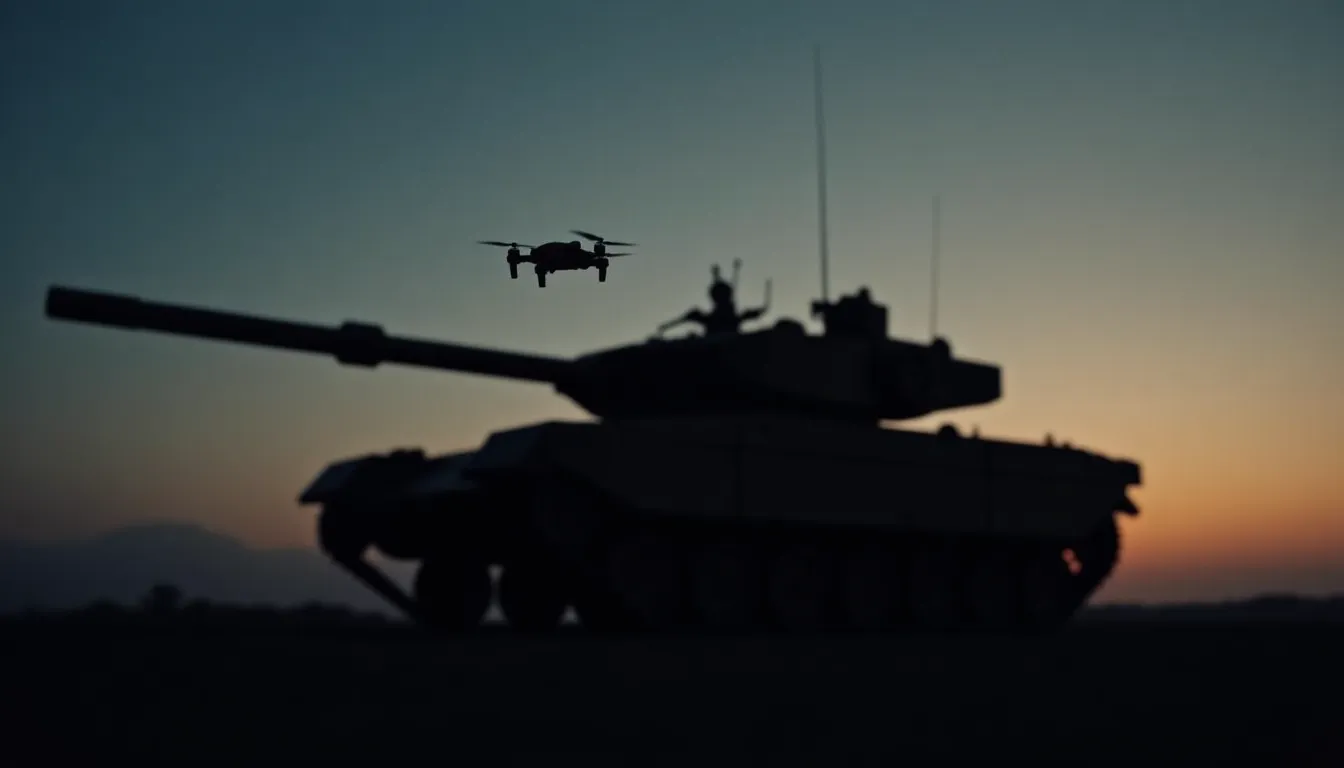
China's People's Liberation Army is overhauling tank survivability doctrine in response to first-person-view drone and top-attack munition threats, implementing layered defenses combining active protection systems, roof barriers, electronic countermeasures, and enhanced crew training to counter the new overhead-attack warfare exposed by the Ukraine conflict.
Key Takeaways
- China's PLA is implementing layered defense strategies combining active protection systems (GL-6), roof barriers, electronic countermeasures, and crew training—not relying on any single armor upgrade to counter FPV drone threats
- The PLA is treating overhead drone strikes as a permanent battlefield feature and designing networked combat systems where armored vehicles operate alongside reconnaissance drones and electronic warfare assets for integrated defense
- Ukraine's conflict demonstrated that cheap FPV drones can defeat traditional tank armor by targeting turret roofs, forcing global militaries including China to fundamentally rethink armor survivability doctrine
- Chinese military researchers acknowledge persistent challenges including small-target detection, short engagement windows, costly interception, and increasingly autonomous drones that can defeat existing defenses
- The speed at which PLA transforms these protection concepts from demonstrations into operational tank units will determine whether China's forces can maintain effective armored capabilities against drone-heavy adversaries
Chinese military planners are redesigning tank armor and doctrine specifically to counter first-person-view (FPV) drones and top-attack munitions, marking a fundamental shift in how the People's Liberation Army (PLA) approaches armored vehicle survivability. According to Breaking Defense, the PLA is treating overhead drone strikes as a central, permanent threat rather than an edge case, prompting changes to turret armor, active protection systems, crew training, and tactical doctrine aimed at reducing exposure to drone-guided strikes.
How Ukraine Exposed Tank Vulnerabilities
The war in Ukraine exposed a brutal reality: a cheap FPV drone can hunt a tank from above, slip past its strongest plates, and turn the turret roof into the vehicle's most dangerous weak point. This vulnerability has forced militaries worldwide to reassess tank survivability doctrine. China's response demonstrates how that lesson is reshaping hardware design and operational practices at the strategic level.
The PLA, having observed how drones and high-angle attacks have battered armored vehicles in recent conflicts, is racing to rebuild protection for the age of overhead attack. In early 2025, Chinese state media revealed nascent efforts to confront this new battlefield reality through footage from a Norinco test site showing a tank fitted with the GL-6 active protection system (APS) knocking out a descending threat from overhead while simultaneously engaging another from the side, with the system demonstrating its ability to engage both high-angle attacks from above (whether from drones, rockets, missiles, or loitering munitions) and near-simultaneous air and ground attacks.
Layered Defense Strategy Over Single Solution
This integrated approach extends beyond hardware. A 2025 article from PLA Army researchers argues that mobile formations facing UAV swarms need a combination of integrated warning, electronic countermeasures, kinetic defenses, camouflage and decoys. The strategy reflects recognition that no single armor upgrade or protection system can defeat the full spectrum of drone threats.
"Smart Armor" Integrates Vehicle and Formation
A common theme emerging from all these studies is that "smart armor" is viewed as less a stand-alone technology than a wider effort to make armored survivability more connected, more responsive and better integrated for a battlefield shaped by overhead attack. This conceptual shift frames the problem as systemic rather than material—the tank becomes part of a larger defensive ecosystem rather than relying solely on improved steel and composite armor.
The more immediate question for the PLA may not be which protection concept proves most advanced, but which one can reach armored units fast enough to matter, as the PLA has given serious attention to roof barriers, cage-like covers, localized reinforcement and other add-on measures. Like Ukrainian forces responding to drone threats, Chinese units are prioritizing practical, deployable solutions that can be implemented with existing vehicles.
Tactical Adaptations Become Doctrine
The wider protection logic has also influenced how crews manage signature and exposure—recent PLA training has emphasized armored units responding to drones by hiding in roadside depressions, erecting camouflage netting, erasing vehicle tracks and using smoke to mask movement during live tactical drills. These procedural changes represent a shift in how tank forces conduct operations, moving from static defensive postures toward dynamic concealment and movement discipline.
Engineering and Production Constraints Shape Implementation
Chinese military writers have increasingly focused on turning battlefield improvisations into sustainable vehicle protection, as scaling such adaptations requires balancing protection with engineering, production, maintenance and logistics. This engineering perspective reveals the real challenge: translating successful field adaptations into mass-producible, logistically sustainable solutions.
An April 2026 PLA Daily assessment looked at cages, wire barriers, composite screens and other foreign adaptations, and highlighted penalties in visibility, weapon movement and mobility. The PLA's analysis acknowledges that every protection measure carries operational costs—improved roof protection reduces turret traverse, added armor reduces speed, and concealment tactics limit combat effectiveness when engagement is necessary.
A September PLA Daily article examined the next step of incorporating these measures seamlessly into operations, describing how Russian manufacturers incorporated physical and electronic anti-drone measures into newly produced tanks after battlefield feedback. China appears to be adopting a similar iterative approach, using combat experience from Ukraine to inform its own design and doctrine evolution.
Persistent Challenges Remain
Chinese military writers themselves acknowledge that no layer offers a complete answer, with earlier this month PLA researchers highlighting small-target detection, short engagement windows, costly interception and increasingly jam-resistant fiber-optic or autonomous drones as persistent problems. This candid assessment suggests the PLA views tank survival against drones as a long-term adaptation challenge rather than a solvable problem with a definitive technical solution.
Active protection systems, roof protection, camouflage, smoke and local reinforcement can all force anti-armor teams to engage in denser salvos, as well as utilize more complex tactics involving mixed-axis strikes, deception and closer reconnaissance, while making support vehicles and key enablers more attractive targets. The PLA appears to recognize that improved tank protection may simply shift the burden to other vehicle types and logistics nodes.
Implications for Regional Forces
Taiwanese military analysts now read PLA displays of APS-equipped heavy armor in much the same way, as a response to asymmetric tactics centered on drones and anti-tank weapons. The regional security implications are significant: if the PLA successfully implements these defenses at scale, it would reduce the effectiveness of drone-centric anti-armor strategies that Taiwan and its allies have relied upon to counter numerical disadvantages in conventional armor.
Transition from Concept to Operational Deployment
The key question now is how quickly these ideas move from demonstrations into operational units, as if that transition gathers pace, US and partner forces may face armored units that no longer offer easy overhead kills. The speed of implementation will determine whether China's drone-age tank strategy represents a genuine operational shift or remains primarily conceptual.
Broader Significance for Modern Warfare
The drone age did not end armored warfare—it rewrote the terms of survival, and China appears determined to adapt before that lesson hardens into a battlefield disadvantage. This shift reflects how autonomous and semi-autonomous weapons are forcing conventional militaries to redesign hardware and doctrine around threats that did not exist in prior military planning cycles. China's comprehensive response, combining active protection technology, tactical adaptation, crew training, and force-level integration, suggests that militaries treating drone-guided top-attack as a permanent feature of modern conflict rather than a temporary phenomenon are likely to maintain competitive armored forces in contested environments.
Sources
- Breaking Defense: How China is rethinking tank survival against FPVs and top-attack threats
- Breaking Defense: Navy wants more offensive, 'expeditionary' cyber capabilities
- Breaking Defense: The still-formidable F-16 will be even more capable with better electronic warfare
- Breaking Defense: SpaceX given unique access to classified DoD space tracking data
- Breaking Defense: Syria looks to end foreign military presence, have sovereignty over all bases
- MachineHours Encyclopedia: Roomba: First Mass-Market Consumer Robot
Frequently Asked Questions
Why is China redesigning tank armor now?
According to Breaking Defense, Chinese planners are responding to the growing effectiveness of FPV drones and top-attack munitions, which have proven capable of destroying armored vehicles despite their traditional top armor protections.
What kind of cyber capabilities does the Navy want?
Breaking Defense reports the Navy wants more offensive, expeditionary cyber teams that can operate forward with fleet units rather than relying solely on centralized cyber commands.
What access has SpaceX reportedly been given to DoD data?
Sources cited by Breaking Defense say SpaceX has unique access to classified Department of Defense space tracking data, a level of access not typically granted to commercial space companies.
What did Syria's president say about foreign military bases?
He said Syria intends to end foreign military presence in the country and reassert full sovereignty over all bases on its territory, according to Breaking Defense.
Get MachineHours in your inbox
AI compute and the machine economy in your inbox.