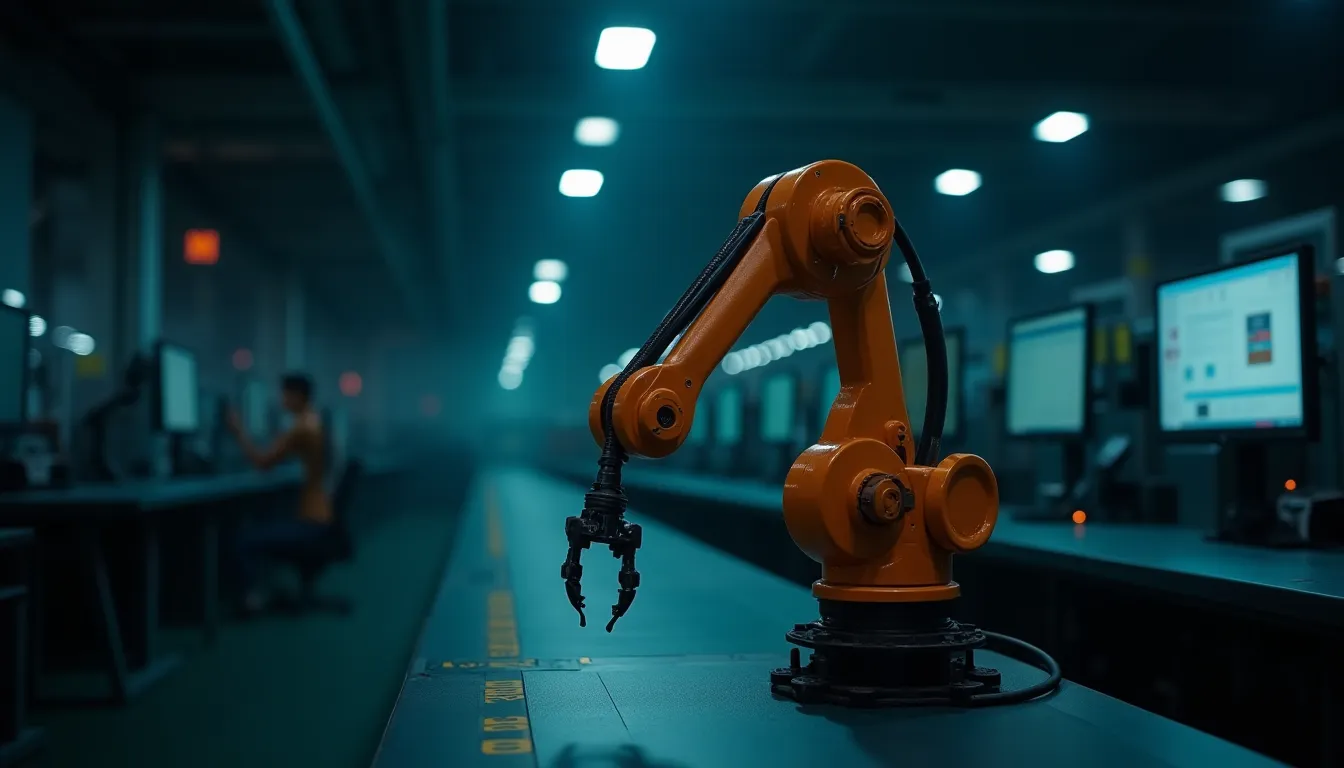
US robotics deployments in manufacturing and data centers accelerate amid competition with China's dominant production capacity, raising urgent questions about jobs, workforce retraining, and whether automation can offset structural manufacturing decline without displacing workers faster than new roles emerge.
Key Takeaways
- Meta is testing robots across its data centers to automate cable management, server cycling, and hardware maintenance—work currently performed by skilled technicians, with one worker estimating robots could replace 80% of physical workloads if successful
- China commanded 86% of global humanoid robot shipments in H1 2026 (22,000 units) through five manufacturers, creating a scale advantage that allows cost reduction and real-world data generation faster than US competitors can match
- US export controls on Chinese drones and robots face a structural problem: Chinese manufacturers can absorb regulatory friction that constrains smaller competitors, while US domestic robotics remains at far smaller production scale
- Automation creates new technical roles (robot maintenance, systems integration, fleet supervision) requiring qualifications far above displaced jobs, but retraining infrastructure is not moving at the pace of deployment
- Without deliberate workforce transition investment, productivity gains from robotics will concentrate among narrow technical classes while displacement spreads across regions and occupational categories with fewer alternatives
The Financial Times published a detailed examination in late August asking whether robots can realistically rescue American manufacturing, even as reporting reveals China's robotic production capacity may simply be too large for US trade barriers to contain. The convergence of these dynamics—accelerating automation within US factories and data centers alongside China's commanding global market share—presents a structural challenge that reshapes what "saving manufacturing" means for American workers and communities.
Robot Deployment Accelerates Across US Industry
Meta is actively deploying robots inside its data centers to handle physical infrastructure tasks including rack installation, cable management, and hardware maintenance—work that currently requires large numbers of skilled technicians. According to reporting based on current and former workers, Meta is using robots from several vendors including Watney Robotics, Kinova, and ABB, and one data center worker estimates that if the trials succeed, robots could replace up to 80 percent of some workers' physical workloads.
The scope of testing is expanding. At one of Meta's Altoona, Iowa facilities, the company is evaluating a Kinova Gen3 robotic arm for power cycling servers, and it is testing a separate robot to swap networking cables. At Meta's newest data center campus in New Albany, Ohio, known as Prometheus, four-wheel robots with scissor-lift-style risers and six-axis arms made by automation giant ABB are being tested to reseat parts and may eventually take on other tasks with diminishing human oversight.
Meta has not disclosed the scale of the deployment or the workforce implications, but the initiative signals that robotics ambitions are moving from warehouse logistics into the technical labour market. Meta's statement emphasizes that the company is investing heavily in training and hiring workers to build and operate data centers, noting that "America is in the middle of its biggest infrastructure boom since World War II, and there's a major shortage of skilled workers to fill the roles". However, worker discussions at Meta's Altoona facility have taken on a demoralized tone, with messages indicating concern that jobs will disappear within years due to robots.
The technical obstacles remain real but declining. Until recently, robots were poorly suited for data center work because they were expensive and sometimes crushed servers in earlier trials, but hardware costs have fallen and AI models powering robots are now far more capable than a few years ago. Workers have complained about robot downtime for battery recharging, and Meta has acknowledged internally that robots aren't equipped for certain tasks, such as the intense cabling work required for Nvidia GB300 supercomputers. Yet the trajectory is clear: as hardware improves and AI capabilities advance, more data center roles become automatable.
Manufacturing Automation Without Job Recovery
The Financial Times investigation into US manufacturing automation does not offer a clean answer to whether robots can save American factory employment. Robot deployment in US manufacturing is accelerating, but the benefits are unevenly distributed, concentrated in capital-intensive industries that already employ relatively few workers. The core tension is direct: robots may restore output without restoring jobs, fundamentally reshaping what "saving manufacturing" means for communities dependent on factory employment.
This tension points to a deeper structural problem. Modern automation creates new roles—systems integration, maintenance engineering, robot fleet supervision—but these positions require qualifications far above the jobs they displace. The skill gap is not self-correcting. Without retraining infrastructure moving at the pace of technological deployment, automation concentrates opportunity among a narrow technical class while spreading displacement more broadly.
China's Manufacturing Scale Outpaces US Policy Barriers
In July and August, Washington tightened restrictions on foreign-made advanced robotic systems and imposed steep tariffs on imported drones and their components, citing national-security concerns, with drone tariffs taking effect in September and additional component tariffs following in 2027. These moves are part of a broader U.S. effort to restrict foreign technology in strategically important industries through mechanisms including the FCC's Covered List, established in 2021.
Yet the restrictions face a fundamental constraint: China's market scale. China dominates global humanoid robot manufacturing, with global shipments hitting 22,000 units in the first half of 2026, the vast majority from Chinese manufacturers, while U.S. companies operate at a far smaller scale. The world's five largest humanoid robot makers by shipments—AgiBot, Unitree, Galbot, UBTECH, and Leju Robotics—were all Chinese and together accounted for 86% of global shipments in the first half of 2026.
This advantage could compound: lower prices allow Chinese manufacturers to put more robots into use, generating real-world data that can improve their technology, and higher production volumes can drive costs down further. Chinese humanoid makers are pushing costs down by bringing more of the technology stack in-house and drawing on China's existing manufacturing base—Unitree, for example, is developing more components internally, while automakers like XPeng are drawing on their experience in chips and vehicle manufacturing as they move into robotics.
The asymmetry is structural, not temporary. An analyst at TDK Ventures noted that "you cannot sanction your way around a cost curve. You can only out-build it, and America has yet to begin making the decade-long investment that will require." This suggests that US export controls may succeed only partially, leaving domestic manufacturers competing against rivals that can deploy robots at lower cost and higher volume.
Labor Market Pressure From Multiple Directions
The convergence of automation across manufacturing and data centers creates pressure on labour markets from multiple simultaneous directions. In manufacturing, robots offer productivity without proportional employment recovery. In data centers, they are entering skilled technical roles previously insulated from automation. The common thread is that new roles created by robotics deployment—systems integration, maintenance engineering, robot fleet supervision—require qualifications far above the jobs they displace.
The geopolitical dimension compounds this challenge. If US restrictions on Chinese robotics succeed only partially, domestic manufacturers face competitors operating at lower cost and higher volume. The regional economic consequences of workforce automation are already visible in areas where factory closures have depressed housing demand and local tax bases. Further displacement without retraining infrastructure accelerates that pattern.
The central question is not whether robots will take more jobs—deployment timelines and technical capability suggest they will. The urgent question is whether institutions responsible for workforce transition are moving at the pace of technology. Current evidence suggests they are not. Meta launched a long-term program to train thousands of people annually in electrical, mechanical, and plumbing work at no cost, and is guaranteeing employment in states such as Louisiana, Ohio, Indiana, and Texas for those who complete the training, while also partnering with building trade unions to fund apprenticeship programs. These efforts represent a beginning, but lack clarity on scale relative to displacement risk.
The Skill Premium and Regional Inequality
Productivity gains from automation tend to accrue to capital owners faster than they diffuse through wages or retraining programs. Without deliberate policy intervention, automation concentrates opportunity in a narrow technical class—those with skills to build, maintain, and operate robot systems—while spreading displacement across geographies and occupational categories with fewer alternatives.
This dynamic has long-term consequences for wage growth and regional economic stability. Communities that built prosperity on manufacturing employment face a dual challenge: robots displace existing workers while the jobs that robots create demand qualifications not easily acquired through traditional pathways. Without retraining pipelines specifically targeting robot maintenance, fleet operations, and systems integration roles, the skill gap widens into an opportunity gap.
Sources
- Financial Times: Can robots save US manufacturing?
- TechCrunch: The U.S. is building barriers around drones and robots, but China has scale to get around them
- Ars Technica: Inside Meta's push to put robots to work in data centers
- The Verge: China's robots race ahead
- 404 Media: ICE Plans to Spend Millions on Boston Dynamics Dog Robots
- MachineHours Encyclopedia: AI and Wealth Generation — How Artificial Intelligence is Reshaping Who Gets Rich
- MachineHours Encyclopedia: Silver, Chips, and Solar — The Precious Metal Powering the AI Revolution
- MachineHours Encyclopedia: AI in Real Estate — How Artificial Intelligence is Transforming Property Markets
Frequently Asked Questions
Can robots actually save US manufacturing jobs?
The Financial Times investigation suggests robots may restore industrial output but not proportional employment, concentrating gains in capital-intensive sectors that already employ relatively few workers.
Why can't US trade barriers stop Chinese robotics competition?
TechCrunch reported that China's manufacturing scale lets its robotics producers absorb export control friction that would cripple smaller rivals, and Chinese components continue to reach US markets via third countries.
What is Meta doing with robots in data centers?
According to Ars Technica, Meta is deploying robots to handle physical tasks like rack installation, cable management, and hardware maintenance inside its data centers. The company has not disclosed the scale or workforce impact.
What robots is ICE planning to buy?
404 Media reported that US Immigration and Customs Enforcement plans to spend millions of dollars on Boston Dynamics quadruped robots for enforcement and surveillance roles.
What skills will be in demand as robotics deployment accelerates?
The reporting points to robot fleet supervision, systems integration, and maintenance engineering as growth roles - all requiring technical qualifications above the manual and logistics jobs being automated.
Get MachineHours in your inbox
AI compute and the machine economy in your inbox.