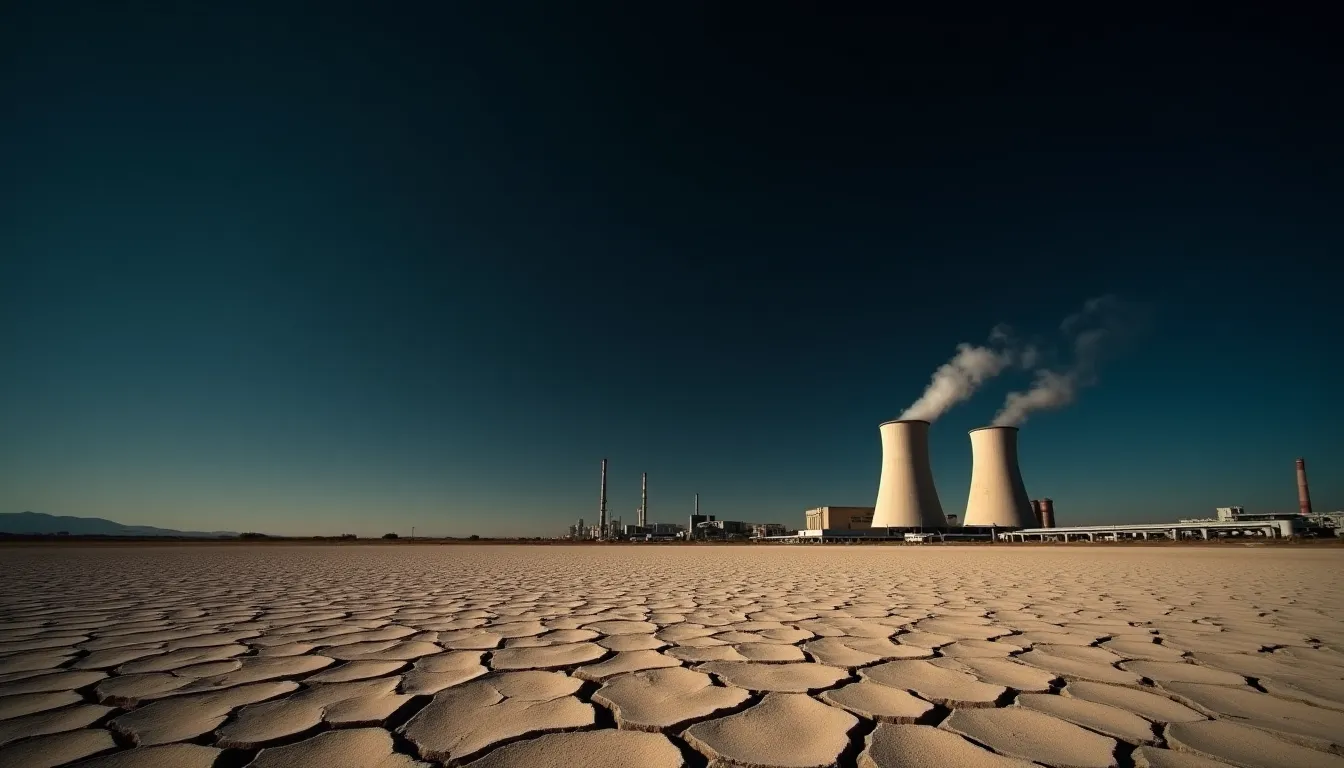
Arizona's semiconductor expansion, anchored by TSMC and Intel investments tied to CHIPS Act funding, faces a critical constraint: the Colorado River is running dry. Federal water allocation cuts starting in 2027 will force manufacturers to rely on costlier alternatives, raising questions about the viability of domestic chip self-sufficiency.
Key Takeaways
- Arizona will lose at least 760,000 acre-feet of water annually starting in 2027 under federal allocation cuts, directly threatening TSMC and Intel fab operations that depend on 10-16 million gallons of water daily per facility
- The federal government invested $52.7 billion in the CHIPS Act to reduce dependence on Taiwan-based chip manufacturing, but failed to account for water scarcity constraints in Arizona when making those investment commitments
- Semiconductor manufacturers plan to increase water recycling rates—TSMC targeting 90 percent—but infrastructure costs will drive up water bills for residents and companies alike under Phoenix's uniform pricing policy
- Arizona's pivot to groundwater and alternative sources provides near-term buffer but risks long-term aquifer depletion, shifting costs to future generations rather than solving the underlying shortage
- The collision between rapid AI-driven demand for chips and the physical limits of water availability in an arid region exemplifies how industrial policy assumptions often ignore environmental constraints
The Core Challenge: Water Scarcity Meets Manufacturing Demand
Arizona's ambition to anchor U.S. semiconductor independence is colliding with a hard physical reality: the Colorado River is running dry. The state has become a flagship destination for domestic chip manufacturing on the strength of the 2022 CHIPS and Science Act, which allocated $52.7 billion to rebuild domestic semiconductor capacity. Yet the water supply that chip fabrication plants depend on is under severe and growing pressure, casting doubt over Arizona's role as a domestic manufacturing hub at the moment when the federal government is counting on it most.
The crisis stems from decades of overallocation. The Colorado River Basin has faced "unprecedented" drought for more than a quarter century, according to the US Bureau of Reclamation, while climate change is making the region more dry as growing water demand adds to decades of overuse. With 40 million Americans from Denver to Los Angeles relying on water from the Colorado River, states have been locked in dispute over allocation for years. The "Law of the River" guidelines, which govern water management, expired this year, and after states failed to reach an agreement on their own, the US Department of the Interior finalized its own plan in August.
The federal decision is harsh for Arizona. Arizona stands to lose the most, at least 760,000 acre-feet of water a year starting in 2027. To put that in perspective, an acre-foot represents how much water it would take to cover an acre with a foot of water, and is enough to supply about three homes with water for a year in the Phoenix area. The City of Phoenix uses about 300,000 acre feet of water in a year. The cuts affect downriver states broadly—Arizona, Nevada, and California all face reductions—but Arizona bears the largest absolute loss.
Water Intensity of Semiconductor Manufacturing
Semiconductor fabrication is among the most water-intensive industrial processes on earth. Fabs use "ultra-pure" water to clean surfaces and etch sensitive chips. It takes more municipal water to create a smaller amount of ultra-pure water through deionization and reverse osmosis. A typical facility might use 10 million gallons of ultra-pure water a day, which could require up to 16 million gallons of municipal water.
Arizona has attracted two of the world's largest chipmakers with federal CHIPS Act funding. Armed with a $7.86 billion grant from the government, Intel is planning to spend $32 billion on two new factories and an expansion of an existing facility in Arizona. In 2025, the company's facilities in Chandler, Arizona withdrew more than 2.7 billion gallons of freshwater, according to its latest corporate responsibility report. Meanwhile, TSMC, the world's largest chipmaker, received up to $6.6 billion in CHIPS Act funding and decided to build at least six new semiconductor fabs in Phoenix. TSMC's first fab in Arizona uses roughly 4.75 million gallons of water a day, the company told The Verge last year. It's approximately equivalent to the water usage of more than 14,000 homes a day, or 2 percent of Phoenix's housing.
The demand trajectory is climbing. That amount grows with each new fab the company builds, and with the more advanced manufacturing processes TSMC is developing. While chip manufacturing still represents a small fraction of Arizona's overall water consumption—agricultural uses account for just over 70 percent of the state's water, while industrial uses, including the chip manufacturing that's had a foothold in the state since the 1940s, account for just 6 percent—the growth trajectory of semiconductor manufacturing coincides with the most acute period of water shortage in the region's recorded history.
Geopolitical Logic Meets Physical Constraints
The Arizona water story is not simply an environmental footnote. It represents a supply chain risk embedded in the core logic of U.S. industrial policy. The rationale for the CHIPS Act centered on reducing dependence on Taiwan-based production, partly to insulate the United States from geopolitical disruption. Arizona, an epicenter for the bipartisan push to revive American chip manufacturing, is about to lose more than a quarter of the water it typically pulls each year from the Colorado River.
Yet a domestic water crisis creates a different but equally real form of supply fragility. If reliable water supply cannot be guaranteed, the geopolitical rationale for onshoring fabs weakens. The U.S. sought to de-risk semiconductor supply chains by building capacity at home; instead, it is building capacity in an arid region that is depleting the only renewable water source available to it. When production timelines and capacity projections depend on secure access to a resource under federal allocation dispute, the advantage of geographic proximity to end markets erodes.
Cost and Adaptation Strategies
Local leaders and the semiconductor industry are not passive in the face of these constraints. City planners and industry leaders have already taken precautions to conserve water and find alternative sources. Both TSMC and Intel have made commitments to reduce freshwater consumption through recycling and reclamation technology. The company recycles 65 percent of the water it uses in Arizona, TSMC says, a figure that's supposed to grow to at least 90 percent when it finishes building a water reclamation plant.
However, these adaptations carry cost. Local leaders insist that Phoenix and other cities in the region are prepared for water cuts, citing plans to make up for the shortfall with underground water stores and other surface water sources. But the infrastructure required to exploit those alternative sources is capital-intensive and time-consuming to build. Even without sudden tap water shortages, Sorensen expects utility bills to climb over time. The transition to alternative water resources will entail new infrastructure, like new wells and pipes. That's likely to be the most significant driver of higher tap water prices.
The manufacturers themselves have been cautious about discussing the constraints publicly. TSMC and Intel both declined interviews with The Verge for reporting on this issue. However, both have made public commitments to minimize the amount of fresh water they consume. "A stable supply of water is critical to chip production," TSMC deputy spokesperson Nina Kao said in an emailed statement. "One of the reasons the city of Phoenix was selected for our US expansion is because of their long-term water plan, which includes varied water supply sources, as well as steps taken in preparation for reduced water supplies over the course of decades."
Long-Term Sustainability and Future Groundwater Depletion
Maricopa County, home to Intel and TSMC's chip fabs, isn't as reliant on water from the Colorado River as other counties. Its primary resource is groundwater, but surface water flowing from the Colorado and Salt rivers still make up close to 40 percent of the county's supply. This diversification provides short-term buffer, but it masks a longer-term problem.
Over the long term, a shortage of water from the Colorado River will result in the depletion of groundwater in Central Arizona, as most cities cope by increasing how much water they draw from local aquifers. "It's something they can sustain, but it is only sustained at a cost to future generations," Sorensen notes. Shifting the burden from surface water to groundwater does not solve the underlying problem; it defers it and transfers it to aquifers that refill on geological timescales, not annual ones.
The Policy Disconnect
Phoenix city leaders have pushed back against the federal water allocation decision. Mayor Kate Gallego argued that the federal government's decision to cut the state's intake "does not provide the fair, basin-wide leadership the Colorado River crisis demands." That said, "Phoenix is prepared for this moment because of decades of planning and conservation, we will push for new federal support to mitigate the rising cost of water that will result from this federal decision," Gallego added in an August press release.
The implicit tension in that statement—that the city is prepared but also seeking federal support to mitigate federal cuts—underscores the gap between the policy assumptions underlying CHIPS Act investment and the physical realities on the ground. Policymakers allocated $52.7 billion to revive domestic semiconductor manufacturing on the assumption that Arizona's infrastructure could support the investment. Water scarcity was not meaningfully factored into those calculations at the time of commitment.
Apprehensions are mounting over the impact that AI and the tech industry as a whole have on the region. AI has spawned a new generation of semiconductor factories, chip packaging plants, and data centers across Arizona. The collision between the speed of capital deployment and the pace of environmental constraint is becoming impossible to ignore.
Arizona's Water Crisis Threatens U.S. Semiconductor IndependenceSources
- The Verge: Arizona's lifeline for chip manufacturing is drying up
- TechCrunch: Jensen Huang explains why Nvidia will grow an astounding 70% next year
- MarkTechPost: NVIDIA Details BioNeMo Inference Runtime (BioIR)
- Quantum Computing Report: Xanadu and AMD Launch Open-Source Backline Extension for PennyLane
- IEEE Spectrum: Codeveloper of Ethernet Predecessor Dies at 91
- MachineHours Encyclopedia: Silver, Chips, and Solar — The Precious Metal Powering the AI Revolution
Frequently Asked Questions
Why do semiconductor fabs need so much water?
Chip fabrication requires ultra-pure water in vast quantities to clean silicon wafers at each production stage and to cool manufacturing equipment. A single facility can consume 2 to 4 million gallons per day.
How does Arizona's water shortage affect the CHIPS Act strategy?
The CHIPS Act directed over $52 billion toward domestic semiconductor manufacturing, with Arizona as a flagship destination. Water constraints could delay or limit production capacity at the exact facilities the policy relies on to reduce U.S. dependence on Taiwanese fabs.
What did Jensen Huang say about Nvidia's growth?
TechCrunch reported that Nvidia CEO Jensen Huang explained why he expects the company to grow approximately 70% in the coming year, citing sustained demand for AI compute infrastructure.
What is Nvidia's BioNeMo Inference Runtime?
BioIR is an Nvidia inference system that achieved 2.90x higher Boltz-2 protein folding throughput and 58,500 residues per GPU-hour on an 8xH100 cluster, extending GPU utility into pharmaceutical and biotech research.
Can fabs reduce their water consumption to address the shortage?
Some fab operators have explored water recycling systems that reclaim up to 80% of process water, but the capital cost is high and deployment timelines have not been publicly confirmed for Arizona facilities.
Get MachineHours in your inbox
AI compute and the machine economy in your inbox.