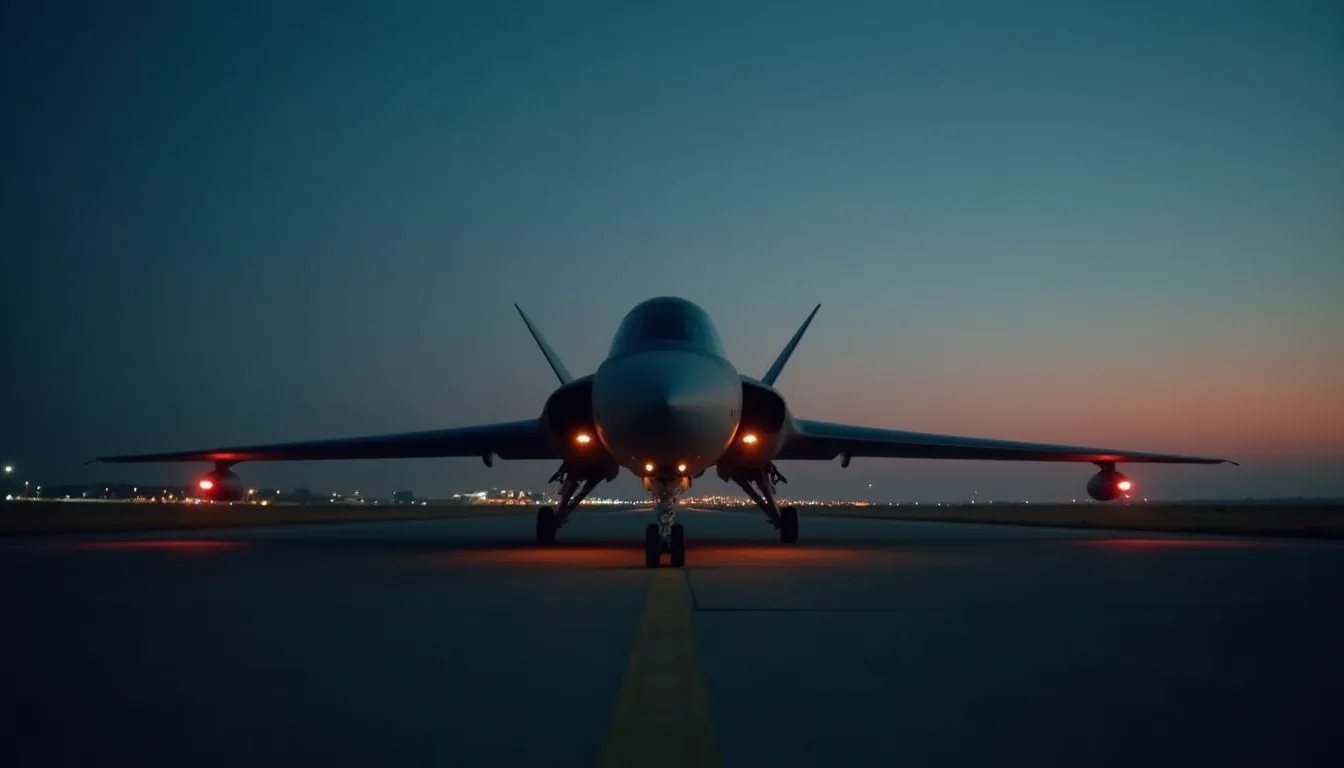
Anduril says it cannot begin production of its FQ-44 Fury autonomous combat drone without an approved FY27 defence budget, as Pratt & Whitney clears a key F-35 engine design review and the CBO tallies Iran war costs at $38 billion.
Key Takeaways
- Anduril confirmed it cannot start FQ-44 Fury CCA drone production without an approved FY27 defence budget, despite investing its own funds in a new production facility.
- Air Force Secretary Troy Meink said the service expects 500 CCA drones in service by 2032, though contract quantities for Anduril and General Atomics remain undisclosed.
- The CBO estimates Iran war costs at roughly $38 billion through August 1, 2026, including $21.7 billion to replace expended munitions, with $2-3 billion per month projected ongoing.
- Pratt & Whitney cleared a risk reduction design review for its F-35 Engine Core Upgrade, though production isn't expected until 2031 per a prior GAO review.
- Rafael is integrating its SPICE 1000 stand-off munition onto F-35s in a joint project with Lockheed Martin, initially benefiting Israeli F-35i aircraft.
- A continuing resolution keeps defence spending at FY26 levels through December 11, restricting new program starts including CCA production.
Anduril Industries officials have confirmed the company cannot begin production work on its Collaborative Combat Aircraft (CCA) contract until Congress passes a fiscal year 2027 budget, according to Breaking Defense — a funding gap that threatens to delay one of the Pentagon's most closely watched autonomous weapons programs at a moment when defence budgets face mounting pressure from active combat costs.
What Happened
Speaking at the Air and Space Forces Association conference, Anduril's vice president for strategy execution, Erin Simpson, told reporters that production of the company's FQ-44 Fury drone cannot start until Congress appropriates FY27 funds. Anduril has invested its own money in a new production facility and begun buying long-lead-time items, but Simpson said "even a company like ours can only do so much without procurement dollars." A continuing resolution passed earlier in September keeps government spending at FY26 levels through December 11 and restricts the Defense Department's ability to start new program work; Simpson said a further stopgap could potentially include a funding exemption allowing CCA production to begin. Air Force Secretary Troy Meink said at the same conference that the service now expects 500 CCA drones in service by 2032, though officials have not disclosed how many aircraft are covered under the June production contracts awarded to Anduril and General Atomics.
On the propulsion side, Breaking Defense reported that Pratt & Whitney has cleared a risk reduction design review — described by the company as equivalent to a critical design review — for its Engine Core Upgrade (ECU) to the F-35's F135 engine. Jill Albertelli, president of Pratt's military engines business, said the milestone confirms "the design is solid" and that the company is "ready to move forward from an industrial base" standpoint. About one-third of unique hardware for the first test engine is in process, with the next step being the first engine test. An Air Force official has previously said ground testing will begin in 2027 and flight testing around 2030, while a Government Accountability Office review found ECU production is not slated to begin until 2031. The Pentagon recently awarded a roughly $240.8 million modification for ECU work, following a $1.3 billion base contract issued in September 2024.
Meanwhile, the Congressional Budget Office has put a price tag on the ongoing Iran conflict. Breaking Defense reported the CBO estimates total costs through August 1 at roughly $38 billion, including $21.7 billion to replace expended munitions, with an additional $2 to $3 billion per month projected going forward depending on intensity. Those figures add fiscal context to the budget constraints now affecting programs like the CCA, as sustained combat operations compete directly with modernisation investments for appropriations.
Separate reporting from Breaking Defense covered discussions at the same conference about building stand-off and stand-in munitions, featuring comments from Twenty-Six Defense (the rebranded Elbit America) on extending situational awareness to weapons for longer-range attacks and reattack capability.
On the international front, Breaking Defense reported that Israeli defence firm Rafael is integrating its SPICE 1000 precision stand-off munition onto the F-35, a joint project with Lockheed Martin expected to take several months and initially benefit Israeli F-35i aircraft before potentially extending to other F-35 operators. SPICE 1000 uses an electro-optical seeker with scene-matching algorithms to strike targets at stand-off range of more than 75 miles, and has been operational with the Israeli Air Force since 2017.
Why It Matters
The Anduril funding blockage is more than a contracting footnote. The CCA program is the U.S. Air Force's primary vehicle for fielding AI-piloted combat aircraft intended to operate alongside crewed fighters. Delays at the production contract stage risk compressing the timeline for fielding the roughly 500 drones the Air Force says it wants in service by 2032. Every month without an appropriated budget is a month the production line cannot fully ramp up, even as Anduril continues building prototypes and testing munitions integration on its own funds.
The roughly $38 billion Iran war cost figure from the CBO makes the budget pressure concrete. Sustained combat operations draw on the same defence appropriations pool that funds modernisation programs. With $2 to $3 billion per month in ongoing costs and the CBO warning that rebuilding depleted interceptor inventories could take at least five years, the competition for appropriations between active operations and next-generation procurement is a live dynamic for Congress to resolve. The Rafael SPICE 1000 integration on Israeli F-35s illustrates a parallel trend: allies are moving to add precision stand-off capability to existing platforms even as the U.S. debates funding for next-generation autonomous systems.
Background
The Collaborative Combat Aircraft program reflects the Air Force's push to pair crewed fighters like the F-35 with lower-cost, AI-directed autonomous "loyal wingman" aircraft capable of performing strike, electronic warfare and other missions. The Air Force awarded CCA production contracts to Anduril and General Atomics in June. Anduril's FQ-44 Fury has already conducted a live-fire test of an AMRAAM missile and has flown in formation with F-35s, and the company says it is integrating additional munitions including guided bombs and its Barracuda 500 cruise missile using internal funding.
The F-35 engine upgrade runs alongside this evolution. Pratt & Whitney's Engine Core Upgrade targets improved thrust, fuel efficiency and restored engine life for the F135 powerplant, supporting the F-35's planned Block 4 upgrades. The design was selected over a separate "adaptive" propulsion concept that was passed over for the F-35. Officials have said the upgrade could save "tens of billions" of dollars in maintenance costs over time, though production is not expected to begin until 2031.
What to Watch
The most immediate indicator will be the pace of FY27 budget negotiations in Congress. If a further continuing resolution replaces a full appropriation after the current one lapses on December 11, Anduril's CCA production start could slip further, though Simpson indicated a future CR could potentially include a funding exemption for the program. Watch also for any Air Force statements on how many FQ-44 Fury or General Atomics aircraft are covered under the June production contracts. On the propulsion side, the next milestone for Pratt's F-35 engine upgrade is the first engine test, with ground testing expected in 2027 and flight testing around 2030. Rafael's SPICE 1000 integration is worth monitoring as the joint project with Lockheed Martin progresses over the coming months.
- Anduril says it cannot begin FQ-44 Fury CCA production until Congress passes an FY27 appropriations budget.
- The Air Force expects 500 CCA drones in service by 2032, per Air Force Secretary Troy Meink.
- The CBO estimates Iran war costs at roughly $38 billion through August 1, 2026, with $2-3 billion per month projected ongoing.
- Pratt & Whitney cleared a risk reduction design review for its F-35 Engine Core Upgrade, announced at the September 2026 AFA conference.
- Rafael is integrating the SPICE 1000 stand-off munition onto F-35s in a joint project with Lockheed Martin.
Sources
- Breaking Defense: Anduril officials say company can't start on CCA production contract without FY27 budget
- Breaking Defense: F-35 engine upgrade clears key design review, Pratt says
- Breaking Defense: Iran war costs: $38B, plus $2-3B per month going forward, CBO says
- Breaking Defense: Building the stand-off and stand-in weapons needed for the fight
- Breaking Defense: Rafael integrating SPICE 1000 stand-off munition on Israeli F-35s
- MachineHours Encyclopedia: Von Neumann Architecture — The Blueprint of Every Computer
Frequently Asked Questions
Why can't Anduril start production on the CCA contract?
Anduril VP Erin Simpson said production of the FQ-44 Fury drone requires appropriated FY27 funds. A continuing resolution currently holds spending at FY26 levels and restricts new program starts, so the company cannot begin production work until Congress passes a budget or includes a funding exemption.
How much has the Iran conflict cost the U.S. so far?
The Congressional Budget Office estimates combat operations cost the Defense Department roughly $38 billion through August 1, 2026, including $21.7 billion to replace expended munitions, with an additional $2 to $3 billion per month projected if operations continue.
What is the SPICE 1000 and why is it significant on the F-35?
The SPICE 1000 is a Rafael-built stand-off munition with an electro-optical seeker that uses scene-matching algorithms to strike targets at ranges beyond 75 miles. Rafael and Lockheed Martin are jointly integrating it onto F-35s, starting with Israeli F-35i aircraft.
What did Pratt & Whitney's F-35 engine design review milestone mean?
Pratt & Whitney said the risk reduction design review for its Engine Core Upgrade confirms the design is solid and ready to move toward testing. The first engine test is the next step, with ground testing expected in 2027 and flight testing around 2030, though production isn't slated until 2031.
What is the Collaborative Combat Aircraft program?
CCA is the Air Force program to field AI-piloted autonomous drones, such as Anduril's FQ-44 Fury, to fly alongside crewed fighters like the F-35. The Air Force awarded CCA production contracts to Anduril and General Atomics in June, and expects 500 CCA aircraft in service by 2032.