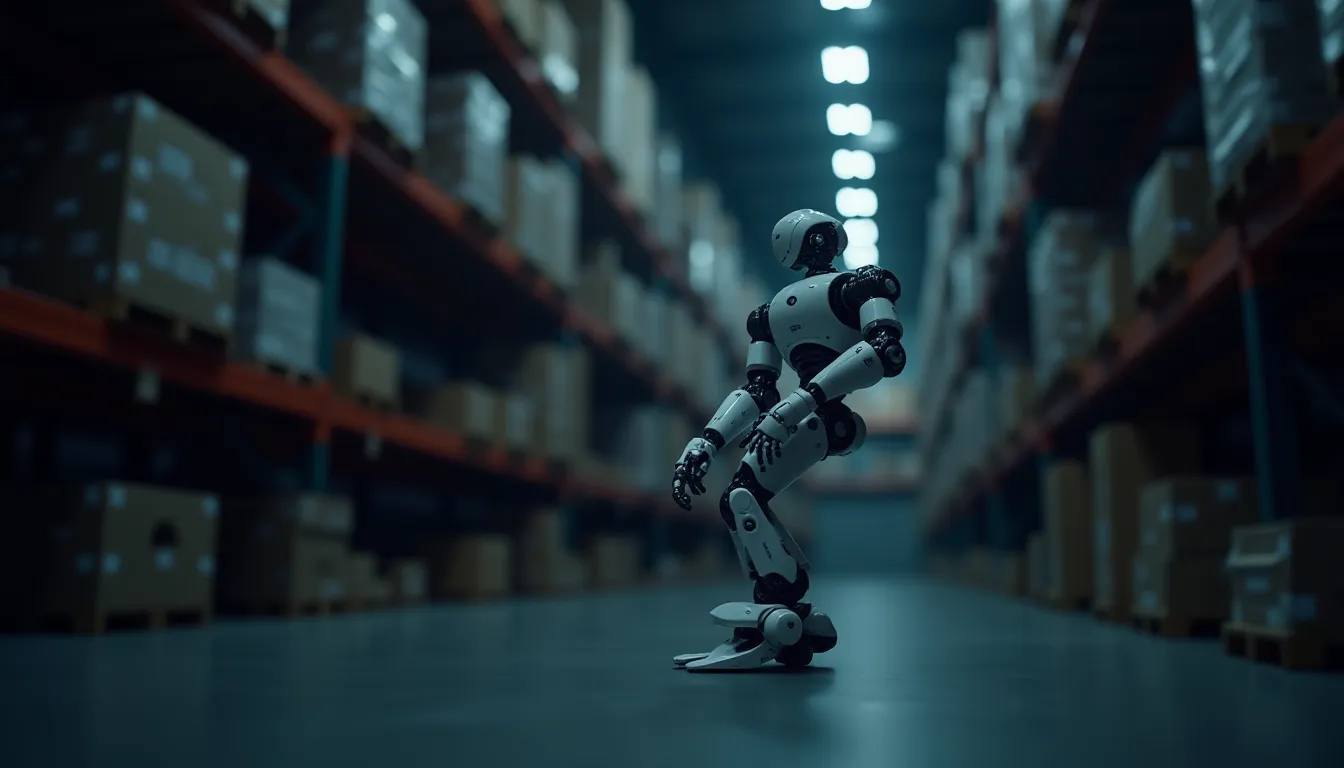
Amazon unveiled a warehouse robot that responds to voice commands from workers. Meanwhile, researchers demonstrate pneumatic-powered walking robots and Chinese companies train AI on everyday tasks.
Key Takeaways
- Amazon developed a warehouse robot that responds to natural language voice commands from workers
- Chinese companies train robots by having them repeatedly fold shirts to build task datasets
- DIY bipedal robot uses pneumatic air-muscles instead of electric motors for movement
- Voice-controlled robots could reduce technical barriers for human-robot collaboration
- Training robots on mundane tasks may prove more effective than complex behavior attempts
- Alternative actuation methods like pneumatics offer new approaches to robot mobility
The Verge reports that Amazon has developed a warehouse robot that workers can speak to using natural language commands. The next-generation Proteus robot can interact using language instead of code, marking a significant shift from programmed automation to interactive robotics in logistics.
What Happened
Amazon's new conversational warehouse robot represents a major advancement in human-robot interaction within industrial settings. According to The Verge, the system allows warehouse workers to assign tasks using language in the same way they'd communicate with colleagues, eliminating the need for specialized software. The robot can process language instructions and adapt its behavior accordingly.
Separately, Rest of World reports that Chinese companies are training robots for everyday tasks by having them fold shirts repeatedly. This approach focuses on building extensive datasets from mundane activities to improve robotic dexterity and task learning. The methodology reflects China's systematic approach to robotics development through repetitive training on basic household and commercial tasks.
Meanwhile, IEEE Spectrum covered a DIY bipedal robot project that uses pneumatic "air-muscles" instead of traditional electric motors. The Shadow Walker robot demonstrates alternative actuation methods for humanoid locomotion, potentially offering advantages in weight distribution and movement fluidity compared to motor-driven systems.
Why It Matters
Amazon's voice-controlled warehouse robot signals the evolution from pre-programmed automation to adaptive, conversational robotics in industrial environments. This development could reshape how humans and machines collaborate in logistics, manufacturing, and other sectors where robots operate alongside workers. The natural language interface reduces the technical barrier for robot interaction, potentially expanding robotics adoption across industries.
The Chinese focus on training robots through repetitive everyday tasks highlights a different philosophical approach to robotics development - building competency through extensive practice on simple activities rather than attempting complex behaviors immediately. This methodology could prove more effective for developing strong, reliable robotic systems for consumer and commercial applications.
Background
These developments build on the broader transformation in computing architecture that has enabled more sophisticated robotics applications. The GPU revolution has provided the parallel processing power necessary for real-time natural language processing and machine learning inference that makes conversational robots possible. Graphics processing units, originally designed for rendering, now power the AI models that enable robots to understand speech and adapt to new instructions dynamically.
What to Watch
Amazon's conversational robot could accelerate adoption of voice interfaces across industrial robotics, particularly in environments where workers need to quickly redirect automated systems. The success of this approach may influence other logistics companies to develop similar human-robot interaction capabilities. Meanwhile, the Chinese emphasis on training robots through repetitive tasks may yield new approaches to robotic learning that could be applied to domestic and service robots. The pneumatic actuation research suggests continued innovation in robot mobility and could lead to more energy-efficient humanoid designs.
Key Facts: GPU Revolution
- GPUs evolved from specialized graphics chips to general-purpose parallel processors
- Nvidia's CUDA architecture in 2007 enabled programmable GPU computing
- Modern AI training relies on thousands of GPUs working in parallel
- GPU clusters now power everything from autonomous vehicles to conversational AI
- The parallel processing revolution enabled real-time robotics applications
Sources
Frequently Asked Questions
How does Amazon's voice-controlled warehouse robot work?
The robot uses natural language processing to understand and respond to voice commands from workers, eliminating the need for complex programming interfaces.
Why are Chinese companies training robots to fold shirts?
Repetitive training on simple tasks builds extensive datasets to improve robotic dexterity and task learning for more reliable system development.
What are pneumatic air-muscles in robotics?
They are alternative actuators that use compressed air instead of electric motors, potentially offering advantages in weight distribution and movement fluidity.
What makes conversational robots possible now?
GPU-powered parallel processing enables real-time natural language processing and machine learning inference needed for robots to understand speech.
Could voice-controlled robots spread beyond Amazon warehouses?
Yes, the success of natural language interfaces in industrial settings could accelerate adoption across logistics, manufacturing, and other collaborative environments.