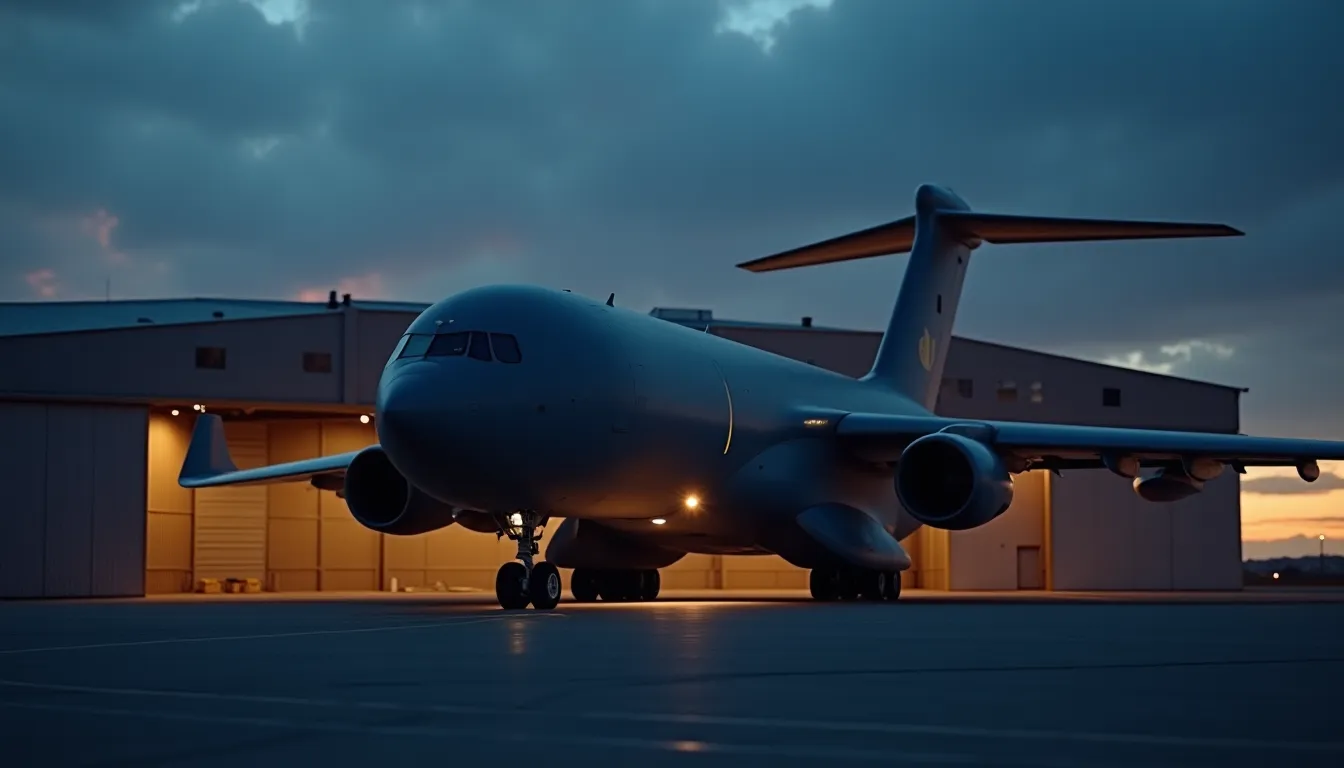
The Air Force awarded startup Natilus $3.5 million to develop its KONA blended wing body cargo aircraft, its first government contract. The move follows JetZero's larger 2023 BWB demonstrator deal.
Key Takeaways
- Air Force awarded Natilus a $3.5 million contract for its KONA blended wing body cargo aircraft.
- It is Natilus's first US government contract, following JetZero's $235 million BWB demonstrator deal in 2023.
- KONA has an 85-foot wingspan, 19,000-pound max takeoff weight, and will use a Pratt & Whitney PT6 turboprop engine.
- Natilus targets first flight by late 2027 or early 2028, according to COO Nolan Giblin.
- Space Force plans RFIs for cislunar technology and AI software, aiming for fielded capability by fiscal 2029.
- Maj. Gen. Stephen Purdy cited Chinese cubesat launches near Earth-Moon Lagrange points as driving urgency.
The Air Force has handed aircraft startup Natilus a $3.5 million contract to develop its blended wing body KONA aircraft for military cargo missions, according to Breaking Defense. The award marks the company's first US government investment and arrives roughly three years after the service committed $235 million to rival JetZero for a full-scale blended wing body demonstrator.
What Happened
According to Breaking Defense, Natilus Chief Operating Officer Nolan Giblin described the contract as a complement to privately raised capital, helping the company de-risk key technologies ahead of a planned first flight for the KONA aircraft by late 2027 or early 2028. The blended wing body design fuses the wings and fuselage into a single aerodynamic shape, similar in concept to the B-2 bomber's flying wing but retaining smaller, distinct wings. The approach generates more lift than conventional tube-and-wing aircraft, improving fuel efficiency, though the design's structural complexity has historically kept it out of production.
Giblin specified that the KONA has an 85-foot wingspan and a maximum takeoff weight of 19,000 pounds, and that Natilus plans to power it with Pratt & Whitney's PT6 turboprop engine. Breaking Defense noted the Air Force's BWB interest is not new: JetZero received its $235 million award in 2023 to build a demonstrator, a project the Pentagon has backed as it looks to prove out a design concept studied for decades but never commercialized.
In a related development covered the same week, Breaking Defense reported that the Space Force is preparing to issue requests for information seeking commercial technology and AI software for cislunar operations, Maj. Gen. Stephen Purdy, the service's portfolio acquisition executive for advanced programs, told the Space Industry Days conference in Los Angeles, "China is moving out in this area. We have traditionally not," with Breaking Defense separately noting China's recent launch of 30 cubesats near an Earth-Moon Lagrange point as a project that has raised concerns about cislunar surveillance. Purdy said the service wants fielded capability by the end of fiscal 2029, a timeline that echoes the Air Force's push with Natilus and JetZero to move quickly from study to hardware.
Why It Matters
Both contracts point to a Pentagon posture that is funding multiple competing designs rather than betting on a single vendor, a pattern now extending from airframes to cislunar software and spacecraft. The Natilus award is small next to JetZero's $235 million deal, but it signals the Air Force is willing to seed early-stage work from newer entrants rather than consolidating around one blended wing body program. That approach mirrors the logic behind the Space Force's planned RFIs, which aim to pull in commercially available technology quickly rather than wait on a single prime contractor to deliver. For investors tracking how defense dollars move toward unproven airframe and space concepts, this kind of parallel-track funding is worth watching through defence and space sector equity analysis, since contract size and timeline slippage both carry real signal about which designs the Pentagon expects to mature first.
Background
Natilus's push into military cargo sits within a broader shift toward commercializing autonomous and efficiency-focused aircraft platforms, a trend detailed in MachineHours' Drone Technology encyclopedia entry, which tracks how autonomous flight systems are reshaping logistics and defense operations as the sector scales toward a projected $109.8 billion market by 2030. Blended wing body aircraft are not drones, but Natilus and JetZero both frame their designs around reducing fuel and labor costs for cargo movement, the same economic drivers pushing broader adoption of uncrewed aviation across military logistics chains.
What to Watch
The next milestone is Natilus's targeted first flight window of late 2027 to early 2028, which will test whether the $3.5 million contract and private capital are enough to get KONA airborne on schedule. JetZero's larger demonstrator program remains the bigger bet to watch, since its outcome will likely shape whether the Air Force commits further funding to blended wing body cargo designs industry-wide. On the space side, the Space Force's promised RFIs for cislunar technology and autonomous spacecraft software could arrive within weeks, and their scope will indicate how seriously the Pentagon is treating the fiscal 2029 fielding target Purdy described.
Sources
Frequently Asked Questions
What did the Air Force fund for Natilus?
The Air Force awarded Natilus a $3.5 million contract to develop its KONA blended wing body aircraft for moving military cargo, the company's first US government contract.
How does the KONA aircraft compare to JetZero's program?
JetZero received a much larger $235 million Air Force award in 2023 to build a full-scale blended wing body demonstrator, while Natilus's contract is smaller and earlier stage.
What is a blended wing body aircraft?
It is a design where the wings and fuselage blend into one aerodynamic shape, similar to a flying wing like the B-2 bomber, offering more lift and fuel efficiency than traditional tube-and-wing planes.
When will Natilus's KONA aircraft first fly?
Natilus COO Nolan Giblin told Breaking Defense the company targets first flight by late 2027 or early 2028.
What is the Space Force planning for cislunar operations?
The Space Force plans to issue requests for information seeking commercial cislunar technology and AI software for autonomous spacecraft operations, aiming for fielded capability by fiscal 2029.
Get MachineHours in your inbox
AI compute and the machine economy in your inbox.