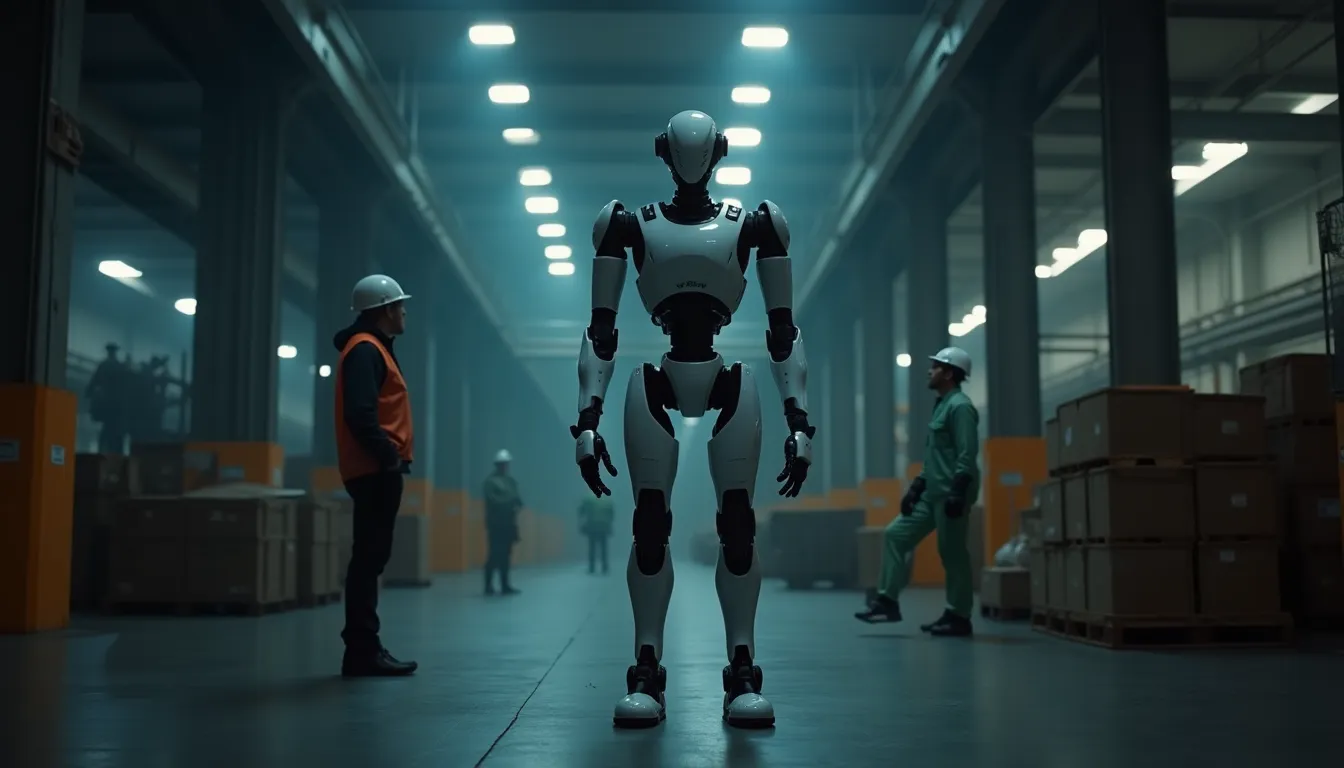
Agility Robotics has unveiled Digit 5, a humanoid robot designed to work alongside humans without safety fences. The capability marks a significant technical shift for warehouse and industrial deployments.
Key Takeaways
- Agility Robotics announced on September 15, 2026 that Digit 5 can operate alongside humans without physical safety fencing.
- Fence-free certification removes a major cost and infrastructure barrier to humanoid deployment in existing warehouses and factories.
- Agility has not yet published specific reaction-time benchmarks or named the certifying body for the safety claim.
- Digit 5 continues Agility's human-scale design approach, suited to standard industrial environments without facility redesign.
- Competitors including Boston Dynamics Atlas and Unitree R1 are active in adjacent spaces, increasing pressure on safety compliance differentiation.
- Amazon has been a known commercial pilot partner for previous Digit generations; updated deployment terms have not yet been disclosed.
Agility Robotics has announced that its fifth-generation humanoid robot, Digit 5, is certified to operate directly alongside human workers without the physical safety barriers that have long defined industrial robot deployments, according to The Decoder. The announcement, made on September 15, 2026, positions Digit 5 as one of the first commercially targeted humanoid robots to achieve this level of human-robot coexistence without additional physical infrastructure.
What Happened
The Decoder reported that Agility Robotics confirmed Digit 5 has received the technical clearance necessary to share workspace with people, removing the need for safety cages or exclusion zones that are standard practice for most industrial robots. This is a direct response to one of the most persistent friction points in deploying humanoid robots in warehouses and logistics facilities: the floor space, cost, and workflow disruption associated with physical safety fencing.
Digit 5 is the latest iteration of Agility's bipedal platform, which has been under development and limited commercial deployment with partners including Amazon. The company did not disclose the specific sensing systems, response latency figures, or the certifying body responsible for validating the fence-free capability, but the claim itself signals that Digit 5 has met defined human-collaborative robot standards - the ISO 10218 and ISO/TS 15066 framework covers most such certifications in industrial settings. Agility describes the robot as capable of navigating shared spaces, avoiding collisions, and responding to the presence and movement of nearby workers in real time.
The broader significance of this announcement sits in the technical architecture required to achieve it. Human-collaborative operation demands sensor fusion across multiple modalities - typically depth cameras, lidar, and force-torque sensing - combined with onboard inference fast enough to halt or redirect motion before contact thresholds are breached. For a bipedal platform that is inherently less stable than a fixed-arm cobot, achieving this at a commercially viable cost represents a meaningful engineering advance. Agility has not yet published benchmark data on reaction times or collision-avoidance test results, which will be the next point of scrutiny from potential enterprise customers.
Digit 5 also continues Agility's design philosophy of building a robot with human-scale proportions suited to environments already built for people, including standard aisles, shelving systems, and loading docks. This is a direct contrast to purpose-built robotic warehouses that redesign the environment around the machine, an approach associated with companies like Ocado and Autostore.
Why It Matters
Fence-free human-robot coexistence is not a minor upgrade - it is a prerequisite for humanoid robots to be economically viable in most real-world workplaces. Building safety enclosures, reconfiguring floor plans, and managing exclusion zones add cost and reduce flexibility, which has historically made robot deployment feasible only at scale in purpose-built facilities. Digit 5's claimed capability, if validated at production scale, removes one of the most significant structural barriers to humanoid adoption in mixed-use environments.
The development also has supply chain and real estate implications. Facilities that were not designed for traditional caged robots could, in theory, integrate Digit 5 without major retrofitting. This is particularly relevant to older distribution centers and manufacturing floors that represent the bulk of global industrial infrastructure. For investors tracking the equity market implications of robotics deployment, the shift from controlled to open-floor operation could accelerate the total addressable market for humanoid platforms considerably.
The competitive context matters here too. Boston Dynamics, whose Atlas humanoid has demonstrated impressive dynamic capability, and Unitree, whose R1 platform targets price-sensitive buyers, are both active in adjacent spaces. Agility's differentiation is now centering on certification and workplace safety compliance as a product feature rather than raw capability alone.
Background
Agility Robotics was founded in 2015 as a spin-out from Oregon State University and has been one of the longer-tenured commercial humanoid programs in the United States. Digit, its primary platform, has gone through multiple hardware generations and has been piloted in Amazon fulfillment operations. The company's strategy has consistently focused on logistics and light manufacturing rather than the broader consumer or healthcare markets.
The wider deployment of robots in physical workplaces is also reshaping adjacent industries. As covered in the MachineHours encyclopedia entry on Robotics in Property, automated systems are reducing labor costs and improving safety across construction, inspection, and facilities management, with safety compliance emerging as a central design driver across all of these verticals.
What to Watch
The critical next step is third-party validation. Agility's fence-free claim carries weight only if the specific safety standard and certifying body are publicly disclosed, and if independent testing confirms consistent performance across varied environments and worker densities. Enterprise customers in logistics and automotive supply chains will want to see documented reaction-time data and failure-mode analysis before committing to large-scale deployments.
Watch also for how competitors respond. If Digit 5's certification holds up to scrutiny, it will push Boston Dynamics, Figure, and European humanoid programs to prioritize compliance certification alongside raw performance benchmarks. The race to deploy humanoids at scale is increasingly a regulatory and safety engineering challenge as much as a hardware one. Agility's commercial partnerships and any updates from Amazon on expanded Digit 5 pilots will be the clearest near-term signal of whether this announcement translates into production-scale orders.
- Construction robots are projected to handle up to 30% of repetitive on-site tasks in large infrastructure projects by 2030, according to industry forecasts.
- AI-powered inspection drones can scan a multi-story building facade in under two hours, a task that takes human teams several days with scaffolding.
- Automated facilities management systems can reduce building energy consumption by 20-30% through real-time HVAC and lighting optimization.
- Human exposure to hazardous environments is a primary driver of robotics adoption in construction and property inspection, with falls and structural collapses among the leading causes of worker fatalities in the sector.
Sources
- The Decoder: Agility Robotics says its new Digit 5 robot can work next to people without safety fences
- MachineHours Encyclopedia: Robotics in Property — Construction Robots, Inspection Drones, and Automated Facilities
- MachineHours Encyclopedia: Boston Dynamics Atlas Humanoid Robot
- MachineHours Encyclopedia: The $5,900 Robot — Unitree R1 and the Race to Affordable Humanoids
Frequently Asked Questions
What does it mean for a robot to operate without safety fences?
It means the robot is certified to share a workspace with humans without physical barriers, relying instead on sensors and onboard software to detect people and avoid contact. This is governed by standards such as ISO 10218 and ISO/TS 15066 in industrial settings.
Who makes Digit 5 and where has it been deployed?
Digit 5 is made by Agility Robotics, a US company founded in 2015. Previous Digit generations have been piloted in Amazon fulfillment operations, making Amazon a key commercial reference customer for the platform.
How does Digit 5 differ from other humanoid robots like Atlas or Unitree R1?
Agility is positioning Digit 5 on safety certification and workplace compliance as a product feature. Boston Dynamics Atlas emphasises dynamic capability, while Unitree R1 targets price-sensitive buyers. Agility's focus is logistics and light manufacturing in human-shared spaces.
Why hasn't Agility published benchmark data for Digit 5's safety systems?
As of the September 15, 2026 announcement, Agility had not released specific reaction-time figures or named the certifying body. Enterprise customers and independent reviewers are expected to seek this data before committing to large-scale deployments.
What is the commercial significance of fence-free robot operation?
Safety enclosures add cost, consume floor space, and limit workflow flexibility. Removing this requirement means humanoid robots could be deployed in existing facilities without major retrofitting, expanding the addressable market.
Get MachineHours in your inbox
AI compute and the machine economy in your inbox.