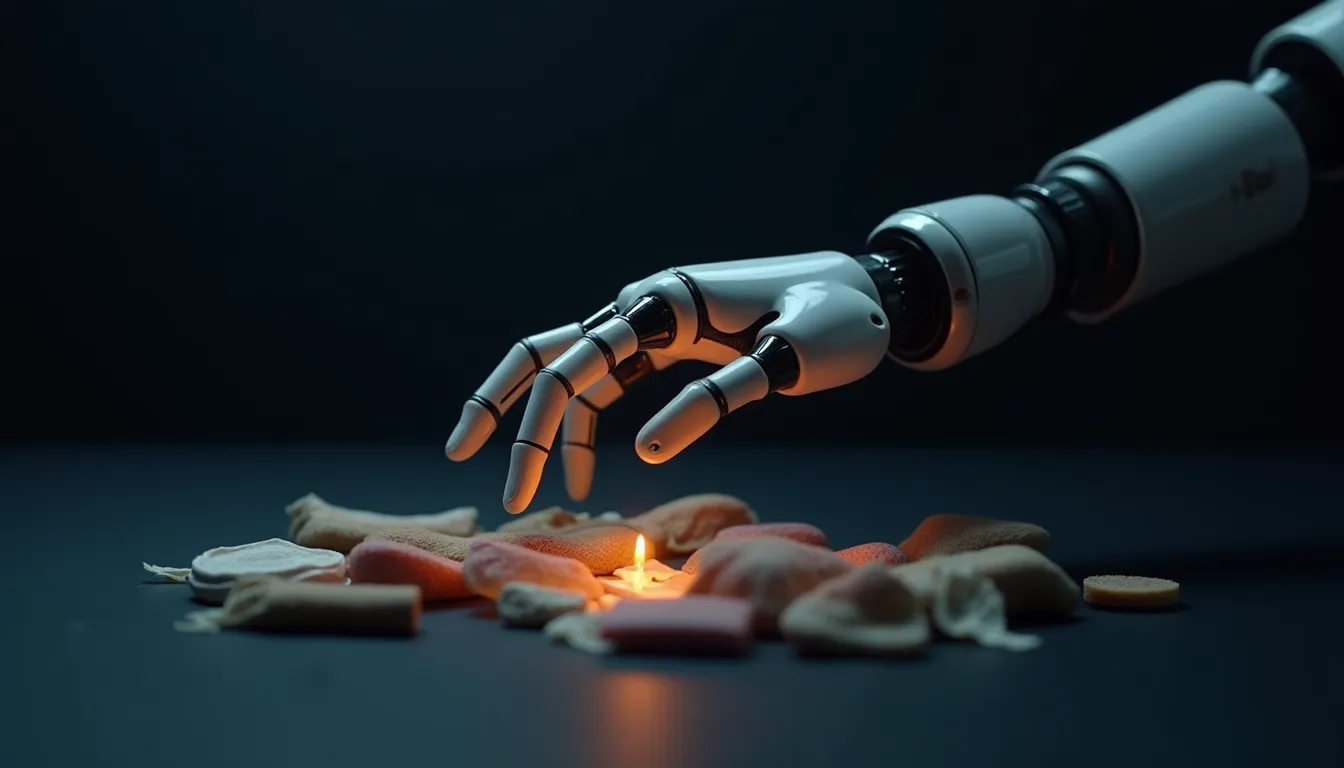
Contact intelligence technology promises to revolutionize robot manipulation by focusing on tactile sensing rather than pure dexterity. This approach could unlock new capabilities in manufacturing and logistics applications.
Key Takeaways
- Contact intelligence prioritizes tactile sensing over traditional robot dexterity approaches
- Technology focuses on force feedback and material property detection rather than mechanical precision
- Industry shift moves away from human-like hand replication toward specialized capabilities
- Applications could expand robot use in delicate material handling and variable environments
- Development represents more practical approach to real-world manipulation challenges
Contact intelligence is emerging as the next major advance in robotics manipulation, moving beyond traditional dexterity-focused approaches to prioritize tactile sensing and force feedback. IEEE Spectrum reports that this shift represents a fundamental change in how robots interact with objects and environments.
What Happened
The robotics industry is witnessing a major shift from pure dexterity to what researchers call "contact intelligence" - the ability for robots to make sophisticated decisions based on tactile feedback and force sensing. The source demonstrates that contact intelligence focuses on maintaining stable interaction while objects are changing, as shown in AGILINK's balloon-twisting demonstration
The development represents a move away from the traditional emphasis on creating human-like hand dexterity in robots. Instead, researchers are exploring how contact-based sensing can enable robots to perform complex manipulation tasks through intelligent force application and tactile feedback systems. This approach could prove more practical for industrial applications where understanding material properties and surface conditions matters more than finger-level precision.
The source demonstrates contact intelligence through AGILINK's balloon-twisting example, which shows handling of deformable, slippery, and force-sensitive objects The contact intelligence framework promises to make robots more adaptable to real-world conditions where perfect environmental mapping isn't always possible.
Why It Matters
This technological shift signals a maturing understanding of what makes robotic manipulation truly effective in practical applications. Rather than pursuing the complexity of human-like dexterity, the industry appears to be converging on solutions that prioritize sensory intelligence and adaptive response systems.
The implications extend beyond manufacturing into logistics, healthcare, and service robotics. Contact intelligence could enable robots to handle fragile items, work with varied textures and materials, and adapt to changing conditions without extensive reprogramming. This represents a more achievable and scalable approach than attempting to replicate human hand capabilities.
The development also suggests the robotics field is moving toward specialized intelligence rather than general-purpose humanoid capabilities, focusing on what robots can do uniquely well rather than mimicking biological systems.
Background
The robotics industry has long grappled with manipulation challenges, particularly in warehouse and logistics environments. Amazon's deployment of warehouse robots represents the largest-scale implementation of robotics automation in logistics history, demonstrating how AI-driven robotics can achieve massive efficiency gains while reshaping entire industry sectors.
Traditional approaches to robot manipulation have focused heavily on mechanical precision and human-like dexterity. However, real-world applications often require robots to work with unpredictable materials and environments where tactile feedback and force sensing prove more valuable than pure mechanical precision.
What to Watch
The development of contact intelligence technology will likely accelerate as companies seek more practical solutions for robot deployment. Key indicators include partnerships between sensor technology companies and robotics manufacturers, as well as pilot programs in industries handling delicate or variable materials.
Manufacturing sectors dealing with quality control, food processing, and electronics assembly may be early adopters of contact-intelligent systems. The technology's success will be measured by its ability to handle tasks that have previously required human workers due to their tactile sensitivity and adaptive capabilities.
Key Facts
- Amazon operates over 750,000 robots across its fulfillment network as of 2024
- The company's robotic systems process over 5 billion packages annually
- Amazon's robot deployment has reduced order processing time by up to 25%
- Warehouse automation has eliminated an estimated 100,000 traditional picker jobs
- The company continues expanding robotic capabilities to handle 75% of warehouse tasks
- Amazon's robotics division generates over $3 billion in annual efficiency savings
Sources
Frequently Asked Questions
What is contact intelligence in robotics?
Contact intelligence is a robotics approach that prioritizes tactile sensing and force feedback over traditional dexterity, enabling robots to make sophisticated decisions based on physical contact with objects.
How does contact intelligence differ from traditional robot dexterity?
Instead of focusing on human-like hand precision, contact intelligence emphasizes understanding material properties and surface conditions through tactile feedback and force sensing systems.
What industries could benefit from contact intelligence technology?
Manufacturing, logistics, healthcare, and service robotics could benefit, particularly in scenarios involving delicate objects, variable materials, or unpredictable environments.
Why is contact intelligence considered more practical than dexterity-focused approaches?
Contact intelligence addresses real-world manipulation challenges by adapting to conditions through sensory feedback rather than requiring perfect environmental mapping or complex mechanical systems.