Key Takeaways
- ▸AI is a primary mechanism governing market operations, credit decisions, and investment management, moving beyond just efficiency.
- ▸Algorithmic trading, including high-frequency trading, dominates US equity market volume (60-75%), operating at nanosecond speeds.
- ▸Robo-advisors have grown to manage over $2.5 trillion globally, democratizing investment management through automation.
- ▸AI significantly enhances financial operations like fraud detection (reducing rates by 40-60%) and automates complex tasks like document review, saving vast amounts of human effort.
Key Facts
- Algo Trading Share
- Algorithmic trading accounts for 60–75% of US equity market volume — the majority of trades are now machine-executed
- AUM in Robo-Advisors
- Robo-advisor assets under management exceeded $2.5 trillion globally by 2024 — led by Vanguard Digital Advisor, Betterment, and Wealthfront
- High-Frequency Trading
- The fastest HFT systems execute trades in under 100 nanoseconds — co-located at exchange data centres to minimise latency
- Fraud Detection
- AI-powered fraud detection systems process millions of transactions per second and have reduced card fraud rates by 40–60% at major banks
- JP Morgan COIN
- JP Morgan's COIN platform reviewed 12,000 commercial credit agreements in seconds — a task that previously took 360,000 hours of lawyer time annually
- Credit Scoring
- Alternative AI credit scoring models now assess 1.7 billion previously 'credit invisible' consumers globally using non-traditional data
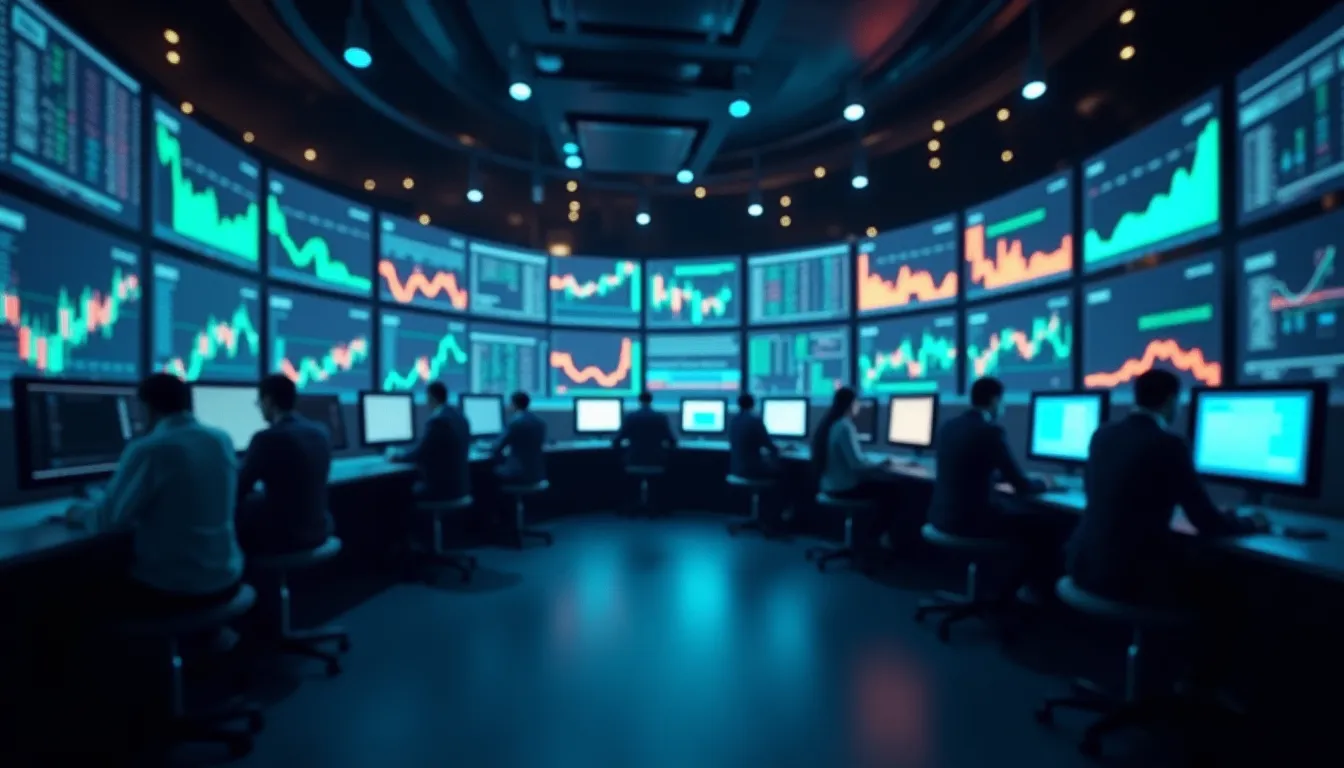
The transition from human floor traders to algorithmic systems has compressed trade execution times from minutes to nanoseconds, fundamentally changing market microstructure and creating new forms of liquidity provision that operate beyond human comprehension.Modern algorithmic trading encompasses multiple strategy categories. Market making algorithms provide continuous bid-offer quotes, earning the spread between buying and selling prices. Statistical arbitrage models identify temporary pricing anomalies between correlated securities. Momentum strategies use machine learning to detect price trends and execute directional trades. Mean reversion algorithms capitalise on price movements away from historical averages. The integration of machine learning has introduced adaptive algorithms that modify their behaviour based on market conditions. Reinforcement learning systems optimise trading strategies through trial and error, while natural language processing algorithms parse news feeds and social media sentiment to inform trading decisions. Renaissance Technologies, the quantitative hedge fund founded by mathematician James Simons, exemplifies this approach with its Medallion Fund generating annual returns exceeding 35% through sophisticated pattern recognition. ## Robo-Advisors and Investment Automation Robo-advisors emerged in the aftermath of the 2008 financial crisis as technology companies sought to democratise professional investment management. These platforms combine Modern Portfolio Theory with algorithmic execution to provide automated investment services at a fraction of traditional advisory fees. The core architecture of robo-advisors begins with risk assessment questionnaires that determine client risk tolerance and investment objectives. Algorithms then construct diversified portfolios using low-cost exchange-traded funds (ETFs) across multiple asset classes. The mathematical foundation relies on Harry Markowitz's portfolio optimisation framework, seeking to maximise expected returns for a given level of risk. Tax-loss harvesting represents a key value proposition of robo-advisors. These systems continuously monitor portfolios for opportunities to realise losses that offset taxable gains, potentially improving after-tax returns by 0.5–2% annually. The algorithms must navigate complex tax rules, including wash sale regulations that prevent repurchasing substantially identical securities within 30 days. Automatic rebalancing maintains target asset allocations as market movements cause portfolio drift. Traditional advisors typically rebalance quarterly or annually, but robo-advisors can rebalance daily or whenever allocations deviate beyond predetermined thresholds. This disciplined approach helps investors avoid emotional decision-making during market volatility.
| Platform | Assets Under Management | Management Fee | Key Features |
|---|---|---|---|
| Vanguard Digital Advisor | $230 billion | 0.15% | Human advisor access, comprehensive planning |
| Schwab Intelligent Portfolios | $75 billion | 0% advisory fee | ETF-only portfolios, cash allocation requirement |
| Betterment | $32 billion | 0.25% | Goal-based investing, socially responsible options |
| Wealthfront | $27 billion | 0.25% | Advanced tax optimization, direct indexing |
| Personal Capital | $20 billion | 0.49–0.89% | Wealth management focus, human advisors |
The shift from traditional credit scoring to AI-driven models represents a fundamental reimagining of risk assessment, enabling lenders to serve previously excluded populations while potentially introducing new forms of bias and discrimination that regulators struggle to understand and address.Machine learning models continuously learn from repayment patterns, automatically adjusting risk assessments as new data becomes available. Ensemble methods combine multiple algorithms — random forests, gradient boosting, neural networks — to improve prediction accuracy. The challenge lies in balancing model performance with regulatory compliance and fairness considerations. JP Morgan's COIN (Contract Intelligence) platform exemplifies AI's impact on commercial lending. The system uses natural language processing to analyse legal documents, extracting key terms and identifying potential risks in seconds rather than the hours required for human review. Similar systems now evaluate loan applications, assess collateral values, and monitor borrower financial health in real-time. ## Fraud Detection and Anti-Money Laundering Financial crime detection has evolved from rule-based systems flagging suspicious patterns to sophisticated AI models that identify novel fraud schemes in real-time. Traditional systems generated excessive false positives, with over 95% of flagged transactions proving legitimate upon investigation. Modern fraud detection systems employ multiple AI techniques simultaneously. Anomaly detection algorithms establish baseline patterns for individual accounts and flag deviations. Network analysis identifies suspicious relationships between accounts, merchants, and geographic locations. Real-time scoring models assess each transaction within milliseconds of initiation. The architecture typically involves streaming data platforms processing millions of transactions per second. Feature engineering creates hundreds of variables describing transaction characteristics — timing patterns, merchant categories, geographic deviations, device fingerprints, and behavioural biometrics. Ensemble models combine multiple algorithms to improve detection accuracy while reducing false positives. Anti-money laundering (AML) compliance has similarly embraced AI automation. Traditional AML systems relied on predetermined rules flagging transactions above specific thresholds or involving certain countries. AI systems now analyse complex transaction networks, identifying layered money laundering schemes that obscure fund origins through multiple transfers and jurisdictions. Graph neural networks excel at detecting suspicious patterns across interconnected accounts. These models can identify potential money laundering rings by analysing transaction flows, timing patterns, and network topology. The challenge lies in balancing detection sensitivity with customer privacy and reducing investigation workloads for compliance teams. Major banks report that AI-powered systems have reduced fraud investigation times by 70% while improving detection rates. Card fraud losses have declined significantly despite growing transaction volumes, demonstrating the effectiveness of real-time AI monitoring systems. ## Risks and Vulnerabilities of Financial AI The concentration of trading activity in algorithmic systems creates new categories of systemic risk. Flash crashes — sudden, severe price drops followed by rapid recovery — illustrate how algorithmic interactions can amplify market volatility. The May 6, 2010 Flash Crash saw the Dow Jones Industrial Average fall nearly 1,000 points in minutes before recovering, triggered by a large algorithmic sell order that overwhelmed market liquidity. Model herding represents another concern as similar algorithms react identically to market events. When multiple trading systems employ comparable strategies or data sources, they may simultaneously trigger buying or selling pressure that destabilises markets. The convergence of quantitative strategies around similar factors — momentum, mean reversion, volatility — can create crowded trades that unwind violently during stress periods. The black box problem in AI lending decisions raises significant regulatory and fairness concerns. While machine learning models may outperform traditional credit scoring, their decision-making processes often lack transparency. Borrowers denied credit cannot easily understand why, and regulators struggle to identify potential bias or discrimination embedded in complex algorithms. AI credit models may inadvertently discriminate against protected classes through proxy variables that correlate with race, gender, or other characteristics. For example, zip code-based features might reflect historical redlining patterns, perpetuating discriminatory lending practices through seemingly neutral algorithms. The challenge intensifies as models incorporate thousands of variables whose individual and interactive effects prove difficult to interpret. Cybersecurity vulnerabilities multiply as financial institutions become increasingly dependent on AI systems. Adversarial attacks can manipulate machine learning models by introducing carefully crafted inputs designed to cause misclassification. Trading algorithms may be susceptible to market manipulation through coordinated actions designed to trigger predictable responses. The interconnectedness of AI systems across financial institutions creates potential cascade failures. If multiple banks use similar fraud detection models, a successful attack against one system might compromise others. The concentration of AI development among a few technology vendors could introduce single points of failure affecting multiple institutions simultaneously. ## Regulatory Responses and Compliance The Securities and Exchange Commission has increased scrutiny of algorithmic trading through enhanced oversight requirements. Regulation Systems Compliance and Integrity (Reg SCI) mandates that trading systems maintain adequate capacity and integrity. The SEC's 2023 guidance on AI in investment management emphasises that firms remain responsible for AI system decisions and must maintain appropriate oversight and control mechanisms. The European Union's AI Act classifies certain financial AI applications as high-risk systems requiring conformity assessments, risk management systems, and human oversight. Credit scoring algorithms that significantly affect access to financial services must meet transparency and accuracy requirements. The regulation mandates that individuals have the right to explanation for automated decisions affecting them. Model risk management frameworks now encompass AI-specific considerations. Banking regulators require institutions to validate AI models, monitor their performance, and maintain documentation of model development and deployment. The challenge lies in applying traditional model validation techniques to complex machine learning systems whose behaviour may evolve over time. The Federal Reserve has issued guidance emphasising that banks remain accountable for AI-driven decisions regardless of model complexity. Institutions must demonstrate they understand their AI systems' limitations, potential biases, and failure modes. Regular model audits must assess performance across different demographic groups to identify potential discrimination. International coordination efforts seek to harmonise AI financial regulation across jurisdictions. The Basel Committee on Banking Supervision is developing guidance on AI and machine learning in financial services, focusing on governance, risk management, and operational resilience. The challenge lies in balancing innovation encouragement with appropriate risk controls. ## Investment Implications and Market Impact The proliferation of AI in financial markets has created new investment opportunities and risks that investors must navigate. Traditional active management faces pressure from AI-driven strategies that can process information and execute trades faster than human managers. This has contributed to the continued growth of passive index investing and quantitative strategies at the expense of discretionary portfolio management. Factor investing has evolved as AI identifies new market anomalies and pricing inefficiencies. Machine learning algorithms now uncover complex, non-linear relationships between stock characteristics and returns that traditional factor models miss. However, the democratisation of these techniques may reduce their effectiveness as more investors implement similar strategies. The cost of market data and technology infrastructure has become a critical competitive advantage. Institutional investors increasingly require sophisticated AI capabilities to remain competitive, leading to substantial technology investments. Smaller asset managers may struggle to compete without access to the same algorithmic tools and data sources as larger competitors. Market microstructure changes driven by AI have implications for all investors. Bid-ask spreads have generally narrowed due to algorithmic market making, reducing trading costs. However, market depth may be more fragile, with algorithmic liquidity providers potentially withdrawing during stress periods. The concentration of trading activity among a small number of high-frequency trading firms raises questions about market structure and systemic risk. While these firms provide liquidity during normal conditions, their potential withdrawal during crises could amplify volatility and reduce market functioning. For individual investors, robo-advisors offer access to sophisticated portfolio management techniques previously available only to institutions. The low-fee structure of these platforms has pressured traditional advisors to justify their higher costs through enhanced service offerings and personalised advice. The transformation of financial markets through AI continues accelerating, with implications extending far beyond trading efficiency. As these systems become more sophisticated and pervasive, their impact on market structure, risk distribution, and capital allocation will likely prove even more profound than currently apparent. The challenge for investors, regulators, and financial institutions lies in harnessing AI's benefits while managing its inherent risks and unintended consequences.
Frequently Asked Questions
What is algorithmic trading?
Algorithmic trading uses computer programs to execute trades based on pre-defined rules and strategies, often at very high speeds, accounting for a significant portion of market volume.
How do robo-advisors work?
Robo-advisors are digital platforms that provide automated, algorithm-driven financial planning services with little to no human supervision, managing investment portfolios based on client profiles.
What is high-frequency trading (HFT)?
HFT is a type of algorithmic trading characterized by extremely fast execution speeds, often under 100 nanoseconds, using sophisticated algorithms to capitalize on tiny price discrepancies.
How does AI contribute to fraud detection in finance?
AI-powered fraud detection systems use machine learning to analyze vast amounts of transaction data in real-time, identifying unusual patterns and anomalies indicative of fraudulent activity, significantly reducing fraud rates.
What is the impact of AI on credit scoring?
AI has revolutionized credit scoring by using alternative data sources to assess the creditworthiness of millions of previously 'credit invisible' consumers, expanding access to financial services globally.
Recommended Reading

Get MachineHours in your inbox
AI compute and the machine economy in your inbox.