Key Takeaways
- Waymo and Zoox use sensor fusion; Tesla pursues a camera-led autonomy strategy.
- Zoox’s purpose-built bidirectional vehicle differs from a conventional consumer car.
- Tesla FSD (Supervised) is not equivalent to an unsupervised robotaxi deployment.
- Safety comparisons need equivalent mileage, crash definitions, road conditions and supervision.
- Service footprints and pilot conditions change; check current provider availability rather than old launch lists.
- Fleet utilization, charging, maintenance, insurance and support remain important after removing an onboard driver.
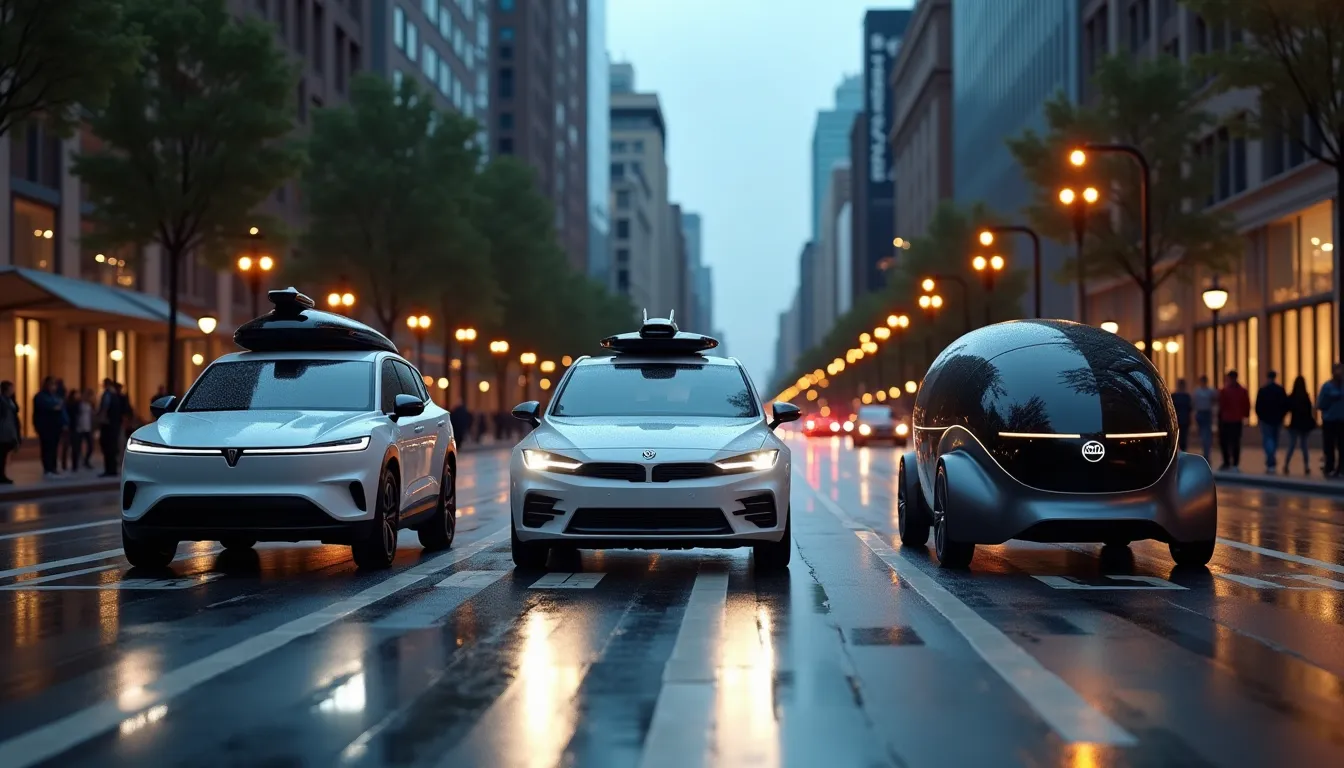
Waymo, Tesla and Zoox represent three different robotaxi strategies: sensor-fusion autonomy, camera-led autonomy and a purpose-built driverless vehicle. The meaningful comparison is the deployed operating domain, human supervision, safety evidence and fleet economics. Consumer driver assistance must not be treated as equivalent to an unsupervised robotaxi service.
Robotaxi Comparison Matrix
| Decision factor | Waymo | Tesla | Zoox |
|---|---|---|---|
| Approach | Sensor-fusion Waymo Driver | Camera-led autonomy strategy | Purpose-built autonomous vehicle |
| Vehicle strategy | Autonomy integrated into vehicle platforms | Consumer-platform deployment and robotaxi ambitions | Bidirectional cabin without conventional driver controls |
| Classification check | Confirm driverless service domain | Distinguish supervised FSD from each robotaxi deployment | Confirm approved driverless service domain |
| Safety evidence | Published driverless studies with stated exposure | Deployment-specific evidence, not consumer metrics alone | Deployment-specific reports and exposure |
| Scaling | Validation and fleet operations | Capability, approvals and fleet operations | Production, approvals and fleet operations |
Current State and Evaluation Scope
This is a strategy comparison, not a live service directory. Distinguish public driverless service, restricted pilots, supervised rides and testing. Historical launch details below are not a complete list of October 2026 operating areas.
Sensors and Technical Architecture
The most consequential technical divide in the robotaxi industry is the sensor debate, and it maps directly onto the three companies profiled here.
Waymo: Sensor Fusion
Lidar measures three-dimensional structure, radar provides range and motion information, and cameras capture visual detail. They offer complementary information but retain weather and occlusion limitations. Vehicle and sensor generations vary; mapping, validation and fleet preparation constrain expansion.
Tesla: Camera-Led Autonomy
Tesla emphasizes camera-based perception. Hardware and service arrangements vary by deployment. Consumer FSD (Supervised) requires driver attention; do not generalize its classification to every robotaxi operation or assume every consumer vehicle can become driverless through a software update.
Zoox: The Purpose-Built Pod
Zoox has taken a hybrid sensor approach similar to Waymo's — lidar, radar, and cameras — but has paired it with a radically different vehicle design. Rather than retrofitting an existing consumer car, Zoox built a bidirectional, symmetrical vehicle with no traditional driver's seat or steering wheel, four-wheel steering, and face-to-face bench seating for up to four passengers. This purpose-built approach allows sensor placement optimized purely for autonomous perception rather than constrained by a human-driver cockpit layout. The economic bet is longer-dated: Zoox is not retrofitting an existing manufacturing line at scale the way Tesla can, and its custom vehicle requires new production infrastructure, but the company argues the end result is a superior-economics vehicle once produced at volume, with no wasted space for manual controls and a cabin designed purely for ride-hailing throughput.
Safety Records: What the Data Shows
Waymo publishes driverless crash research, but peer review is not necessarily an independent audit of raw data. Compare exposure periods, crash definitions, road conditions and human baselines. Zoox’s lack of manual controls does not establish fault in an incident; other road users, infrastructure and hardware may contribute. No universal safety ranking is established here.
Safety is the single most scrutinized metric in the robotaxi debate, and the available public data, while imperfect and difficult to compare apples-to-apples, offers some directional signal.
For readers wanting the broader context on how self-driving systems are classified and evaluated, see our explainer on levels of autonomous driving and our deeper look at lidar versus camera-based autonomy.
Historical Context: How We Got Here
Waymo's roots trace back to Google's self-driving car project, launched in 2009, making it by far the most mature of the three programs. The project spun out as an independent Alphabet subsidiary in 2016 and launched the world's first commercial driverless ride-hailing service, Waymo One, in the Phoenix suburbs in 2018 — initially with safety drivers, then fully driverless by 2020. Waymo's expansion since then has been methodical: San Francisco, Los Angeles, and Austin followed over subsequent years, with additional cities announced for 2025 and 2026 including expansion into new Texas and Southwestern markets. The company's history is marked by heavy, patient capital investment from Alphabet, periodic leadership turnover, and a consistent strategic choice to prioritize safety validation and regulatory relationships over speed of expansion.
Tesla's autonomy ambitions date to Elon Musk's early and repeated public predictions — beginning as far back as 2016 — that full self-driving capability was imminent, predictions that have been revised many times. Tesla's Full Self-Driving (Supervised) beta program, rolled out progressively to consumer owners starting in 2020, generated an enormous real-world data set used to train Tesla's neural networks, which the company argues is its core competitive advantage given the scale of its consumer vehicle fleet relative to Waymo's purpose-built fleet. The pivot to an actual commercial "robotaxi" product, distinct from consumer-owned supervised driving, culminated in the limited Austin launch in June 2025, a watershed moment that finally let Tesla claim entry into the category it had promised for nearly a decade, albeit with meaningfully more restrictions (geofencing, safety monitors, limited hours) than Musk's earlier rhetoric had suggested.
Zoox was founded in 2014 with the explicit mission of building a vehicle for autonomous ride-hailing from a blank sheet of paper, distinguishing it from both Waymo's retrofit approach (at the time) and Tesla's consumer-vehicle approach. Amazon acquired Zoox in 2020 for a reported sum north of a billion dollars, giving the startup the balance sheet patience needed to pursue a capital-intensive custom-vehicle strategy without the quarterly pressure of being a standalone public company. Zoox spent years in closed testing and limited employee-shuttle programs before opening limited public rides in Las Vegas in 2025, with San Francisco and Austin testing following.
Key Players and Corporate Backing
Each company's parent-company relationship shapes its strategic latitude. Waymo operates as a subsidiary of Alphabet, which has provided sustained, patient funding for over a decade, including dedicated external fundraising rounds for Waymo specifically that have valued the unit in the tens of billions of dollars. This structure gives Waymo access to Alphabet's AI research talent and cloud infrastructure (Google Cloud, DeepMind-adjacent research) while still requiring it to eventually justify its capital intensity, particularly as Alphabet faces its own competitive and regulatory pressures elsewhere.
Tesla's robotaxi program is embedded directly within the parent company rather than spun off, which concentrates both upside and risk onto Tesla's own stock and balance sheet. Tesla's market valuation has, at various points, been explicitly tied by investors and analysts to the perceived probability of its autonomy and robotaxi ambitions succeeding at scale, meaning Tesla shareholders carry direct, undiluted exposure to robotaxi execution risk in a way Alphabet shareholders (who hold Waymo as one asset among many) do not.
Zoox sits inside Amazon, which provides capital patience similar to Alphabet's relationship with Waymo, along with potential longer-term synergies in logistics, delivery, and Amazon's existing operational footprint in cities, though Zoox has thus far remained focused on passenger ride-hailing rather than freight or delivery applications. Amazon's broader logistics and AI investments (including its own chip and cloud infrastructure) could eventually provide Zoox with cost advantages in compute and fleet orchestration, though this synergy remains more a thesis than a proven combination today.
Beyond the big three, other players remain relevant context: Cruise (formerly GM-backed) scaled back dramatically after a high-profile 2023 incident and subsequent suspension of operations, General Motors has since restructured its robotaxi ambitions, and a range of Chinese players such as Baidu's Apollo Go and WeRide are scaling rapidly in domestic Chinese markets and some international pilots, representing a geopolitically distinct competitive track that could eventually export technology or compete for the same global ride-hailing capital.
Service Availability and Deployment Constraints
Check each provider’s current app or official service-area information for locations, access conditions, fares and supervision. Zoox announced public Las Vegas rides in September 2025; that dated milestone is not a complete current footprint. Vehicle supply, validation, approvals, charging and operational support constrain all three approaches.
Economic Implications
Public ride growth does not establish positive margins. The financial contribution to Alphabet, Tesla or Amazon depends on disclosed costs and revenue, not autonomy announcements alone. Removing the onboard driver changes labor economics without eliminating fleet operating costs.
The economic stakes of the robotaxi race are enormous and extend well beyond the three companies themselves. For investors, the category represents one of the clearest tests of whether AI and robotics investment translates into defensible, cash-generating businesses rather than speculative narrative. Ride-hailing itself is already a large market, but the removal of driver labor costs — which typically represent the majority of a ride-hailing trip's cost structure — is the central economic thesis behind robotaxis: proponents argue that once vehicle costs, maintenance, and fleet utilization are optimized, per-mile costs could fall well below current Uber- or Lyft-style pricing, expanding the addressable market to include trips currently made by personal car ownership.
Beyond the three companies' own cap tables, robotaxis carry second-order economic implications worth flagging for wealth-focused readers. Traditional auto insurers face a long-term disruption risk as liability shifts from individual drivers to fleet operators and technology providers, a dynamic already prompting some insurers to develop new autonomous-vehicle-specific products and partnerships. Commercial real estate tied to parking — garages, surface lots, and parking-adjacent retail — faces gradual demand erosion in cities where robotaxi fleets achieve meaningful market share, since shared autonomous fleets require far less dedicated parking per capita than personally owned vehicles. Labor markets for taxi, rideshare, and eventually trucking occupations face displacement risk over a multi-year horizon, concentrated initially in the specific metro areas where robotaxi services scale fastest. And automakers without a credible autonomy program — the traditional legacy players outside of GM's now-scaled-back effort — face a strategic question about whether they will eventually need to license autonomy technology from one of these three players or a Chinese alternative, creating a potential long-term licensing-revenue opportunity for whichever company's technology proves most exportable.
For a broader framework on evaluating robotics and automation investment themes, see our related analysis on the automation investment thesis and our primer on insurance implications of autonomous vehicles.
Risks Across the Industry
Several risk categories apply across all three companies, even as each faces distinct variants of them.
Regulatory risk remains the single largest near-term variable. NHTSA at the federal level and individual state departments of motor vehicles retain significant authority over where and how driverless vehicles can operate, and a serious high-profile incident involving any one company has historically triggered scrutiny that affects the entire industry's public perception and regulatory posture, as seen after the 2023 Cruise incident in San Francisco. A major incident involving Waymo, Tesla, or Zoox in 2026 could plausibly slow approvals for all three, regardless of which company was involved.
Public trust and adoption risk is a second major factor. Survey data has consistently shown a meaningful share of the public remains hesitant to ride in a fully driverless vehicle, and high-profile viral incidents — even minor ones, such as a robotaxi getting stuck or behaving erratically — can disproportionately shape public perception relative to the underlying statistical safety case. Building durable consumer trust at scale, across demographics and geographies, remains unproven for all three companies beyond their current limited user bases.
Weather and edge-case performance represents a technical risk that varies by sensor approach but affects everyone. Heavy snow, dense fog, and extreme rain all challenge both camera and lidar systems, and none of the three companies has yet demonstrated extensive public commercial operation in harsh winter-weather cities, meaning cold-climate expansion (Chicago, New York, much of the Midwest and Northeast) remains a largely untested frontier for the entire category.
Capital intensity and path-to-profitability risk is particularly acute for the hardware-heavy approaches of Waymo and Zoox, both of which require expensive vehicles and extensive mapping or manufacturing infrastructure before reaching scale economics; Tesla's camera-only approach is cheaper per vehicle but carries the risk that the underlying technology may require more time and iteration than hoped to reach unsupervised safety levels in complex urban environments, potentially consuming significant R&D capital without a clear timeline to resolution.
Cybersecurity and liability risk is an underappreciated but growing concern: fleets of networked, software-controlled vehicles represent an attractive target for malicious actors, and a successful attack or systemic software failure affecting many vehicles simultaneously would be a qualitatively different and potentially more severe event than a single human-driver accident, with liability and insurance frameworks still catching up to this possibility.
Competitive and geopolitical risk also deserves mention: rapidly scaling Chinese robotaxi operators, operating with different regulatory environments and potentially lower-cost hardware supply chains, could eventually pressure the economics or export ambitions of all three U.S.-based companies, particularly if Chinese autonomy technology becomes competitive on safety metrics while significantly cheaper to deploy.
Use Case Recommendations
Passengers should verify current availability and supervision before booking. City planners should compare equivalent operating domains and incident definitions. Investors should model utilization, depreciation, maintenance, charging, cleaning, insurance and remote support rather than equating ride growth with profitability.
Strategic Verdict
Waymo, Tesla and Zoox offer different technological and vehicle-design choices, but commercial success depends on safe, approved and economical service. No sensor choice alone proves superiority. Deployment-specific evidence is more useful than promised fleet scale or a comparison of incompatible safety statistics.
Related Comparisons and Background
- Robotaxi fleet economics
- Autonomous vehicle deployment and regulation
- Humanoid robot technology comparison
Sources and Comparison Method
Official sources were checked on 23 October 2026. Safety datasets require equivalent exposure and definitions. The Tesla document describes the covered supervised rideshare service, not every Tesla robotaxi deployment. Launch announcements establish dated milestones, not current citywide availability.
- Waymo: Safety — research and safety methodology.
- Tesla: FSD (Supervised) rider rules — covered service is SAE Level 2 with a safety driver.
- Zoox: Las Vegas public launch, 10 September 2025 — purpose-built vehicle and dated public-service milestone.
Frequently Asked Questions
How do Waymo, Tesla and Zoox differ?
Waymo combines lidar, radar and cameras in its autonomy system. Tesla pursues a camera-led approach. Zoox combines sensor fusion with a purpose-built bidirectional vehicle without conventional driver controls. Deployment conditions and supervision must be compared separately.
Is Tesla FSD the same as a driverless robotaxi?
No. Full Self-Driving (Supervised) is a driver-assistance feature requiring an attentive driver. A robotaxi deployment has its own operating conditions, supervision arrangements and approvals; its name alone does not establish driverless capability.
Which robotaxi has the best safety record?
A universal ranking is not justified by non-equivalent datasets. Compare crash definitions, mileage, operating areas, road types and supervision. Waymo publishes driverless safety research, but vendor metrics require scrutiny of their methodology and comparison group.
Where can I use these robotaxi services?
Check each provider’s current app or official service-area page. Locations, eligibility, hours, fares and supervision can change; historical pilot announcements are not a live availability list.
Why are robotaxi economics different from ordinary ride-hailing?
Removing an onboard driver can change labor costs, but autonomous fleets still need vehicles, charging, maintenance, cleaning, insurance and operational support. Profitability depends on utilization and the full cost per completed trip, not autonomy alone.