Key Takeaways
- IBM and Google use superconducting qubits; Quantinuum uses trapped-ion hardware.
- Physical qubit counts are not a substitute for logical error rates and reliable circuit execution.
- Google’s Willow result concerns below-threshold error correction, not universal commercial quantum advantage.
- IBM’s Starling specification is a 2029 roadmap target, not a delivered capability.
- Connectivity, operation speed and error-correction overhead create different trade-offs across modalities.
- Commercial pilots and investment decisions should distinguish published demonstrations, vendor claims and future targets.
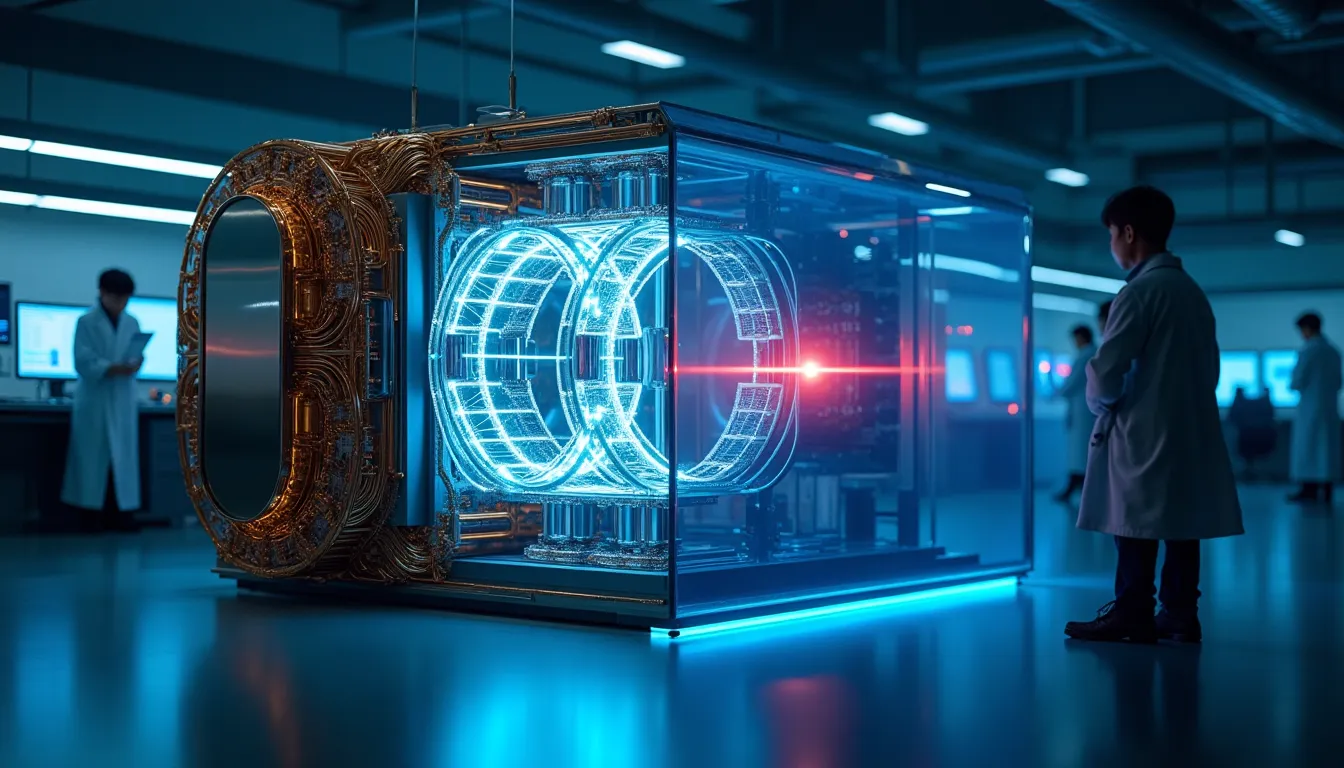
IBM and Google pursue superconducting quantum hardware, while Quantinuum uses trapped ions. The most useful comparison is reliable logical computation, not physical qubit counts alone. Error correction, connectivity, operation speed and demonstrated workloads determine progress; vendor fault-tolerance roadmaps are targets, not delivered commercial capability.
Quantum Computing Comparison Matrix
| Decision factor | IBM | Quantinuum | |
|---|---|---|---|
| Hardware | Superconducting qubits | Superconducting qubits | Trapped-ion qubits |
| Error correction | qLDPC-based modular roadmap | Surface-code error suppression | Logical-qubit demonstrations on trapped-ion systems |
| Evidence to evaluate | Starling: 2029 target of 200 logical qubits and 100 million gates | Willow below-threshold error-correction result, December 2024 | System-specific gate quality, connectivity and logical performance |
| Engineering trade-off | Connectivity, modularity and cryogenic control | Surface-code overhead and cryogenic control | Ion transport, operation speed and scaling |
| Commercial verdict | Workload-specific evidence required; no universal winner established | ||
Current State of the Industry
As of early 2026, no company has deployed a large-scale, fully fault-tolerant quantum computer capable of outperforming classical supercomputers on a broad class of commercially valuable problems. What exists instead is a set of increasingly credible proof points — individual logical qubits protected by error correction, specific sampling experiments that are extremely hard to simulate classically, and early enterprise pilots in chemistry, materials science, and optimization. The industry has moved past the "qubit count" marketing era of the late 2010s and into a "qubit quality and logical error rate" era, where the relevant metrics are two-qubit gate fidelity, coherence time, and the overhead required to turn noisy physical qubits into one reliable logical qubit.
IBM continues to pursue superconducting transmon qubits, the same basic technology it has championed since its earliest cloud-accessible quantum processors. Google, also committed to superconducting qubits, has focused its public narrative heavily on quantum error correction milestones using its Willow-class processors, emphasizing the theoretical threshold result that larger error-corrected arrays can suppress logical error rates exponentially. Quantinuum, formed from the merger of Honeywell Quantum Solutions and Cambridge Quantum, has taken a structurally different path with trapped-ion qubits, which boast substantially higher native gate fidelities at the cost of slower gate speeds and more complex scaling engineering.
These are not merely academic distinctions. The choice of qubit modality dictates everything downstream: how much physical hardware overhead is needed for error correction, how quickly logical operations can be performed, how the systems can be networked together, and ultimately what it will cost to deliver a given amount of fault-tolerant quantum computation. Readers unfamiliar with the basics of how quantum bits differ from classical bits may wish to review the foundational explainer at quantum computing fundamentals before proceeding further into the comparative detail below.
Historical Context: Three Divergent Bets
IBM made a five-qubit processor publicly cloud-accessible in 2016 and developed Qiskit and hardware roadmaps. Quantinuum formed in 2021 from Honeywell Quantum Solutions and Cambridge Quantum. Google’s Willow announcement in December 2024 reported below-threshold error suppression. These milestones concern different capabilities and cannot be ranked as interchangeable benchmarks.
Google's quantum program, housed within Google Quantum AI, took a different reputational path. Rather than emphasizing broad cloud access, Google pursued headline-grabbing scientific demonstrations. In 2019, its Sycamore processor was used to claim "quantum supremacy" — performing a specific sampling task faster than the team estimated a classical supercomputer could manage, a claim that was immediately and vigorously contested by IBM researchers who argued classical methods could narrow the gap substantially. That rivalry set the tone for a decade of dueling benchmark claims between the two superconducting giants. Google's subsequent Willow chip, unveiled in late 2024, marked an important shift in emphasis from supremacy claims toward error-correction scaling, demonstrating that increasing the size of a surface-code logical qubit could reduce, rather than increase, the logical error rate — the long-sought crossing of the fault-tolerance threshold in a real device.
Key Players and Technical Architecture
IBM: Superconducting Scale and Modularity
IBM proposes modular superconducting systems and qLDPC error correction. Its cited roadmap targets Starling in 2029, with 200 logical qubits and 100 million quantum gates. This is a vendor development target, not a completed system or guaranteed delivery.
IBM's superconducting transmon qubits operate at millikelvin temperatures inside dilution refrigerators, offer fast gate times measured in tens of nanoseconds, and benefit from fabrication techniques adapted from the semiconductor industry, which gives IBM a scaling pathway that leverages existing chip-manufacturing know-how. The tradeoff is that transmon qubits have shorter coherence times and historically higher two-qubit error rates than trapped ions, meaning more physical qubits are needed per logical qubit to suppress errors to usable levels.
Google: Surface Codes and the Threshold Milestone
Willow experiments showed decreasing logical error rates as the tested surface-code distance increased. Below-threshold error suppression is an important ingredient for scalability, but it does not establish universal fault-tolerant computation or broad commercial quantum advantage.
Quantinuum: Trapped Ions and Qubit Quality
Quantinuum uses trapped-ion hardware with flexible connectivity. Gate fidelity, logical-qubit behavior and circuit capabilities should be attributed to the specific system and experiment. Ion transport, operation speed and control create different scaling trade-offs from superconducting architectures; none establishes an automatic universal advantage.
Other Notable Competitors
While IBM, Google, and Quantinuum dominate headlines, the competitive field also includes neutral-atom companies such as QuEra and Pasqal, which use optical tweezers to arrange and manipulate large arrays of neutral atoms and have demonstrated impressive physical qubit counts with promising scaling economics; photonic computing firms like PsiQuantum and Xanadu, betting that light-based qubits will sidestep some cryogenic cooling challenges; and Microsoft, which has pursued the scientifically ambitious but still unproven topological qubit approach, claiming breakthroughs with its Majorana-based Station Q research that remain subject to significant scientific scrutiny. Amazon's Braket cloud service and startups like IonQ (another trapped-ion player) and Rigetti round out a field that remains far more fragmented than the classical computing industry ever was at a comparable stage, a fragmentation that itself signals how unsettled the winning architecture remains. Readers interested in the broader competitive landscape may find background in the quantum hardware landscape.
Comparing Error Correction Roadmaps
Error correction is the single most important technical battleground because physical qubits are inherently noisy, and useful quantum algorithms — particularly those with real commercial value, such as Shor's algorithm for factoring or high-precision quantum chemistry simulations — require many more reliable operations than any current physical qubit can sustain on its own. The industry consensus is that fault tolerance requires encoding information redundantly across many physical qubits to form a smaller number of highly reliable "logical" qubits, with the key metrics being the logical error rate achieved and the physical-to-logical qubit overhead ratio required to get there.
No company has yet definitively "won" this argument, and it is plausible that different codes and modalities will prove optimal for different classes of problems or will coexist as complementary infrastructure, much as GPUs and CPUs coexist in classical computing rather than one eliminating the other.
Economic Implications and Investment Considerations
For allocators seeking exposure to the quantum thesis, several approaches carry differing risk profiles. Exposure through diversified technology conglomerates like IBM or Alphabet offers low direct risk but also heavily diluted upside, since quantum computing represents a small fraction of either company's total enterprise value today. Direct investment in quantum pure-plays offers higher potential upside but correspondingly higher risk of capital loss if fault tolerance timelines slip further, a real possibility given the field's history of ambitious projections. Private market exposure through venture capital funds focused on deep tech offers another route, though typically only available to institutional and accredited investors, with longer lockup periods that may actually better match the multi-year, possibly multi-decade, horizon required for quantum computing to reach broad commercial maturity. Enterprise customers evaluating early pilot programs — in drug discovery, materials science, financial portfolio optimization, and logistics — represent a more conservative form of participation, allowing organizations to build internal expertise and identify use cases without making a speculative capital allocation bet on which hardware architecture will ultimately prevail.
Risks and Challenges
The quantum computing sector faces several interlocking risks that temper even the most optimistic roadmaps. First is pure engineering risk: scaling any of these architectures from today's hundreds or low thousands of physical qubits to the millions of physical qubits that some fault-tolerance estimates suggest may be required for the most demanding algorithms (such as breaking modern encryption) represents an unsolved manufacturing and control-systems challenge, not merely an incremental extension of current techniques. Cryogenic cooling infrastructure, control electronics, and wiring density all face physical scaling limits that have not been fully resolved for superconducting approaches, while trapped-ion approaches face their own scaling bottlenecks around ion shuttling speed and laser control complexity as qubit counts grow.
Second is the persistent gap between laboratory demonstrations and reproducible, audited commercial value. Many quantum computing milestones, including some supremacy and advantage claims from both IBM-adjacent and Google research teams, have later been challenged or substantially narrowed by improved classical algorithms, a pattern that should inject healthy skepticism into any claim of definitive quantum advantage until it is independently replicated and the classical comparison is rigorously defended. This dynamic — claim, counterclaim, and classical algorithmic improvement — is likely to continue through the current decade and represents a structural source of volatility in both the scientific narrative and associated public equity valuations.
Third is talent and supply chain concentration risk. The pool of physicists and engineers capable of building and operating these systems remains small, and critical components — including specialized lasers for trapped-ion systems and dilution refrigerators for superconducting systems — are produced by a limited number of specialized suppliers, creating potential bottlenecks if the industry's growth accelerates faster than supply chains can scale. Fourth, there is a meaningful possibility that near-term quantum computers, even error-corrected ones, may find commercially valuable use cases are narrower and arrive later than currently projected, concentrated in scientific applications such as quantum chemistry and materials simulation rather than the broader enterprise optimization and machine learning applications that have driven some of the more aggressive market-sizing forecasts circulated since 2023.
Finally, there is regulatory and geopolitical risk. Export controls on quantum computing hardware and components have already been implemented by the United States and allied governments, restricting the sale of advanced quantum systems to certain countries, and this trend is likely to intensify as the technology's dual-use implications for cryptography and national security become more concrete, potentially fragmenting the global quantum supply chain and research collaboration networks that have historically accelerated progress in the field.
Use Case Recommendations
For research or enterprise pilots, compare supported circuits, connectivity, access terms and measured error behavior. For investment analysis, distinguish recognized revenue, financing needs and published technical milestones. Public quantum companies have reported revenue; revenue alone does not establish profitability or fault-tolerant capability.
Strategic Verdict
Track logical error rates, reliable circuit depth and fair classical baselines rather than physical qubit counts or roadmap dates alone. qLDPC and surface-code overhead depend on noise, connectivity and implementation assumptions. IBM, Google and Quantinuum retain unresolved scaling challenges, so no single defensible winner is established.
It is increasingly plausible that the industry converges on a hybrid future, in which different quantum hardware modalities, classical high-performance computing, and AI-driven algorithm design work together, with quantum processors acting as specialized accelerators for specific sub-routines within larger classical-quantum hybrid workflows, rather than quantum computers replacing classical infrastructure wholesale. This mirrors the eventual trajectory of GPUs in classical computing, which became indispensable accelerators for specific workloads (graphics, then AI training) without displacing general-purpose CPUs. Enterprises and investors would be well served by tracking logical error rates and independently audited benchmark results, rather than physical qubit counts or press-release language, as the primary indicator of genuine progress toward fault-tolerant, commercially transformative quantum computing. Related developments in classical high-performance computing and AI infrastructure, which increasingly intersect with the quantum narrative through hybrid algorithm research, are covered in more depth at quantum algorithms and classical comparisons.
For now, IBM, Google, and Quantinuum each offer a credible but distinct path forward, and the prudent conclusion for 2026 is that the race remains genuinely open: no single architecture has demonstrated a decisive, unambiguous lead toward the ultimate goal of large-scale, fault-tolerant, commercially transformative quantum computation, and capital allocation decisions should be made with that fundamental uncertainty, rather than any single company's marketing timeline, as the central planning assumption.
Related Comparisons and Background
- Quantum error correction
- Quantum investment risks
- Quantum annealing vs gate-based computing
- Post-quantum cryptography
Sources and Comparison Method
Official sources were checked on 23 October 2026. Roadmaps are attributed targets; vendor hardware descriptions and specialized experiments do not establish a universal commercial advantage. Compare logical performance, circuit capabilities and classical baselines on equivalent tasks.
- IBM: Quantum hardware and roadmap — modular architecture and Starling targets.
- Google: Willow announcement, 9 December 2024 — error-correction demonstration and research context.
- Quantinuum: Quantum systems — trapped-ion architecture and vendor-reported system capabilities.
Frequently Asked Questions
What is the main difference between IBM, Google and Quantinuum quantum computers?
IBM and Google use superconducting qubits; Quantinuum uses trapped ions. The approaches have different connectivity, gate speed, control and scaling trade-offs, so physical qubit counts alone do not determine performance.
What is the difference between physical and logical qubits?
A physical qubit is a noisy hardware element. A logical qubit encodes information across physical qubits with error correction. Useful fault-tolerant computation depends on logical error rates and reliable operations, not only the physical count.
What did Google’s Willow result demonstrate?
Google’s December 2024 announcement described decreasing logical error rates as surface-code size increased. That is an error-correction milestone, not proof of a general-purpose quantum computer that outperforms classical systems on commercial problems.
Has IBM delivered Starling?
The cited IBM roadmap describes Starling as a 2029 target for 200 logical qubits and 100 million quantum gates. A roadmap target should not be reported as a completed system or guaranteed delivery date.
Which company is winning the quantum computing race?
There is no single defensible winner across all metrics. Compare logical error rates, circuit capabilities, connectivity, independently checked results and execution against roadmaps; each hardware approach retains unresolved scaling challenges.