Latest Developments
Updated 31 Oct 2026Meta announced a $95 billion stock offering to accelerate AI infrastructure deployment through 2026-2027, amid industry warnings from Elon Musk that over 200 neocloud firms face potential collapse due to unsustainable capex spending. The announcement underscores major tech companies' commitment to data center expansion despite market consolidation pressures.
Technological advances are enabling more efficient AI infrastructure utilization. IQM and NVIDIA automated 20-qubit quantum processor calibration using specialized vision-language models, with NVIDIA's approach outperforming general-purpose alternatives by up to 19 points on benchmarks. The companies released QCalEval, a standardized 243-chart evaluation framework spanning 22 experiment types.
NVIDIA released Nemotron 3.5 Bolt E4B, a compact 4GB model designed for local deployment on edge devices including robots and voice agents, demonstrated on a Jetson-powered Reachy Mini platform. This shift toward efficient edge computing complements centralized data center investment strategies.
Key Takeaways
- Hyperscale cloud providers are committing nearly $500 billion annually to AI infrastructure and data center construction.
- Enterprise AI revenue reached only $100 billion in 2024, creating a 4:1 investment-to-revenue gap requiring justification.
- Microsoft leads with $80 billion capex commitment for 2025, up 52% from 2024 levels.
- NVIDIA captured $126 billion in data center revenue with 70%+ gross margins on AI chips.
- Enterprise AI revenue must grow 65% annually through 2027 to justify current infrastructure investment levels.
- Current capex levels mirror the 1999-2001 telecom fiber overbuild that led to multiple bankruptcies.
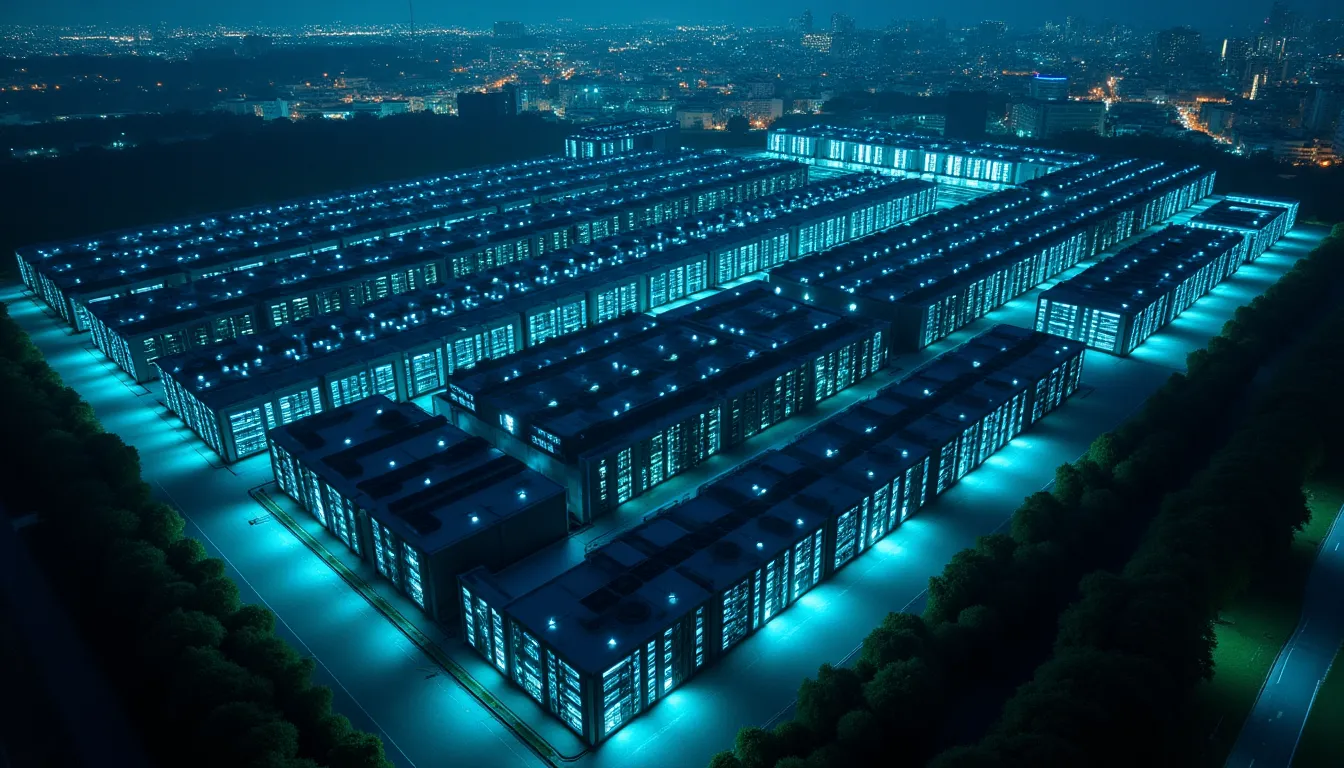
The technology sector is witnessing the largest infrastructure buildout in corporate history, with hyperscale cloud providers committing nearly $500 billion annually to data centre construction and AI hardware procurement. Yet this unprecedented capital deployment faces a stark reality: enterprise AI revenue remains a fraction of infrastructure investment, creating a revenue justification gap that echoes the telecom fiber overbuild of 1999-2001. The critical question for investors is whether this capex surge represents rational investment in future growth or the early stages of a capital allocation bubble that will reshape technology valuations across the next two years.
The Scale of Hyperscaler Investment
The numbers are staggering in both absolute terms and growth trajectory. Microsoft has committed $80 billion in fiscal year 2025 capex, representing a 52% increase from 2024 levels. Google parent Alphabet is deploying $75 billion, up 35% year-over-year, while Amazon Web Services accounts for $75 billion of Amazon's total infrastructure spend. Meta has allocated $65 billion for 2025, doubling its 2023 capex of $32.6 billion.
These four companies alone represent $295 billion in committed capital expenditure, with Oracle ($15 billion), ByteDance ($12 billion), and second-tier cloud providers adding another $80-100 billion to reach industry totals approaching $500 billion annually.
| Company | 2025 Capex Commitment | YoY Growth | Primary Focus |
|---|---|---|---|
| Microsoft | $80 billion | +52% | Azure AI, OpenAI infrastructure |
| Google (Alphabet) | $75 billion | +35% | Gemini training, TPU deployment |
| Amazon (AWS) | $75 billion | +41% | Trainium chips, Bedrock platform |
| Meta | $65 billion | +103% | Llama model training, inference |
| Oracle | $15 billion | +67% | GPU clusters, enterprise AI |
The majority of this capital flows directly to NVIDIA, which captured $126 billion in data centre revenue over the past four quarters ending January 2024. NVIDIA's gross margins on H100 and H200 GPUs remain above 70%, making the company the primary beneficiary of this capital reallocation.
The Revenue Justification Gap
The economic challenge becomes apparent when examining actual AI-generated revenue against infrastructure investment. Enterprise spending on AI software and services reached approximately $100 billion in 2024, according to IDC data, while infrastructure investment exceeded $400 billion.
Microsoft's commercial AI revenue, primarily from Copilot subscriptions and Azure OpenAI services, reached $10 billion annually by Q2 2024. Google Cloud's AI revenue hit $8 billion, while Amazon's AI services contributed $6 billion to AWS revenue. Combined, the three largest cloud providers generated roughly $24 billion in direct AI revenue against $230 billion in combined AI-focused capex.
The current revenue-to-capex ratio of roughly 1:4 requires enterprise AI adoption to accelerate by 300-400% over the next 24 months to justify current investment levels on traditional return metrics.
This disconnect mirrors the telecom industry's fiber optic cable buildout from 1999-2001, when companies like WorldCom, Global Crossing, and Level 3 deployed $200 billion in fiber infrastructure chasing internet traffic growth that took nearly a decade to materialize. The parallel raises questions about circular investment patterns, where hyperscaler capex drives NVIDIA revenue, which inflates market valuations that provide cheaper equity capital for further capex expansion.
Historical Parallel: The Telecom Fiber Overbuild
The telecom comparison offers both warnings and distinctions. Between 1999 and 2001, telecommunications companies raised $1.2 trillion in debt and equity to build fiber networks, anticipating internet traffic growth that ultimately occurred but over a much longer timeframe than investors expected. WorldCom collapsed with $41 billion in debt, Global Crossing filed for bankruptcy with $12.4 billion in obligations, and Level 3 required multiple restructurings.
However, key differences distinguish today's hyperscaler buildout from the telecom bubble:
- Cash Generation: Microsoft generated $88 billion in free cash flow in fiscal 2024, while Google produced $69 billion and Amazon $71 billion. These companies fund capex from operations, not external financing.
- Vertical Integration: Hyperscalers own the entire stack from infrastructure to applications, capturing more value from their investments than pure infrastructure plays.
- Immediate Utilization: Unlike fiber networks that required years to find customers, AI training clusters generate immediate internal value for model development.
The sustainability question centers on whether enterprise customers will adopt AI services rapidly enough to justify continued investment at current levels.
Revenue Growth Requirements
Mathematical analysis reveals the revenue growth required to validate current capex levels. Assuming a target 15% return on invested capital, the hyperscaler industry needs to generate $75 billion in incremental AI revenue by 2026 to justify 2025 investment levels.
Given current AI revenue of approximately $50 billion across major providers, this requires 150% growth in enterprise AI spending over 24 months. Historical enterprise software adoption cycles suggest this timeline is aggressive but not impossible, particularly given AI's productivity impact across business functions.
Enterprise AI revenue must compound at 65% annually through 2027 to reach the $200 billion required to support current infrastructure investment levels on traditional return metrics.
Microsoft's Copilot for Microsoft 365, priced at $30 per user monthly, provides a benchmark. With 400 million commercial Office users, full Copilot adoption would generate $144 billion annually—more than current global enterprise AI spending. However, current Copilot adoption remains below 10% of eligible users after 18 months of availability.
Three Scenarios for Capital Allocation
Scenario 1: Capex Vindicated (35% probability)
Enterprise AI adoption accelerates through 2025-2026, driven by measurable productivity gains and competitive pressure. Revenue growth reaches 60-70% annually, validating current investment levels. NVIDIA maintains pricing power, and hyperscaler margins expand as utilization increases.
Scenario 2: Capex Plateau (45% probability)
AI revenue growth moderates to 30-40% annually by late 2025, forcing hyperscalers to slow capex growth to maintain return targets. NVIDIA faces pricing pressure as competition emerges from AMD, Intel, and custom silicon. Infrastructure investment stabilizes around $300-350 billion annually.
Scenario 3: Capex Crunch (20% probability)
Enterprise AI adoption stalls due to implementation challenges, regulatory constraints, or economic downturn. Hyperscalers cut capex by 30-40% in 2026, triggering sharp declines in NVIDIA revenue and broader semiconductor correction.
What to Watch for Investors
The single most important forward indicator remains hyperscaler earnings guidance for capex spending. Historical patterns show that capex adjustments typically occur 2-3 quarters before revenue impact, making quarterly guidance changes the earliest warning system for investors.
Specific metrics to monitor include:
- Utilization Rates: GPU cluster utilization below 60% across multiple quarters would signal overcapacity
- Enterprise AI Revenue Growth: Quarterly growth below 40% would challenge current investment levels
- Competitive Pricing: NVIDIA margin compression below 65% would indicate market saturation
- Alternative Architectures: Meaningful revenue from AMD MI300 or Intel Gaudi chips would fragment NVIDIA's pricing power
Amazon's January 2025 earnings call will be particularly significant, as AWS typically leads industry capex cycles. Any reduction in Amazon's $75 billion commitment would likely trigger broader reassessment across the sector.
Investment Implications
Current capex levels create a binary outcome for technology investors. If enterprise AI adoption matches infrastructure investment, returns will be substantial across the entire value chain from semiconductors to software. However, any material slowdown in capex growth would disproportionately impact NVIDIA, whose revenue concentration in data centre sales now exceeds 85%.
The infrastructure buildout has created unusual market dynamics where hyperscaler success drives semiconductor valuations that enable further infrastructure investment. This circular pattern can sustain itself as long as enterprise AI revenue growth justifies continued capital deployment, but creates systemic risk if adoption disappoints.
For investors, the next 18 months will determine whether this represents the foundation of a new technology cycle or the peak of an infrastructure bubble. The scale of committed capital ensures that any adjustment will be visible in corporate earnings well before market sentiment shifts, providing informed investors with actionable signals for portfolio positioning across the broader technology sector.
Frequently Asked Questions
How much are hyperscale cloud providers spending on AI infrastructure in 2025?
Hyperscale providers are committing nearly $500 billion annually, with Microsoft ($80B), Google ($75B), Amazon AWS ($75B), and Meta ($65B) leading the investment.
What is the current revenue-to-capex ratio for AI infrastructure investments?
The ratio is approximately 1:4, with $100 billion in enterprise AI revenue against $400 billion in infrastructure investment, requiring 300-400% adoption acceleration to justify current spending.
How does current AI capex compare to the telecom fiber buildout of 1999-2001?
Similar scale and timeline concerns exist, but key differences include hyperscalers' strong cash generation, vertical integration, and immediate utilization versus telecom's external financing and delayed customer adoption.
What revenue growth is needed to justify current AI infrastructure spending?
Enterprise AI revenue must compound at 65% annually through 2027 to reach $200 billion required to support current investment levels on traditional 15% return metrics.
What are the key warning signs investors should monitor for capex sustainability?
Critical indicators include GPU cluster utilization below 60%, enterprise AI revenue growth under 40% quarterly, and NVIDIA margin compression below 65%.
Recommended Reading


Get MachineHours in your inbox
AI compute and the machine economy in your inbox.