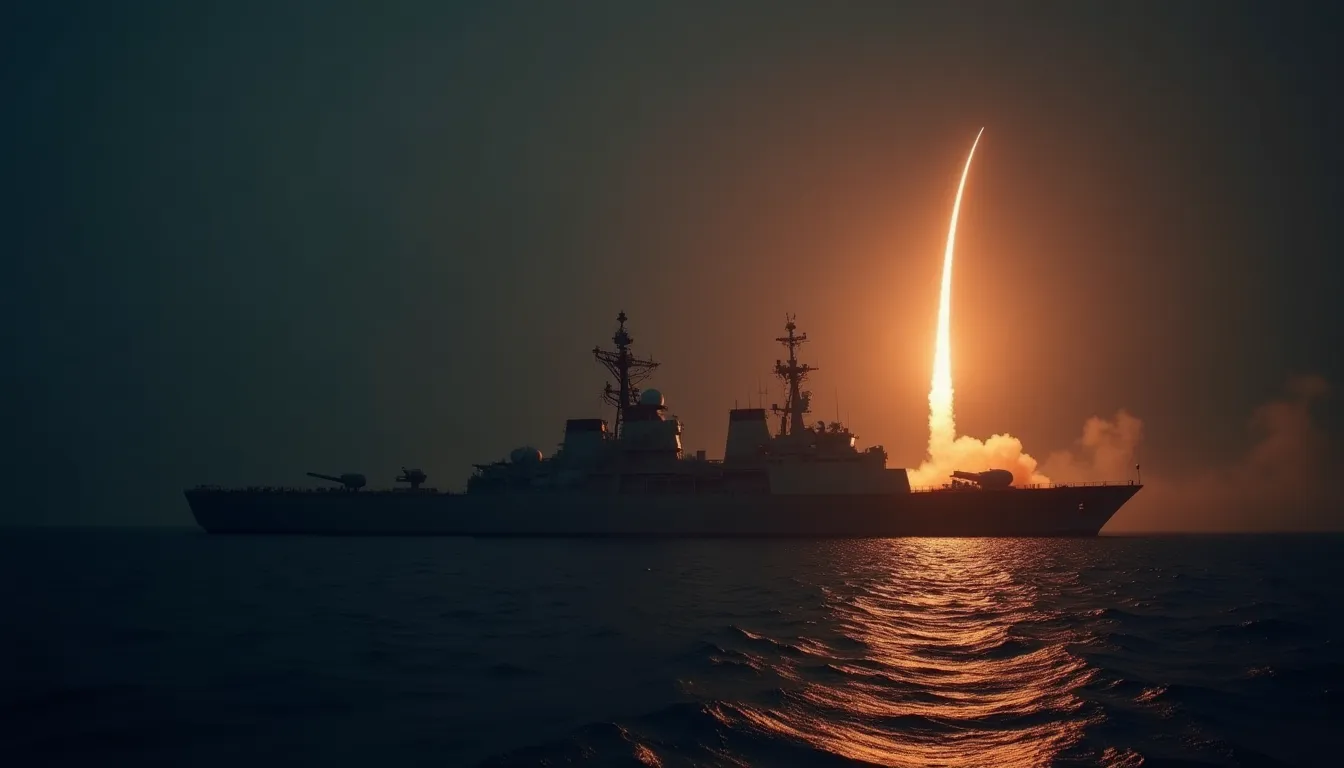
The Pentagon has issued a new memorandum fundamentally restructuring how the US defence industry meets military requirements, moving toward faster, modular solutions rather than decade-long fixed specifications. Simultaneously, the US Navy demonstrated new anti-ship weapons at summer exercises and established a dedicated industrial base office to strengthen its supplier ecosystem.
Key Takeaways
- Pentagon memo directs fundamental reset of defense industry baseline requirements, shifting from decade-long fixed specifications toward faster, modular solutions with continuous updates
- US Navy B-2 stealth bomber conducted first public LRASM anti-ship missile launch and unmanned surface vessels executed live-fire strikes at major 2026 Pacific exercises
- Navy established dedicated Defence Industrial Base office under Andrew Magliochetti to centralise supply chain oversight and expand domestic manufacturing ecosystem
- Structural reforms address documented gaps in acquisition timelines that have hindered integration of AI-enabled systems and autonomous platforms into operational forces
A new Pentagon memorandum is resetting how the US defence industry structures its technology requirements, according to Breaking Defense. Rather than layering new requirements on top of existing frameworks, the memo directs a fundamental recalibration of baseline expectations—a move reflecting frustration within defence acquisition circles over slow delivery timelines and misaligned contractor priorities.
The timing of this requirements reset coincides with two other significant structural moves: the US Navy publicly demonstrated a suite of new anti-ship weapons at summer 2026 naval exercises, and the service stood up a dedicated defence industrial base office. Together, these developments signal a broad institutional push to modernise and integrate the Pentagon's procurement and warfighting systems simultaneously.
The Pentagon Memo's Strategic Shift
Defence acquisition specialists characterise the memo as addressing a fundamental mismatch between how the Pentagon communicates capability needs and how contractors can deliver solutions in a rapidly evolving technological landscape. The memo's full implications remain under analysis by industry participants, but its central directive is clear: the Pentagon wants faster, more modular solutions that can be updated continuously rather than built to decade-long specifications.
This shift carries particular significance for autonomous and artificial intelligence-integrated systems, where capability evolves on software timescales rather than hardware procurement cycles. Contractors building AI-enabled targeting, logistics, and communications systems have long complained that fixed requirements documents become obsolete before contracts are awarded. A requirements reset that embeds flexibility could materially accelerate the integration of machine learning into defence platforms in ways the current framework has actively resisted.
The underlying pressure driving this change reflects a broader recognition within the US defence establishment that its acquisition and industrial systems were designed for a different strategic era and are struggling to keep pace with both adversary capability development and the speed at which AI-enabled systems can now be fielded. The acceleration of deployment timelines for new technologies has exposed constraints in a system optimised for incremental change over multi-year development cycles.
Navy Anti-Ship Weapons Demonstrations
The US Navy used summer 2026 naval exercises to publicly demonstrate new anti-ship weapons systems, with multiple live-fire sinking exercises conducted across two major multinational operations in the Pacific.
During Exercise Valiant Shield on June 27, 2026, a US Air Force B-2 bomber launched an AGM-158C Long Range Anti-Ship Missile (LRASM) against the decommissioned amphibious transport dock USS Juneau north of the Mariana Islands. This strike marked the first public launch of an LRASM from a B-2, a significant operational milestone given that the B-2 is the only in-service stealth aircraft capable of carrying the LRASM internally. The internal bomb bay configuration maintains the stealth aircraft's low-radar cross-section and enables the US military to conduct stealthy, long-range anti-ship attacks across contested airspace and vast Pacific distances.
US Pacific Air Forces commander General Kevin Schneider characterised the demonstration as underscoring "the U.S. military's commitment to adaptability and flexibility in the face of emerging security challenges." Schneider added that by prioritising counter-maritime strike operations, "we can maintain a decisive edge over adversaries, protect our national interests and ensure the free and open Pacific that underpin our global security."
Valiant Shield also involved coordinated operations with forces from Japan, Canada, New Zealand, and Australia, building what the Navy described as "real-world proficiency in sustaining joint forces through detecting, locating, tracking, and engaging units at sea, in the air, in space, on land, and in cyberspace."
The second major exercise, RIMPAC (Rim of the Pacific), conducted off Hawaii from June 24 to July 31, 2026, involved ships, submarines, and aircraft from 30 nations. During RIMPAC's sinking exercise on July 17, the decommissioned cruiser USS Mobile Bay and the helicopter assault ship USS Peleliu were sunk by a combination of submarine-launched torpedoes and missiles, including LRASMs, Spike Non-Line of Sight (NLOS) missiles, and Naval Strike Missiles (NSMs).
Rear Admiral Suzanne Bailey, deputy commander of the US 3rd Fleet and commander of the RIMPAC Combined Exercise Control Group, described the exercises as critical tests of integrated warfighting capability. "It's the ultimate test of our kill chain, requiring our forces to work together with our allies to detect, track, target, and ultimately strike a vessel with live ordnance," Bailey said. "It's a complex, multi-domain effort that provides really the most realistic training possible."
Unmanned Surface Vessels Enter Live Combat Testing
A particularly notable element of the RIMPAC exercise involved Unmanned Surface Vessels (USVs) called Global Autonomous Reconnaissance Craft (GARC) being used for the first time in a live-fire sinking exercise. Pentagon video footage showed at least one USV surveying the damaged hull of USS Peleliu before conducting a direct strike on the target vessel. Lieutenant Sarah Weinstein, commanding officer of USV Division 32, identified the vessel as a GARC built by Baltimore-based BlackSea Technologies in a post following the exercise.
"Honored that USVDIV-32 was given the opportunity to execute the Navy's first GARC Live Fire during RIMPAC 2026," Weinstein wrote. "It was incredible to watch my team execute with precision and we were thrilled to provide a perspective of the former USS Peleliu that often isn't often captured in a SINKEX."
USV Division 32 is one of three USV divisions established in January 2026 and tasked with operating and sustaining unmanned surface vessels. The incorporation of autonomous vessels into major multinational exercises demonstrates the US Navy's commitment to integrating autonomous systems into distributed maritime operations doctrine. The systems underwent real-world validation alongside traditional manned platforms and legacy weapons systems.
Navy Establishes Dedicated Industrial Base Office
The Navy established a new Defence Industrial Base office, formalising responsibilities that had previously been distributed across multiple Navy commands. Andrew Magliochetti, who previously served as director of the Navy's Office of Small Business Programs, was appointed to oversee the newly created Office of the Defence Industrial Base, Acting Secretary of the Navy Hung Cao announced.
Magliochetti will function as the principal civilian advisor for the assistant secretary of the Navy for Research, Development and Acquisition, with responsibility for managing growth and wellbeing of the service's industrial supply chain. "He will spearhead initiatives to expand the domestic manufacturing ecosystem, mitigate supply chain vulnerabilities and integrate dual use commercial technologies to enhance the lethality of the Navy-Marine Corps team," Cao stated in an official announcement.
The appointment follows President Donald Trump's National Security Presidential Memorandum ordering the Pentagon to "restore both capacity and competition to the maritime industrial base as it expands our naval force structure." This directive reflects sustained congressional and executive branch concern about shipbuilding delays, parts shortages, and the resilience of critical defence supply chains.
Magliochetti described the role as central to operational readiness. "An agile, secure industrial base is the cornerstone of our combat readiness," he said. "I am committed to accelerating the delivery of resilient supply chains and cutting-edge, dual-use technologies directly into the hands of our warfighters to ensure our Sailors and Marines are ready for any high-end fight."
Structural Context: Industry Modernisation Pressures
The simultaneous arrival of the Pentagon requirements reset, the Navy's new industrial base office, and the major anti-ship weapons demonstration is not coincidental. Each reflects the same underlying institutional pressure: the US defence establishment recognises that its acquisition and industrial systems were constructed for a different strategic era and are struggling to keep pace with both adversary capability development and the velocity at which modern systems can be fielded and updated.
The US defence industrial base has faced sustained pressure since at least 2022, when the pace of materiel support to Ukraine exposed the limits of a production system optimised for efficiency rather than surge capacity. Shipbuilding delays, munitions inventory drawdowns, and semiconductor supply chain vulnerabilities contributed to a bipartisan congressional push to restructure how the Pentagon sources and sustains its weapons systems. The new Pentagon memo and the Navy's institutional reorganisation represent explicit responses to these documented shortcomings.
The requirements reset's focus on flexibility and modularity directly addresses a documented problem: the current fixed-requirement model struggles to accommodate the pace of software-driven capability evolution. By shifting toward continuous updates rather than multi-year fixed specifications, the Pentagon aims to reduce the lag between emerging military needs and operational deployment of solutions. This structural change could prove particularly consequential for AI-integrated systems, where traditional defence acquisition timelines have historically lagged behind both commercial innovation cycles and actual capability requirements.
Sources
- Breaking Defense: How a new Pentagon memo 'resets' industry requirements, plus highlights from TechNet
- Breaking Defense: US flexes new ship-sinking weapons at summer naval exercises
- Breaking Defense: Navy establishes new defense industrial base office: Cao
- Breaking Defense: Saudi-Turkish-Pakistani defense pact to boost Turkish industry, entire trilateral 'ecosystem'
- SpaceNews: Propulsion is having a moment
- MachineHours Encyclopedia: Von Neumann Architecture — The Blueprint of Every Computer
Frequently Asked Questions
What does the new Pentagon memo actually change for defence contractors?
The memo resets baseline technology requirements rather than layering new demands on existing frameworks. It signals the Pentagon wants faster, more modular solutions that can be updated continuously rather than built to decade-long fixed specifications.
What weapons did the US Navy demonstrate at summer 2026 naval exercises?
The Navy demonstrated new anti-ship weapons systems in a live-fire format. Specific munition designations and performance metrics were not publicly disclosed, but the exercises were framed as deterrence signalling toward adversaries with significant surface fleets.
What is the new Navy CAO industrial base office?
It is a new office established to monitor and strengthen the Navy's defence supplier ecosystem, consolidating responsibilities previously spread across multiple commands into a single accountability point.
What is the Saudi-Turkish-Pakistani defence pact about?
The trilateral agreement is structured to build a co-production and technology-sharing ecosystem across all three nations, with particular benefit to Turkey's defence manufacturing sector and its goal of becoming an export-competitive arms producer.
Why is propulsion described as 'having a moment' right now?
Investment across chemical, electric, and nuclear thermal propulsion is accelerating, driven by growing launch cadence demands and US military space requirements. The sector is seeing competition among multiple approaches as Space Force makes assured orbital access a top priority.
Get MachineHours in your inbox
AI compute and the machine economy in your inbox.