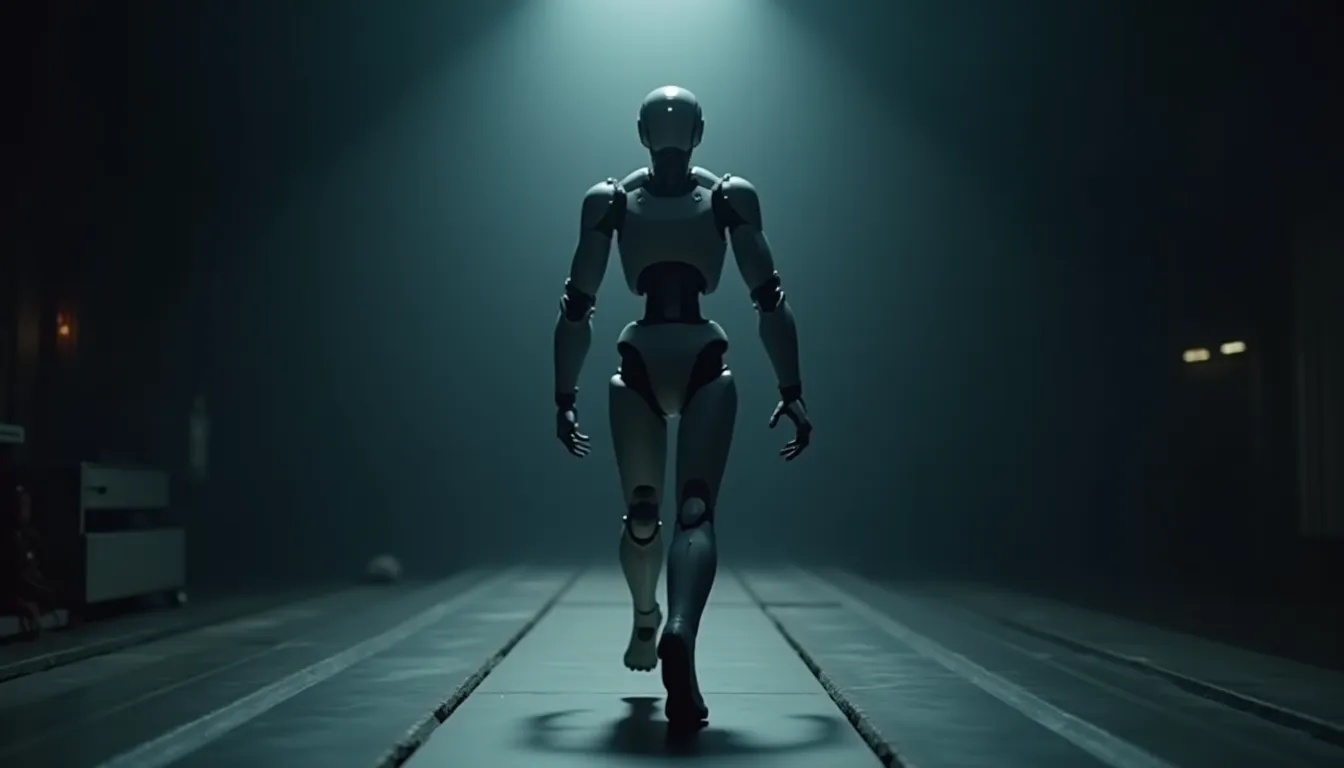
China's Robot Games showcased humanoids outpacing Usain Bolt's sprint record while Bill Gates called for robot taxes and 'Human Reserved' jobs. London's robotaxi launch has slipped amid regulatory uncertainty.
Key Takeaways
- Humanoids at China's Robot Games ran faster than Usain Bolt's 100m world record of 9.58 seconds, per Wired.
- Bill Gates publicly called for a robot tax and legally protected 'Human Reserved' job categories to fund displacement mitigation.
- TechCrunch reported robot foundation model developers consider themselves past an early GPT-2-equivalent capability phase.
- London's robotaxi launch has slipped with no revised date disclosed, citing Transport for London regulatory uncertainty.
- Financial Times raised unresolved questions about whether robotaxi fleets could congest British cities under current urban planning rules.
- Dexterity - specifically tweezer-level manipulation - emerged as the more commercially significant milestone at the Robot Games, not raw speed.
Humanoid robots at China's Robot Games clocked speeds faster than Usain Bolt's 100-metre world record, according to Wired, yet the event's most striking moment was a robot threading a needle-thin tweezer with controlled precision - a detail that speaks more directly to where commercial robotics investment is actually headed than any sprint time.
What Happened
Wired's correspondent reporting from China's Robot Games described humanoid machines exceeding Bolt's 9.58-second benchmark over 100 metres, a headline figure that drew global attention. But the publication's deeper takeaway centred on dexterity tasks: robots handling tweezers with the kind of fine-motor accuracy that manufacturing and logistics operators have demanded for years. The event underscored how Chinese robotics developers - backed by sustained state and private capital - are compressing timelines on capabilities that were theoretical just two years ago.
On the policy front, TechCrunch reported that Bill Gates has publicly backed a robot tax alongside a formal category of "Human Reserved" jobs - roles that would be legally protected from automation. Gates framed the proposal as a way to fund social safety nets and slow displacement in sectors where human labour remains the primary income source for large populations. The proposal adds Gates's name to a growing list of technologists arguing that the pace of robotics deployment requires fiscal rather than purely regulatory responses.
Meanwhile, TechCrunch also published a separate analysis of robot foundation model development, arguing that the teams building "robot brains" - the AI control systems that give physical machines general-purpose reasoning - are now moving past an early, limited phase analogous to GPT-2 in language models. The implication is that embodied AI is approaching an inflection point where generalist capability, not task-specific programming, becomes the investable differentiator.
In the autonomous vehicle segment, Financial Times reported that the planned launch of robotaxis in London has slipped, with Transport for London's regulatory posture creating uncertainty for operators seeking approval. A separate FT piece published the previous day - Financial Times - examined the broader question of whether robotaxi fleets could congest Britain's cities, noting that urban planners and transport authorities have yet to agree on routing rules, pick-up zone allocations, or how autonomous vehicles interact with bus and cycle infrastructure. The FT did not disclose a revised launch date for any specific operator.
Why It Matters
These four stories, arriving on the same day, illustrate the investment contradiction at the centre of robotics in 2026: capability is advancing faster than governance, and governance uncertainty is beginning to delay revenue. London's robotaxi slip is a direct cost to operators who have committed capital on a deployment timeline that is now open-ended. Gates's robot tax proposal, if it gains legislative traction in any major economy, would alter the return models underpinning humanoid and autonomous vehicle investment across the board.
The "GPT-2 era" framing from TechCrunch is the most consequential signal for capital allocators. If robot foundation models are genuinely approaching a step-change in generalist capability - comparable to the jump from GPT-2 to GPT-3 in language AI - the companies holding the leading model positions today may command disproportionate market share once hardware costs fall. Those tracking the equity market implications of robotics deployment will note that this dynamic has historically compressed investment windows: early movers in foundation models captured outsized valuations before the technology became commoditised. The China Robot Games are a reminder that the leading movers may not all be headquartered in North America or Europe.
Background
The push toward humanoid robots is driven in part by a straightforward economic logic: a robot with human proportions can operate in warehouses, factories, and service environments built for human workers without requiring those environments to be redesigned. That compatibility with existing infrastructure removes a significant capital barrier to adoption - operators do not need to retrofit facilities before deploying a humanoid. For a deeper look at how this dynamic is playing out in manufacturing specifically, MachineHours has covered humanoid robots entering European manufacturing as a parallel trend to the Chinese developments on display at the Robot Games.
The dexterity milestone highlighted at China's Robot Games connects directly to one of the hardest open problems in the field: replicating the fine-motor control humans apply unconsciously in assembly, surgery, and logistics sorting. Sprint speed is a tractable engineering target; tweezer-level manipulation requires a combination of sensor resolution, actuator precision, and AI inference that has resisted scaling approaches that worked well for locomotion.
What to Watch
Three near-term signals will indicate whether the current robotics investment cycle is approaching an inflection or a plateau. First, whether any G7 government formally consults on a robot or automation tax following Gates's public endorsement - even a consultation would force operators to model the fiscal downside. Second, whether Transport for London sets a new firm date for robotaxi approvals or enters a prolonged review that pushes UK autonomous vehicle deployment past 2027. Third, which robot foundation model teams publish capability benchmarks that independently corroborate the "post-GPT-2" claim - benchmark results, not press releases, will determine whether institutional capital follows. The gap between China's demonstrable hardware progress at the Robot Games and the West's slower regulatory clearance is a structural risk that investors in robotics deployment companies cannot ignore.
- Humanoid robots are designed with human-compatible proportions so they can operate in existing infrastructure without facility redesign.
- The humanoid robotics market is projected to serve manufacturing, logistics, and service industries from a single generalist hardware platform.
- Bipedal locomotion and dexterous manipulation remain the two hardest engineering challenges in humanoid development - sprint speed and fine-motor control represent opposite ends of that spectrum.
- AI control systems (robot brains) are increasingly the investable layer, separate from the hardware - foundation models for embodied AI are attracting dedicated funding rounds independent of robot manufacturers.
Sources
- Wired: The Humanoids at China's Robot Games Were Faster Than Usain Bolt
- TechCrunch: Bill Gates wants to see a robot tax and 'Human Reserved' jobs
- TechCrunch: Robot brain builders are pushing out of their GPT-2 era
- Financial Times: Launch date for London robotaxis slips amid TfL uncertainty
- Financial Times: Will robotaxis clog up Britain's cities?
- MachineHours Encyclopedia: Humanoid Robots — The Race to Build Human-Form Machines
Frequently Asked Questions
How fast did robots run at China's Robot Games?
According to Wired, humanoid robots at China's Robot Games ran faster than Usain Bolt's 100-metre world record of 9.58 seconds, though the exact robot time was not specified in the report.
What did Bill Gates propose about robots and jobs?
Gates called for a robot tax and a formal category of 'Human Reserved' jobs - roles legally protected from automation - as reported by TechCrunch, framing both as tools to fund social safety nets and slow labour displacement.
Why has London's robotaxi launch been delayed?
The Financial Times reported that the launch has slipped due to uncertainty around Transport for London's regulatory approval process. No revised launch date was disclosed by any operator.
What does 'pushing out of the GPT-2 era' mean for robot AI?
TechCrunch used the phrase to argue that teams building AI control systems for robots are moving past an early, limited capability phase toward more generalist robot intelligence, comparable to the jump from GPT-2 to GPT-3 in language models.
Why is dexterity considered more significant than speed in humanoid robots?
Sprint speed is a tractable engineering problem. Tweezer-level manipulation requires combined advances in sensor resolution, actuator precision, and AI inference - skills directly needed in manufacturing, logistics sorting, and surgical applications.
Get MachineHours in your inbox
AI compute and the machine economy in your inbox.